This year, Knoxville will celebrate the 40th anniversary of the 1982 World’s Fair, which is known as one of its most monumental events to date.
On March 10, the University of Tennessee hosted a Zoom lecture entitled “Science and Technology on Display at Cold War World’s Fairs.” This lecture was given by guest speaker Arthur Molella, who is a Curator Emeritus at Smithsonian Institution’s National Museum of American History.
In the lecture, Molella discussed the political atmosphere in which the 1982 Knoxville World’s Fair took place, the fears that individuals had concerning rising tensions of the Cold War and the overall history of science and technology at World’s Fairs.
Dr. Shellen Xiao Wu, an Associate Professor of History at UT, explained her fascination with the technology of Cold War times.
“I am also a fan of World’s Fairs, which is one of my little side interests ever since I attended in 2010 the ‘Better City Better Life’ expo in Shanghai. When I got the job at the University of Tennessee, I was really shocked to see that Knoxville had also hosted a World’s Fair in 1982. For those of you who are living in Knoxville, there are going to be all kinds of events this year to celebrate the 40th anniversary of that World’s Fair,” Wu said.
Mollela explained the period in which the 1982 World’s Fair took place and the significance of its placement in a small city such as Knoxville rather than its usual metropolitan cities.
“I love World’s Fairs. They’re fantastic. They’re imaginative and exhilarating in many ways, but they’re also a very complex phenomenon … The Knoxville Fair in ’82 fell in the middle of a strange sort of 20-year gap between those major exhibitions that I mentioned. That’s between the Osaka Fair, Osaka, Japan, in 1970 and Seville in 1991. There were these small fairs in between and the big ones were pretty much absent,” Mollela said.
Given its proximity to science hotspots such as Oak Ridge, the 1982 World’s Fair was themed as “Energy Turns Our World,” where researchers aimed to talk about energy sources such as coal, oil, natural gas, nuclear, hydro, biomass, geothermal, wind and solar, and to offer people from all across the world an opportunity to better understand science and how it relates to the arts and cultures of our world.
Molella believes that this intended purpose of soft power representation can be noted through Knoxville’s famous Sunsphere monument, which was instated in celebration of the 1982 World’s Fair. In addition to this remaining Knoxville figure, there was a multitude of technologies for visitors to interact with during the fair, which further represented the progression and confidence in our country’s advancements.
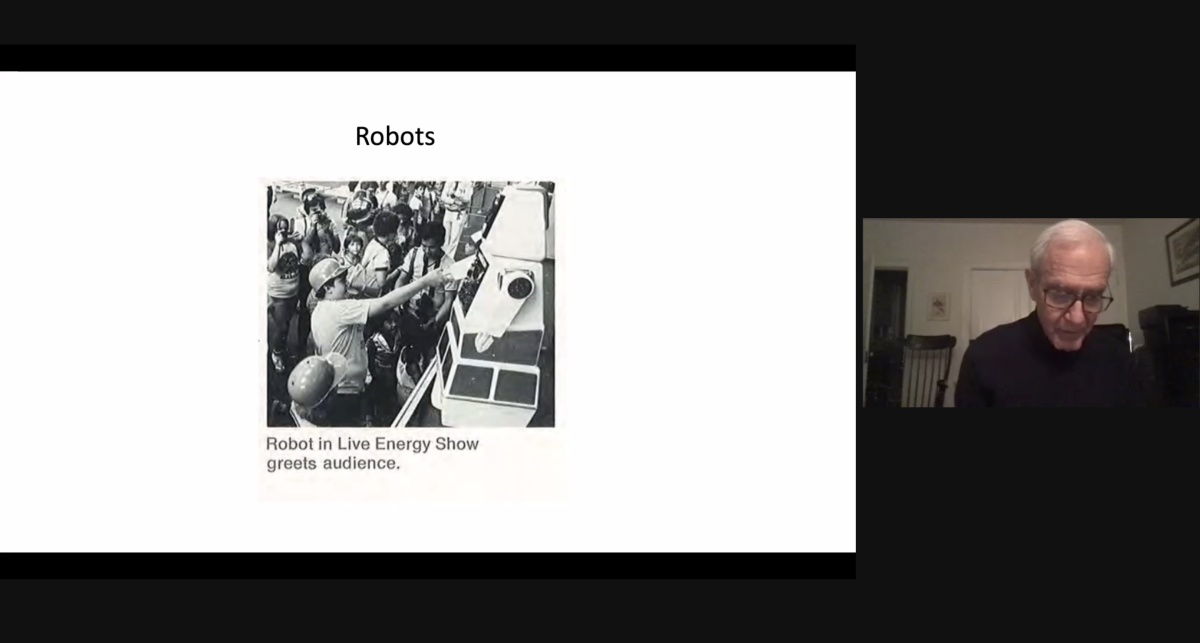
One of the technologies mentioned by Molella was a robot that starred in the live stage energy show that was put on by Oak Ridge Associated Universities. This robot was incredibly popular because of its advancement for the time, as it could talk and interact with fair attendees.
Molella explained why technological advancements such as this robot were so important in the wider scope of national progress.
“From the first fair in London in 1851, it was about progress through science and technology. People believed that was the big engine of human progress of any kind … to make this visible to people, it is important to compare the past to the present,” Molella said.
Molella believes that while nuclear energy has its upsides and possible solutions for modern issues such as nonrenewable resources, it also has immense potential for danger. This was likely not an issue that people of the time were fully aware of, as they were more focused on showing the world their power in terms of science.
Molella addressed the anxieties that many individuals faced surrounding the rapid advancements and uncertainties during the Cold War.
“They guaranteed that nuclear plants could never become an atomic bomb. I’m sure that’s true, but in a way that’s cold comfort isn’t it? That shows you kind of where the mindset was, you’re always looking at your planks to see if a nuclear catastrophe was around the corner,” Molella said.
Not only were the effects of the Cold War seen within the 1982 World’s Fair, but they were seen on a much greater scale within other fairs across the globe.
Considered to be the first of the Cold War fairs, the 1958 Brussels World Fair featured a nuclear piece called the Atomium, which on the surface was simply a piece of iron, but also served to symbolize both nuclear peace and scientific progress.
Molella described its larger purpose in terms of unification within countries.
“It was the chosen instrument of that time to unite Europe, or so they thought. It was supposedly a symbol for European cooperation … but it ended up being quite naturalistic, people were vying for leadership and this conversion to nuclear energy, so this didn’t really bode well for the European community. So you always had this push and pull between cooperation, collaboration and competition,” Molella said.
This trend can be seen within other fairs such as Seattle 1962 and New York 1964-65, which originally set out to host the World’s Fairs in order to build and further develop cities, but as a result of the tenseness of the time and desire for hierarchy in terms of the space race, these fairs ultimately became much more serious than simple representations of culture.