When I ask assistant professor Claire Stigliani, a new addition to UT’s School of Art faculty, to let me interview her in her studio, she respectfully declines.
We end up meeting in the university center, where 31-year-old Stigliani explains her studio is a mess and, ironically, she doesn’t work there.
The real work is done in her bedroom.
It’s a habit she picked up during grade school art classes, where she often felt unable to concentrate. Instead, Stigiliani made art at home. There, splayed on the floor or on top of the covers, drawing doesn’t feel like working – it feels like dreaming.
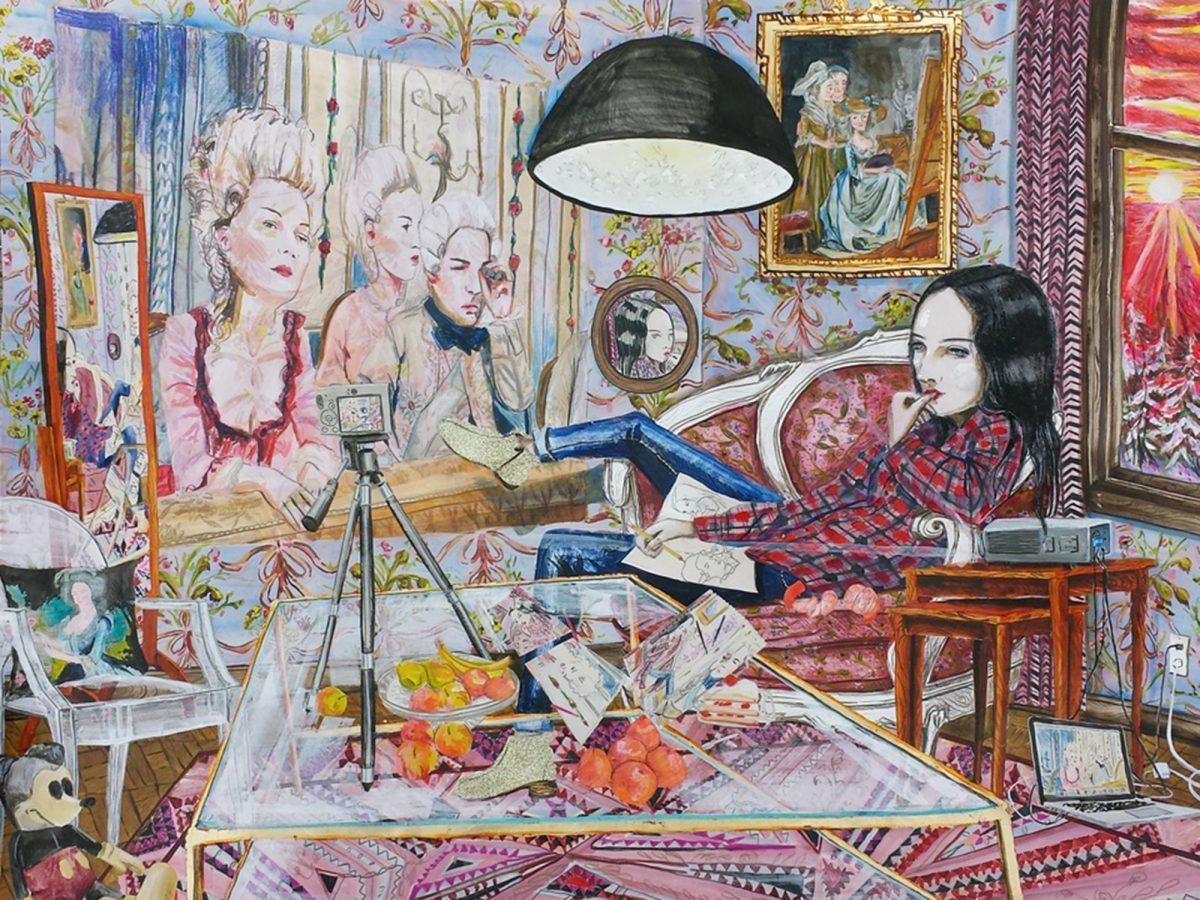
Her recent work reflects this dreamlike quality. In these pieces, Stigliani directs an avatar version of herself in scenes casted with historical figures, pop culture icons and various forms of technology.
“A lot of my spaces are interior and domestic, but I think of them as almost being a stage,” Stigliani said. “I’m not actually drawing a space where anyone lives, but thinking about a stage as a space for performance.”
In a work titled, “On Looking,” Stigliani’s avatar lounges in an antique chair while Sofia Coppola’s “Marie Antoinette” is projected onto the wall for her to draw. The busy scene includes multiple mirrors, a Macbook Pro and a camera mounted on a tripod, capturing the avatar as she works.
These pieces, Stigliani said, fall “somewhere between appropriation,” or found images collaged together, “and imagination.”
This mix reflects her underlying pursuit of the ways people access images.
“Drawing is such an old way of accessing other worlds,” Stigliani says. “If you think about an image as a window of another world, drawing is one of the oldest windows into other worlds.
“But I’m really interested in all the other windows that exist, especially through the screen.”
The mention of screens leads our conversation to another of Stigliani’s passions: reality television. Growing up, however, Stigliani’s parents did not allow television in the house.
“My parents wanted to raise people who read books instead of watched television,” she said, “but I just always loved it. I guess it’s nature vs. nurture. How much can you actually control the way your kids turn out?”
Nevertheless, Stigliani’s upbringing affected her artwork. From ages 3-12, she lived in Austria, where her father worked at the Austrian royal family’s summer palace.
“I would go to work with my father, and it just completely made sense to be there as a kid,” Stigliani says. “Fairy tales were such a big thing for me — the nostalgia of the castles.”
This nostalgia, another kind of dreamlike reality, draws an additional parallel with her artwork: a fictional place rooted in lived experiences. And while Austria’s baroque architecture has a consistent place in her paintings, less obvious are the influences from spending her teenage years in a college town in Iowa.
“It’s the experience of living in a place that’s removed from this idea of culture or everything that’s happening,” Stigliani said. “All of your culture that you’re consuming is through magazines and movies and television.
“It’s this feeling that the world is happening to everybody but you. You’re creating it in your mind.”
Thus the obsession with reality TV. Her favorites include the “Real Housewives” series and the “Howard Stern Show.” With “Howard Stern,” Stigliani particularly loves the celebrity interview, the relationships among the staff and the audience participation.
This fascination with the audience’s gaze is echoed in her work — both the artist herself and the avatar in the painting are distinctly aware they are being watched. Dorothy M. Habel, director of the School of Art, was part of the selection process that brought Stigliani from Carnegie Mellon to UT. Habel said she’s “very solicitous” of a viewer’s response.
“Look at the image, but also think about yourself,” Habel said of Stigliani’s pieces. “Whether this world that she creates is one that touches you in any way or is completely alien, you feel like you’re learning about the artist, but especially for female viewers, you’re learning about yourself.”
Stigliani’s audience often seems to be young girls — the ones on Facebook, the ones obsessed with “Twilight” and the ones taking perfect selfies (one of her pieces is actually called “How to Take a Selfie”). I point out that her style compares nicely to that of Taylor Swift — both artists consider the audience to be part of the work, and both incorporate subject matter typically considered “low culture.”
“I’ve always loved Taylor Swift,” Stigliani said, laughing. “I’ve stood up for her with so many boyfriends. She’s a really interesting persona because she has a sweetness about her. She plays this virginal, pure girl who knows that she actually is.
“She’s playing in the boys’ game, and she’s doing it in a really girly way.”
And like Swift, she knows all work is subject to criticism. But these days, Stigliani simply – ahem – shakes it off.
“When I was a kid I immediately needed to show my mother,” she said. “It wasn’t finished until I got that ‘very good!’
“Now, I don’t take anything personally. I make my work, and I do it because it’s important to me.”
At UT, this attitude extends into the classroom. After teaching at the University of Wisconsin in Madison, the University of Missouri and Carnegie Mellon, Stigliani is well versed in the art of bringing vulnerability and personality out of students.
Fellow drawing professor Joshua Bienko finds Stigliani’s teaching style similar to his own.
“Our teaching styles are in chorus,” Bienko said. “We’re both Socratically skeptical. We’re both intensely devoted to drawing.”
But above all, they share a deep appreciation for art, whether it’s created in a studio or on a bedroom floor.
“And, I’m embarrassed to say, we both know intuitively, that the secrets to our existence are buried somewhere in between cave drawings and Facebook selfies.”