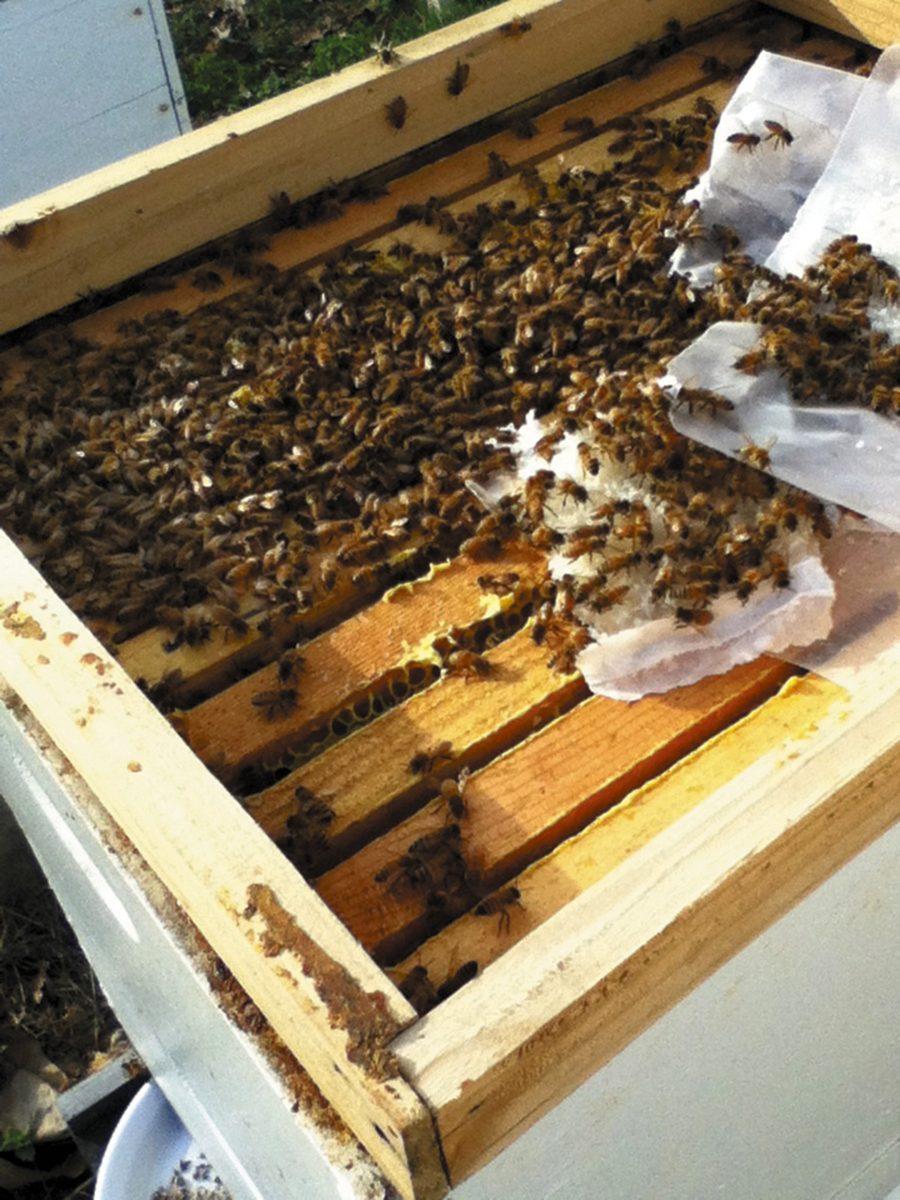
Honeybees are dying, but scientists have yet to pinpoint why the insect population is decimating nationwide.
According to a report by the United States Department of Agriculture regarding Colony–Collapse Disorder (CCD), about a third of the honeybee population has died from this past winter.
Recreational beekeeper and journalism and electronic media professor Jim Stovall said that the reason behind the dying bees is not one culprit, but a myriad of possibilities.
“We don’t have a good environment and we don’t treat bees very well,” Stovall said.
He has been beekeeping since 2007 and said that this particular year, the loss has been especially detrimental for commercial beekeepers who keep the insects for profit by using them for agricultural purposes. ?He said increased use of pesticides is decreasing areas for wild honeybees roam, and chemicals inside the hive are affecting bees lives over the long term.
??”It’s just a whole raft of things that bees rather not deal with,” Stovall said. ??
It’s the weather, too. Stovall said increased rain this spring has an affect on bee behavior. When flowers begin to bloom, bees emerge from their hive and begin making honey from the nectar and using the pollen for food. When it becomes cold inside the hive, bees begin to cluster to protect the queen, the only one who lays eggs. ??
“At sometime around 55 degrees, if it gets warmer than that, they tend to break out of their cluster,” Stovall said. “Wind affects bees too by making it difficult to fly.” ?
?Bees are also susceptible to pests, such as the varroa mite. These pest burrow inside the hive and deform the bees, and if the infestation is severe enough, the organisms can kill an entire hive. Stovall said beekeepers have to manage varroa, but almost every hive in America is infested with the pest to some extent.
??”It’s something every beekeeper has to keep in mind and has to manage for,” Stovall said. “It doesn’t mean every hive is going to die.”
?President of the Knoxville Beekeepers Association Ben Volk said illness plays a role as well.
“(There are) all of these other diseases that can also decimate colonies,” Volk said. “It’s not just the mites themselves that can wipe out the colony; they also carry diseases with them.This year the average loss rate in Tennessee was 60 percent. Several beekeepers lost 100 percent of their colonies.”
At Saturday’s Farmer’s Market in Market Square, Volk was offering his locally grown honey for $6 a jar. He said he lost about 10 percent of his bee population.
“I consider myself extremely lucky,” he said. “One of the things that I think helped me is that all of my bees come from feral colonies that I captured either from swarms or they made a colony in somebody’s house… the hybrid genetics tend to be more vigorous than the purebred genetics.”
The declining bee population is also affecting agriculture, particularly the cultivation of almonds. All almond trees are pollinated by honeybees, which are shipped to farms by commercial bees keepers and used to grow the nuts for a three-week period.At the end of this cycle, Stovall said the bees are left in an area without a food source, yet another reason that could be contributing to the dying bee population.
Will Barbour, junior in biosystems engineering, said using bees as a means to produce a singular product is only hurting the environment further.
“Pollination by bees is one of the principle means by which monoculture crops reproduce in an agricultural setting,” Barbour said. “This setting, however, is not conducive to the sustained bee population, especially at the concentration necessary for large-scale agriculture. This limitation on viable habitat, in conjunction with pesticide overuse and disease, is having a major impact on populations.”
“All of this (CCD effects) is going to make beekeeping very difficult,” Stovall said. “It was a very different environment 20, 30 years ago. Compared to today, it was very easy to keep bees.” ?