Jessica Hamed went to Brazil to take business courses and experience one of the world’s flourishing economies.
And while she did exactly that, she also returned to Tennessee with something more than just a few credit hours toward her human resource management degree.
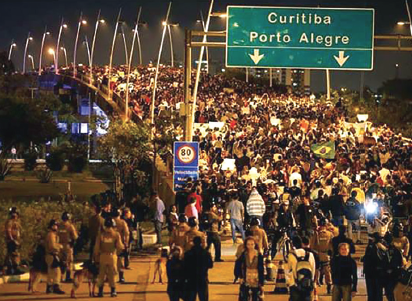
The UT senior found herself suddenly immersed in great social unrest as Brazilians everywhere – pushed to anger by elitist politicians – decided change within their nation is necessary.
“It just kind of happened one day,” Hamed said of the demonstrations that have rocked the nation over the summer months. “I was literally on a hike and then all of the sudden we were talking about not going to the protests because they might get big.”
Although the timing and size of the demonstrations may have been unexpected, Hamed was not oblivious to the injustices around her that finally capsized into peaceful, but enormous, protests when bus fares suddenly increased.
The southern island city of Florianópolis, where her group of 30 American students was studying, remained docile for the first several months of the trip but provided a window into the growing frustration of the Brazilian people.
“I had heard about the corruption and was like ‘oh, okay.'” Hamed said. “Then within a month of living there, I actually started to experience the corruption. For example, they had a human rights leader and the guy specifically said that he hated homosexuals. He didn’t represent the rights of the Brazilian people, and everyone was really mad about that because they didn’t have a choice on who their human rights representative was.
“That was the first example of injustice that I got to witness.”
Other things she noticed were a faulty tax system, poor wages, a low emphasis on education and attempts by the government to control the media.
“If something bad happens on TV, they’ll just change it to a soap opera or a football game,” Hamed said. “They distract people. It’s really bad how it works because the politicians aren’t out to help the people.”
An influx of international attention is centered on Brazil as it gears up to host the 2014 World Cup.
Extreme amounts of money are being spent to ensure the country puts its best foot forward as the eyes of the world descend on it. Pricey preparations are also in gear for the 2016 Summer Olympics to be held in the Brazilian city of Rio
De Janeiro.
But for the average Brazilian, the resulting benefits garnered by politicians and the wealthy are irrelevant, coming at the cost of everyday citizen well-being.
That’s why Hamed joined up in the protests, which even in the peaceful island of Florianópolis were large enough to block traffic to and from the island city for hours at a time.
“It’s been a cry for help because they know the spotlight is on them with the World Cup,” Hamed said, describing how the common people have also used the attention to their advantage. “The whole world is looking at them. The bus fares were just kind of the spark of it.”
The study abroad group remained primarily unaffected by any backlash from the activity. The only difference was that Hamed and her classmates were forced to take taxi’s around town when the bus system was down. Hamed didn’t mind the minor inconvenience.
“I felt like it was a good thing to help promote what they were fighting for,” Hamed said. “Because even as an American, I witnessed it and then I saw change being taken against it.”
Financial turmoil in Europe is one reason why Hamed, as a business student, chose Brazil.
Although she encountered unrest of a different kind in Brazil, she has no reservations encouraging students to participate in similar trips.
“I would 100 percent recommend it,” she said.
“Even though Brazil is going through this right now, it’s definitely mandatory for a country to go through some kind of revolution like this. They’re 100 years behind in their infrastructure and they (have a) lack of education and lack of political structure. So what’s going on right now, it’s needed. It’s not a good thing, but in the long term it’ll definitely help. Brazil isn’t going to stop becoming one of the strongest economies. They’re growing to grow out of this long-term. I would recommend them going to a place like where I went.”