In an era of college athletics that demands maximum performance from everyone involved, the grounds crew remains an integral part of the program.
Such is the case at the University of Tennessee, where the athletic department’s Turfgrass Management division constantly works with athletic teams to ensure the safety and performance of the nation’s top student-athletes. For Duncan Long and Caleb Waters, the job is constantly demanding, but the two are always up to the task.
Long, the head groundskeeper for baseball, and Waters, the head groundskeeper for football, ensure that the playing fields for two of Tennessee’s highest-money sports are always in top condition. Both are among a crew of roughly 10 to 20 people, both full-time staff and students, who work at Neyland Stadium in the week leading up to a football game.
However, the field preparation for Tennessee football begins long before the Vols run through the T in the fall.
“A lot of it starts actually way back in May, believe it or not,” Long said.
Field prep
For football, field preparation begins in the spring with vertical cutting, removing all of the dead grass. The team then lays new grass, as well as aerates and top-dresses to ensure a smooth, yet firm playing surface. The current grass used at Neyland Stadium is Latitude 36, a Bermudagrass which is specially designed for cold resistance and quick, early growth in spring.
“What we’ve noticed with this one, for what we need it to do, it greens up faster coming out of winter,” Long said. “So early spring, we’re usually green by May. And it stays a little bit greener through the winter.”
All of Tennessee’s athletic fields are 100% Bermudagrass, except for Lindsey Nelson Stadium, the baseball field, which was converted to artificial turf prior to the 2019 season. That decision was made by head baseball coach Tony Vitello to improve player development by having a playing surface that did not need significant maintenance, ultimately allowing greater flexibility in scheduling as well as the ability to host more local events for the Knoxville community.
“I consider myself a traditionalist, but player development and building a winning program is more important than any personal preference,” Vitello said in a 2018 release. “All evidence points to this surface being a key component of accomplishing those two major goals.”
Vitello left in October 2025, but not before his leadership brought consistent success to Tennessee baseball, highlighted by the program’s first national championship in 2024.

Managing the fields
For each field, the priorities are clear: safety first, then playability, then aesthetics.
“From a fan standpoint, they always want to look out there and be like, ‘Oh, the field always looks good,’” Long said. “But in reality, that’s not always the case. We’re worried about the safety of the field, make sure none of these athletes are going to get hurt, then they’re out, maybe career-ending, who knows.”
Though Long and Waters hear a lot of nightmare stories about injuries on the playing field, they do not worry too much at the high level of play they work at, with the quality of their fields.
“We hear about it, but I don’t think we are truly responsible for that, because at this level and above, all the fields are pretty much the same,” Long said.
“And football, there’s 130 guys, players, who knows how many coaches. You’re not going to make everybody happy. But at the end of the day, you just want to worry about safety and playability on it.”
Weekly in-season action
The long-term work transitions into weekly jobs as the season grows near. For football, the preparation for a Saturday home game begins on Wednesday, as the grounds crew begins each day around 7 a.m.
“We end at 3:30 (p.m.) on most days,” Long said. “But depending on what we have going on, we could be here till 9, 10 o’clock at night.”
“We just stay until we get everything done, until we get to a point where we’re comfortable with everything,” Waters said.
Before any work is done at Neyland, the team begins at the practice fields, having them ready before the football team practices at 9 a.m. This includes mowing every day and blowing off the playing surface to ensure it is dry.
On Wednesday of game week, they begin painting the field. They will hand mix all of the paint, which can equate to 175 to 200 gallons, according to Waters. White paint is applied on Wednesday and Thursday, and Friday is strictly an orange paint day.
After a football game comes and goes, the crew will go back out and turn it around for the next game.
“We’ll come out here postgame and patch divots, do it again on Tuesday, and just kind of keep it as smooth as possible,” Long said.
Expense of the job
Nothing causes stress for a grounds crew quite like the aftermath of the newest spectacle in college football — field storming.
Long and Waters experienced this firsthand after Tennessee defeated Alabama, 24-17, at Neyland Stadium on Oct. 19, 2024.
“It messed us up bad,” Long said.
“Sunday, we came in, me and Caleb walked around with flags, and we had to mark every spot that we felt was dangerous to the athlete, whether that be sod that got ripped out, glass that we found in the field or just any random hazard that we might have found.”
Approximately 120 different spots on the field were marked as hazardous and requiring repair. Many personal items dropped in the chaos ended up on the field, such as cigar butts, lighters, shoes, sunglasses and even a cell phone.
Among all this was the biggest problem of all: fans had torn up the playing field for personal souvenirs.
“Storming the field is one thorn in our side, but fans ripping up the grass is a whole ‘nother,” Waters said. “That’s like getting stabbed in the back by your best friend.”
“You know, the fans make everything great, and then here we are, postgame, walking around the field, half the T is missing, end zone pieces are missing,” he said. “Not to mention, it was after we just laid brand new grass. It was right after the Morgan Wallen concert.”
“So we’re looking at it from the standpoint of, we just wasted $200,000 because we had to come in and replace so much more of it.”
The entirety of the grass surface at Neyland Stadium was replaced in mid-September of 2024 after the concert, a project which cost approximately $417,000 — ultimately wasted after the Alabama game. Included in the bill for repairs was $30,000 for two new sets of goal posts.
Long said that entire sections of the field had to be replaced in the two weeks before the next home game, including a large square between the 45-yard lines and the entirety of the midfield Power T logo.
Major projects and helpers
Such massive projects require significant resources and manpower to be done quickly while also ensuring the integrity of the playing fields. The University of Tennessee contracts Carolina Green Corp., a third-party source specializing in athletic field construction, for its athletic field products and some larger services.
“They do all our sod work, and obviously, if it’s big repairs, they come in and help us take out the grass, re-grade the field and install the new grass,” Long said.
Carolina Green has performed numerous construction and renovation projects — not only at Tennessee, but at many collegiate and professional athletic venues.
Among these major projects are renovation and modernization at multiple athletic facilities on campus, such as soccer, softball and baseball.
In addition, some fields at Tennessee have received quality upgrades, such as new irrigation and sprinkler systems for both the grass watering and drainage on the playing field. At Regal Soccer Stadium in 2022, a $1.4 million project was undertaken to construct an all-new irrigation system, completely replace the grass playing surface and build a spectator berm on the far side of the field.
All of these renovations help illustrate the priority list for the grounds crew — safety, playability and aesthetics.
All the playing fields at Tennessee frequently receive quality and performance testing to ensure they are safe to be used.
There are several metrics that are used to measure these standards, such as surface firmness, strength, traction, stability and surface hardness. Tennessee’s fields currently utilize FIFA’s standards of measurement.
“We want our numbers to be the best they can,” Long said. “And FIFA usually has the best numbers for testing-wise.”
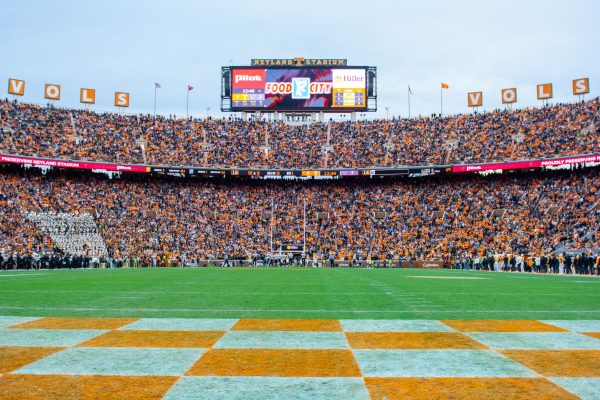
29, 2025. (David Smith / The Daily Beacon)
University support and success
Ultimately, Long and Waters feel they receive favorable support from the university whenever they may need it, especially financially for equipment and projects.
“I would say we’re pretty lucky,” Long said. “We’re probably one of the best schools financially for our department. They help us out with anything we need.”
“Some things are a little bit tougher to get approved and all that. But for the most part, if football needs something, they’re going to get it for football because, obviously, football’s the breadwinner at any major SEC school and brings in the most money for every school.”
At the end of the day, the athletic department recognizes and understands that all parts of its workforce are necessary for excellence, and so it supports all of them to ensure that the overall goals and standards are upheld.
As another fall season passes, the investment in both monetary and labor forms can be seen across the field at Tennessee, as the grounds crew continues to help lay the foundation to success.