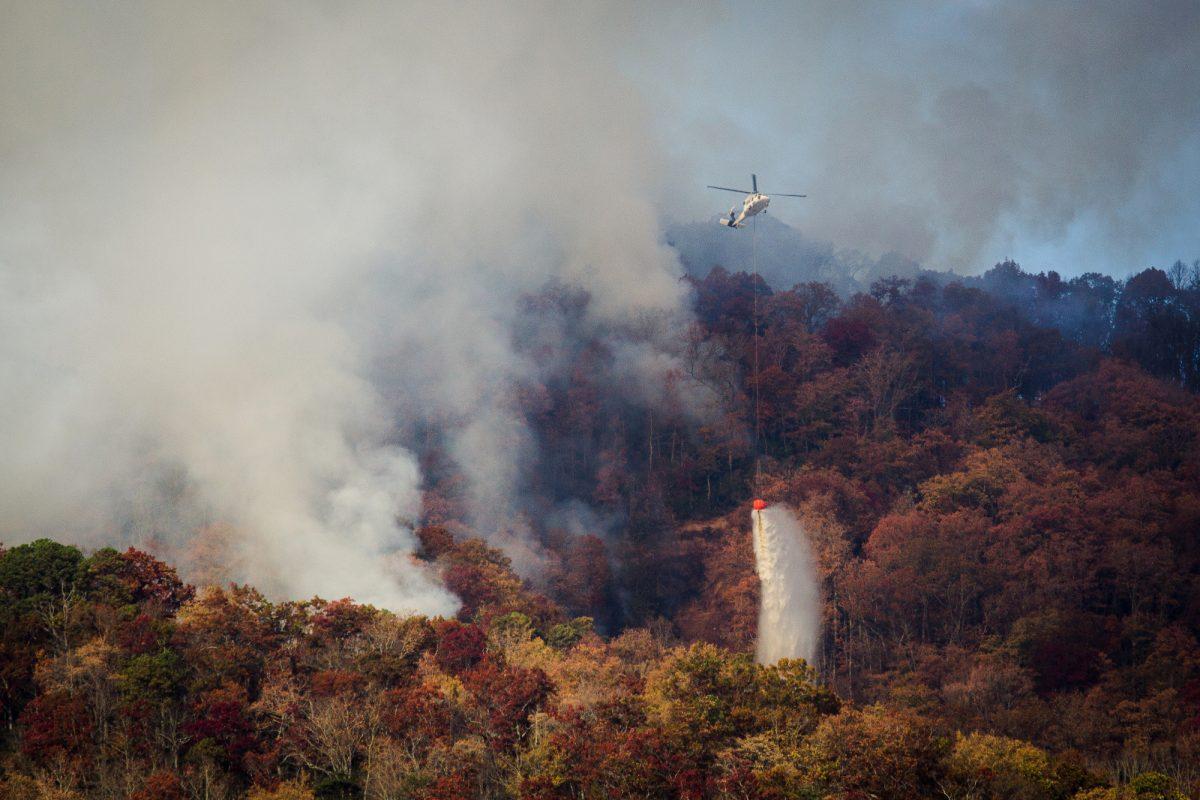
With air clouded by thick smoke, the University of Tennessee is suffering the effects of recent wildfire outbreaks plaguing East Tennessee.
The lack of significant rain since August has created the perfect opportunity for these wildfire outbreaks.
“It’s just super dry, almost unprecedented,” Wayne Clatterbuck, UT professor in forestry, wildlife & fisheries, said.
Knoxville is roughly five inches behind its average yearly rainfall estimate. Chattanooga overshadows that count, being 16 inches behind its normal yearly rainfall.
Despite these drought conditions, the spark that started the fires is not due to nature.
“Majority of our fires are human-induced,” said Clatterbuck. “A lot of people seem to get a thrill out of setting things on fire.”
It has been confirmed that the start to most recent wildfires have been arson and human carelessness. Simple actions, such as not properly extinguishing a campfire or burning a brush pile, can cause major damage in extremely dry conditions.
“We haven’t had any lightning storms to ignite any of this stuff. It’s not like it’s spontaneous combustion,” Gary Dean, UT professor of geology, said. “It’s always a little bit of human help.”
Tennessee Fire Code states protecting structures as a priority in cases of wildfires. After that, trees are targeted because the wildfires cause defective lumber quality.
Clatterbuck said areas most susceptible to wildfires are the mountainous regions. Due to their seclusion, these remote areas often lack the water pressure needed to suppress wildfires or roads navigable to firetrucks.
Rather than treating the wildfires with water, firefighters have initiated a process called “backfiring” in which they actually fight fire with fire.
Once a wildfire is located, the firefighters start a second controlled fire, burning it toward the wildfire.
This strategy is cheaper than using water, important due to the fact that budgets are not currently in place to handle the wildfires at their current capacity.
The controlled fire uses the resources that otherwise might have ignited the wildfire. Through this process, they stall the fire, preventing its spreading.
One of the immediate consequences of the fires has been the depreciated air quality, sending Knoxville into a code red warning. Particulates from the fire debris have been trapped in the atmosphere and remain hovering in the breathable air due to the warm weather.
In response to the air quality and how it affects people within community, Clatterbuck admits there is “not a whole lot you can do about that.” He said, “Just try to stay inside with no prolonged exposure if you can help it.”
Despite these precautions, those with especially sensitive allergies and respiratory problems are suffering.
Alongside the air, the soil is being negatively transformed by the fires. As fires heat up, the soil’s organic matter is changed, microbiomes are killed and nutrient cycling is altered. These effects will remain even when the fires are gone.
The environment is changing through a positive reinforcement; as the ground gets drier, the vegetation gets dehydrated and rainfall has less effect.
“These drought conditions aren’t something that can just be remedied by a nice rain storm,” Dean said. “It’s going to take quite some time of steady, slow rains to actually infiltrate the ground and get it moist.”
The wildfires will end when the rains begin, and there is not currently a prediction as to when that will occur.