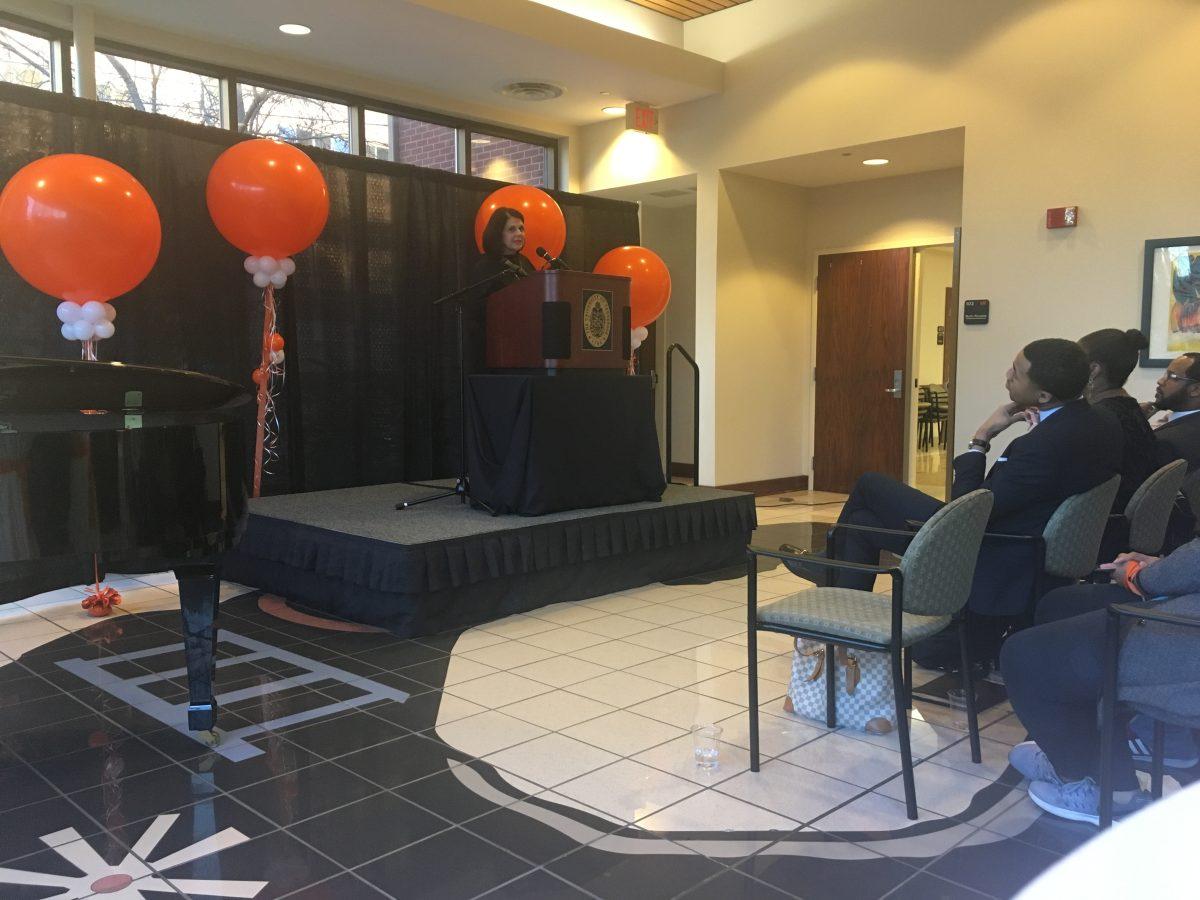
Respected UT students and staff joined the community in celebration of Martin Luther King Jr. early Thursday evening.
Hosted by the Commission for Blacks, Office of Multicultural Student Life, Division of Student Life and Office for Research and Engagement, the small gathering at the Frieson Black Cultural Center began at 4:30 p.m. MLK50 Forward recognized the work of King and the ways the university could move forward based on his philosophies.
Speakers included senior in nursing and Student Government Association (SGA) Vice President Michael “Mickey” Curtis, associate professor in the department of English Michelle Commander and Chancellor Beverly Davenport.
Hannah Chong, chair of Diversity Educators and senior in supply chain management, and Robert Nobles, interim Vice Chancellor for Research, opened the event with remarks and introductions for each speaker.
Curtis spoke first and said the way to change the world is to first understand the world.
“We cannot expect this world to be a better place if, personally, inside, we have not come to part with our own biases, our own thoughts, our own hate that we may have, our own prejudices … We must figure out what’s inside of us,” Curtis said. “We must ask that, ‘Why?’ Why are we accepting these acts that are occurring on campus? Why are we not speaking up?”
After people understand these inner biases, Curtis said it was important that students and the community take control of harmful messages.
“I believe it’s what we think … Words on the Rock, white supremacy, occurrences at the Pride Center (do) not define us,” Curtis said. “We are going to define it. It has no place on this campus. And we have the ability to figure out how we’re going to respond, how we’re going to perceive it. And that’s what really matters”
Curtis went on to include that tolerance is not enough and to effectively move forward, and he said more love and appreciation should be shown. Using phrases like “Black Lives Matter” and “LGBTQ+ Lives Matter” as examples, Curtis said that these sayings are more about equality and love than anything.
“Today, we’re not saying that those lives are extremely more important — not showing favoritism,” Curtis said. “We’re saying right now, in that moment, that these folks, they just need a little more love — that equity and love.”
Commander spoke next and discussed her own experiences with racism and prejudice, especially growing up in South Carolina in the late 1900s.
“We existed in the shadows of former plantations where my family members had been enslaved and where many of them toiled in a kind of neo-slavery under the sharecropping system,” Commander said.
Among her experiences, Commander spoke about her time in Hopkins Middle School from 1989 through 1992. Commander said when she attended neither the literature nor the curriculum included studies on slavery or the Civil Rights movement.
“I do know that the administration and faculty were complicit,” Commander said. “Their willful and, perhaps unintentional, glossing over of our shared histories, their refusal to address the truth in their ensuing silence helped create and maintain our precarious terrain that students were too young and too naive to negotiate alone.”
Following Commander, Davenport talked to the audience about recent issues that have arisen on campus. Like Curtis, Davenport cited the Rock painting in December 2017 during winter break when someone wrote, “White pride.”
Students and others were quick to condemn the message on social media, and when Twitter user McKinley Merritt brought it to the attention of UT’s Twitter, the university tweeted:
“Hi McKinley, While we sometimes disagree with what appears on the Rock, those who paint it are protected by the First Amendment. We trust that the Volunteer community will take care of this quickly.”
UT has since deleted the tweet after backlash from the community.
In her speech, Davenport attempted to reassure the audience that she understood their concerns and said that the former Rock message was not in the Volunteer spirit, calling it “nothing short of despicable and hateful and not the University of Tennessee.”
At the same time, Davenport also said that she has no plans to remove the Rock, viewing it as the message board of campus.
“But I don’t want the Rock to go away because we need that canvas to paint, and we need a lot of canvases to paint and to educate us and to remind us what it is that we do believe.”
Davenport said that many white supremacist groups have targeted college campuses to recruit members and promote their beliefs. But while the First Amendment applies and the campus also has its own policy on free speech, Davenport emphasized the importance of breaking the silence.
“They are coming to our campus precisely because of who we are. They wouldn’t bother with us if they didn’t know who we are. They wouldn’t bother with us if they didn’t know we are all about inclusion, and our mission is to promote free speech,” Davenport said. “But just because the First Amendment and our own campus free speech act protect hate speech doesn’t mean we have to remain silent.”
And although Davenport said that those who intend to threaten or hurt campus will be stopped, she encouraged everyone to also take action against hate speech.
“But I encourage you to be guardians of this campus. It’s our campus. Protect it and make it a symbol of what we honor and what we love,” Davenport said. “Take care of it, and take care of each other … This is our campus and our community. It is on us to make this our University of Tennessee. Now is our University of Tennessee. I can’t own history; I can help own now. ”
For the future, junior in accounting Xavier Greer said he hoped this event would pave the way for other similar events.
“I feel like so many times diversity and inclusion takes a back seat,” Greer said. “But I wish that we could have this at a more grander scale, get out to the masses and make it an event that everyone wants to come to.”