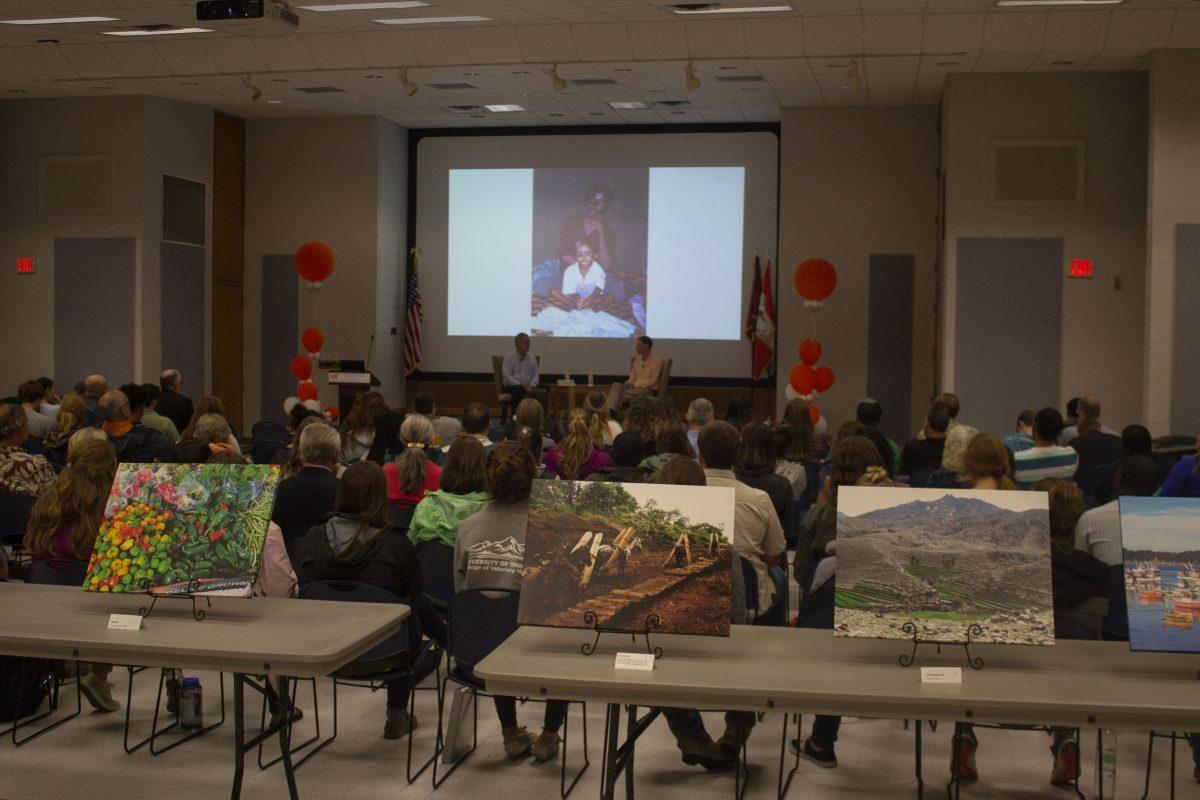
Senior Fellow on global food and agriculture of the Chicago Council on Global Affairs Roger Thurow prompted the University of Tennessee’s agriculture students to consider their roles in addressing global hunger as a part of the third annual University of Tennessee Institute of Agriculture (UTIA) Smith Center International Showcase.
The UTIA Smith Center International Showcase is organized in conjunction with the Herbert College of Agriculture Study Abroad Fair. The showcase was formatted to resemble the talk show “The Real Hunger Games,” with Thurow questioned directly by Tom Gill, director of UTIA International Programs and Smith Chair in International Sustainable Agriculture.
“We have wanted Mr. Thurow to come speak since our initial showcase,” Gill said. “He is a leading author on global hunger issues and we wanted him to come share his work and why we should care about hunger around the world and in America.”
Thurow was a foreign correspondent for the Wall Street Journal for 20 years covering the Cold War, the fall of the Berlin Wall, the release of Nelson Mandela, the end of apartheid, the wars in the former Yugoslavia and the humanitarian crises of the first decade of this century–along with 10 Olympic Games.
In 2003, Thurow and colleague at the Wall Street Journal Scott Kilman wrote a series of stories on famine in Africa that was a finalist for the Pulitzer Prize in International Reporting. Then in 2010 Thurow joined the Chicago Council on Global Affairs and has since authored several books including “ENOUGH: Why the World’s Poorest Starve in an Age of Plenty,” “The Last Hunger Season: A Year in an African Farm Community on the Brink of Change” and his most recent book, “The First 1,000 Days: A Crucial Time for Mothers and Children—and the World.”
Thurow spent majority of his lecture referring to stories of small farm families he heard and witnessed while writing for the journal in Africa.
“My main motivation for writing (“The Last Hunger Season: A Year in an African Farm Community on the Brink of Change”), to explain the importance of these small shareholder farmers” Thurow said. “It’s not only important from a humanitarian aspect, but theses farmers are so important to all of us on the global food chain, because that’s what makes us all connected.”
Thurow’s mantra, as a journalist and author of a book, was to “outrage and inspire.” According to Thurow, the facts and data on starvation and malnutrition in the area served to outrage, but the underlying story was to inspire people outside the community to reach out and do something about the challenges faced by small African farmers.
According to Thurow’s book and research, Africa’s small farmers, who comprise two-thirds of Africa’s population, toil in a time warp, living and working essentially as they did in the 1930s. Without mechanized equipment, fertilizer, or irrigation, using primitive storage facilities, roads, and markets and lacking capital, credit, and insurance, the farmers harvest only one-quarter of the yields of Western farmers, half of which spoil before getting to market. The book follows a group of Kenyan farmers who came together to try to change their odds for success—and their families’ futures.
“It’s interesting to see that the hungriest people in the world are farmers,” Thurow said. “But then, I wondered what would happen when these elements of farming and agricultural development, that we often take for granted, are introduced.”
The result: these farmers, who usually had to prepare and deal with a hunger season after harvest, experienced a surplus for the first time ever and they could contribute to the global food chain.
“By being able to listen to Mr. Thurow and having time to interact with him, I hope our students can be inspired to realize they can have a role in this world and make a difference,” Gill said.
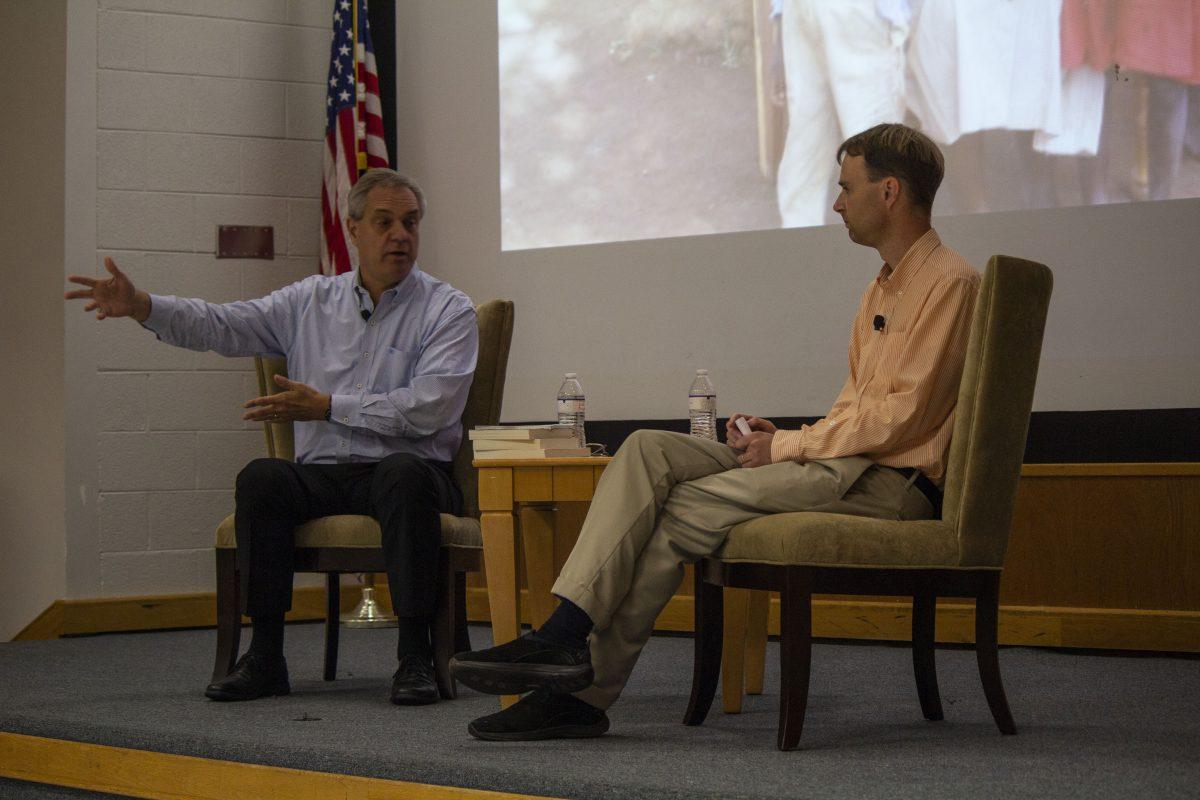
Author Roger Thurow discusses physical and mental stunting at his panel moderated by Tom Gill on Sept. 27, 2018.