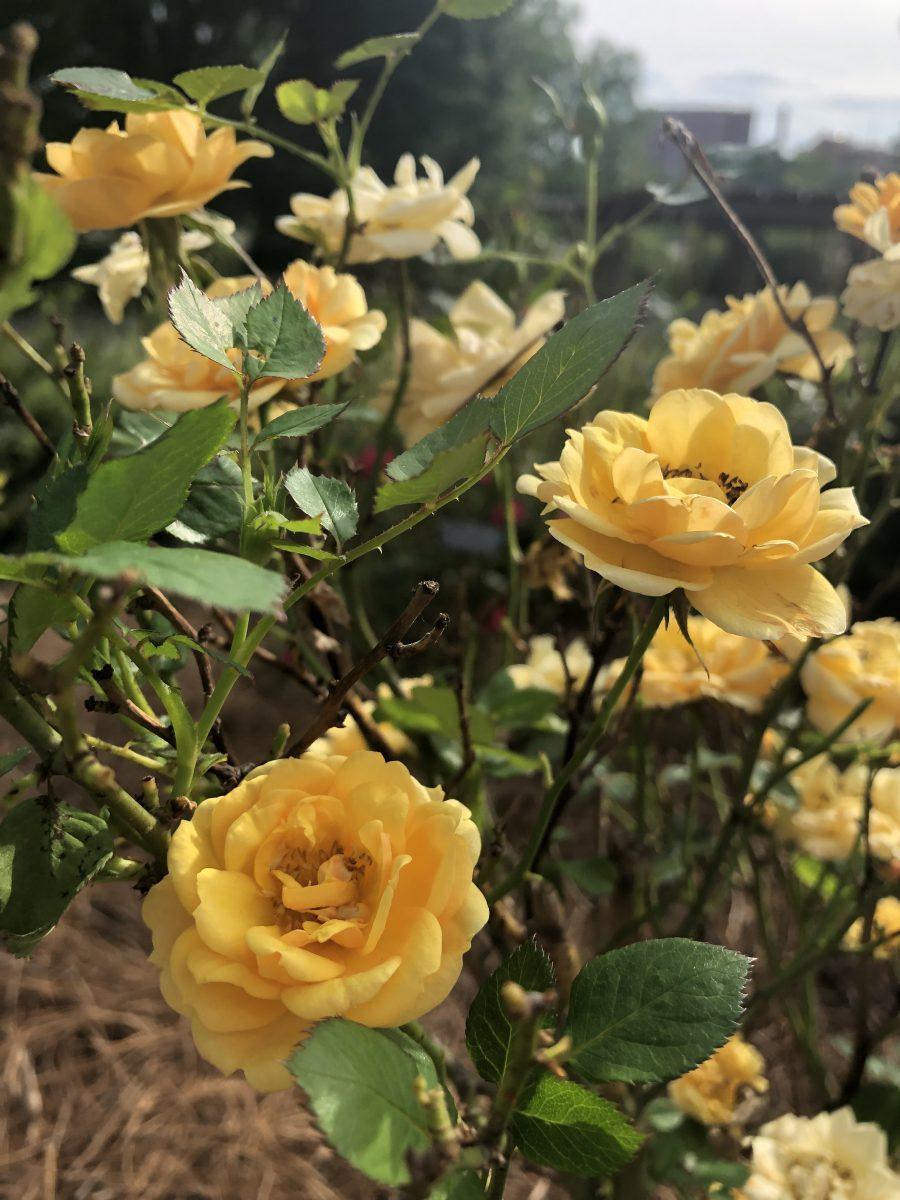
Nestled in the nooks of nature’s landscape, blooms wait to blossom, as April’s showers encourage the speckles of art to break from their nurturing cocoons. Smatterings of red, yellow, blue and all their secondaries splatter earth’s canvas to create the most priceless art, with quite the fragrance, too. Sparks of purple, green, orange and all their tertiaries catch the eye of all, as spring steps out of winter’s shadow.
It doesn’t take long for these little specks of color to make a big impact. Research on the time it takes for nature to sway your mood claims that a walk from class to class could do the trick. Director of the University of Tennessee Gardens and UT faculty member Susan Hamilton said four minutes can reduce stress, anxiety and leave you feeling better than you did before.
“People need to get outdoors (more). They need to surround themselves with nature,” Hamilton said. “You may not be so conscious of it, but (plants) really do have a positive impact.”
“You may have been outside, and maybe you took a stroll through a park or you visited (the gardens),” Hamilton added. “You may not really realize that you’re feeling better because of what you just did.”
Color has already brought the UT Gardens to life, located on the UT’s agriculture campus. The sweet aroma of spring’s debut has brought many to the area, according to Hamilton, who has noticed a plethora of graduation photoshoots, lunch breaks and study sessions across the “outdoor classroom.”
“I frequently hear from people that love to come over here,” Hamilton said. “That is very uplifting, very positive. And they always feel much better when they leave the gardens than when they get there.”
UT Gardens’ blooming viburnums, azaleas, dogwoods and redbuds give a burst of color, and joy, even to those driving past on Neyland Drive, including Flourish Flower Truck owner Savannah Pannell. Pannell’s mobile create-your-own bouquet business operates out of a 1961 Ford Econoline with most of its original parts.
Celebrating her second spring season, Pannell said it “has been so sweet already,” as she hops from location to location across town to help flower lovers create their own unique fresh-cut bouquet within their price range.
“Spring brings such a promise of life and newness, and even though we have only had the flower truck back out for the year for two full weeks, we have been overwhelmed by last year’s customers coming out and being thrilled to see us again,” Pannell said. “There is just so much excitement about things being in bloom after a long winter, and people here really get excited about local blooms coming in on the truck.”
Pannell’s supply of ranunculus and peonies last hardly a weekend, which serve as the centerpiece for most bouquets she packages for visitors. “One post about having flowers like this on social media draws a huge crowd for the week.”
The flower truck’s abundant tulip supply proves popular most days the truck sets up shop across town, which is something that new business owner Sydney Duncan observes at Rivers & Roots, a flower farm where visitors cut and put together their own bouquet of flowers.
“I think business in the spring is exciting, because everyone is ready to finally be outside and have flowers again,” Duncan said. “I think I would grow tired of just growing flowers for myself, but getting to see people experiencing the flowers and cutting the flowers that jump out to them has been so rewarding. It’s hard to describe the feeling.”
It’s not hard, however, for Duncan to describe the way she’s seen her flower farm create a vast oasis for every visitor to spend time soaking up the warm spring sun while making fragrant memories.
“I think flowers are bright and cheerful and wild and free, and they make us feel similar,” Duncan said. “I think everyone connects to flowers differently, and that they provoke different memories or feelings in all of us.”
Pannell, in her pre-flower career as a registered nurse, used most of her free time to research emotional and behavioral health benefits for keeping fresh-cut flowers around before making the switch to full-time mobile business owner.
“I knew I would have to be equipped to face people who thought fresh cut flowers were a waste of money and resources,” Pannell said. “But I knew that just wasn’t true, and that education could play a huge role in changing someone’s perspective.”
“The research I did in the beginning is what really confirmed that this business had worth and could make a difference in the Knoxville community,” Pannell added. “I have seen that become true over the past year.”
Businesses like Flourish Flower Truck and floral educational programming are some of the greatest gifts horticulture is giving to humankind right now, according to Hamilton, as more succumb to “Nature-Deficit Disorder.”
Richard Louv, co-founder of Children Nature Network and author of “Last Child in the Woods,” coined the term in 2005, describing the human cost of refraining from enjoying and spending time outdoors.
“We needed a language to describe the change, and this phrase rang true to parents, educators, and others who had noticed the change,” Louv said in a Psychology Today post. “Nature-deficit disorder is not a formal diagnosis but a way to describe the psychological, physical and cognitive costs of human alienation from nature, particularly for children in their vulnerable developing years.”
As technology develops and situates itself in nearly every aspect of life, a chilling number of children and adults rely on lighting from lamps, LED fixtures and electronic screens. Director of the Sleep at Chronobiology Laboratory at University of Colorado, Boulder, told Time Magazine that exposure to sun-strength rays of light are vital. These rays help “calibrate your body’s circadian ‘clock,’” which is important in regulating appetite, sleep schedules, moods and energy levels.
Hamilton hopes that current trends such as visiting flower fields, keeping succulents and studying outside will continue to spark a change amongst college students, who she primarily sees with headphones in ears and eyes glued to screens.
“They’re not tuned in to their environment. They’re not hearing natural sounds like birds. They’re distracted from taking in beauty and nature,” Hamilton said. “I think your public gardens, your parks, the national parks, the botanical gardens — never before have (they) been so relevant to the health, not only of our environment but (us) by using plants all in the right way.”
Pannell hopes that in helping customers create custom bouquets, she can brighten moods by bringing what visitors want straight to them. “That’s why it’s so fun that people get to add their personality to what they create with us,” Pannell said.
Focal flowers such as sunflowers, mums and other larger flowers aren’t always the stars of the show, which has surprised Pannell and Duncan. People often gravitate toward pieces typically referred to as filler flowers like eucalyptus and other greenery. Both main attraction and filler, however, provide exactly what drew Duncan into the business: joy.
“I was drawn to the process of growing something that’s really just for our enjoyment. There’s a lot of sweat and time and patience that goes into flowers, and even though we get to enjoy them for such a short time, it’s still worth it,” Duncan said. “I was drawn to how life imitates that and how seasons of joy normally follow a long season of growth and struggle, but we normally think back knowing it was all worth it.”
And if bouquets aren’t in the budget, eucalyptus and greenery, along with succulents, English ivy and holly family plants, can easily be integrated into a living space.
“When I hear people say, ‘Oh, I don’t have green thumbs. I kill plants,’ it’s probably that they just have been given or they’ve selected maybe not the easiest plants to grow,” Hamilton said. “There’s just too many plants out there that are forgiving.”
One of the easiest ways to find the perfect plant for a space is to visit local gardening centers like Stanley’s Greenhouse and Kirby Plants, something Hamilton recommends.
“I love to advocate for the support of your locally-owned, family-owned garden centers because that’s your dollars going local and supporting a family’s livelihood,” Hamilton said. “You get the expertise from those people and that’s what they specialize in.”
Other ways to embrace nature’s floral health benefits without spending a dime is to find wild areas to see it all in its natural state. Local areas include sunflower fields at the Forks of the River wildlife management area, native flowers at Max Patch right across the North Carolina border and wildflowers in the Great Smoky Mountains.
“What’s really popular right now are our native wildflowers that are all out in our woodlands and in the mountains,” Hamilton said. “People will come from all over the United States to come here, and they enjoy nature walks (and) hikes.”
Whether fresh-picked bouquets, house plants, nature trails or botanical gardens, Hamilton said plants can transform homes, workspaces and lives, as they filter air, keep productivity high and stress levels low, without their caretaker lifting much of a finger.
“It doesn’t get much better than that,” Hamilton said. “We just cannot overlook the impact, the benefit that plants have on us human beings.”