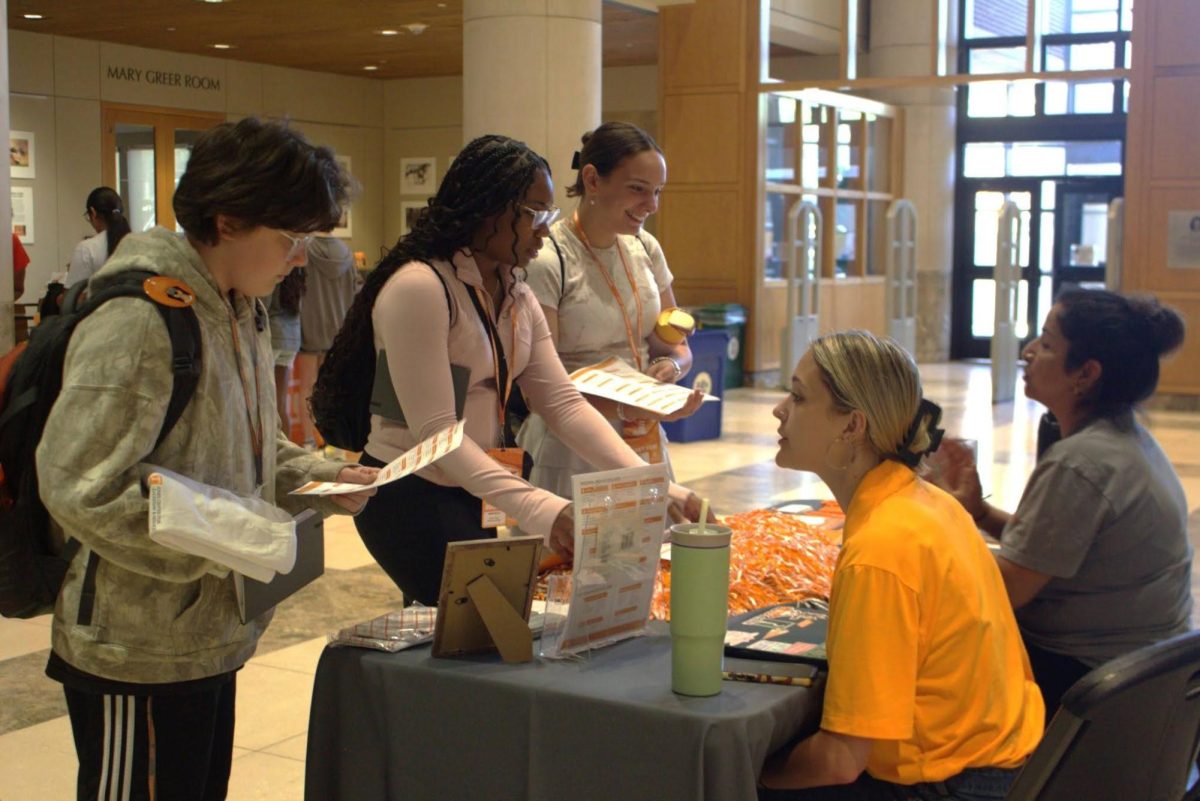
Although UT ultimately lost the “Battle of Orange and Blue” blood drive against the University of Kentucky, the school still greatly contributed to a good cause.
The final score was UT having made a total of 3,107 donations to UK’s 3,159. The competition occurred through last week and was organized by the Medic Regional Blood Center.
Felicia Rhodes, a donor resource coordinator and paramedic at the blood drive, had noted on Thursday that the Vols were behind the Wildcats in terms of donation numbers, but had hoped for a final push to win, a push that never came.
At the time, she suspected part of the lack of enthusiasm might have been because of the lackluster football season.
“A lot of the students are down right now because of the things that have been going on with the football team and the coach, the losing aspect,” Rhodes explained.
Nervousness can also be an obstacle for those donating for the first time, be it from a fear of needles or just facing the unknown procedure that’s about to take place.
Rhodes said that there were many first time donors coming to the “Battle of the Orange and Blue.” She said that many of them were definitely a little nervous about donating for the first time.
“Their anxiety is up a little bit,” Rhodes laughed. “It shows in their blood pressure whenever we check it over there.”
But Rhodes said that once a new donor gets an idea of what is about to happen, they tend to calm down.
“Our phlebotomists are really good at talking to them and letting them know what’s going to happen. They’re very, very good at explaining it, especially if they have questions.”
Sarah Doktyzc, an undecided freshman, was once one of those nervous first time donors.
In high school, Doktyzc missed the chance to donate for the first time because of a tennis match. So when the first university blood drive competition against Florida started earlier this year, she jumped on the occasion.
During that first time, she wasn’t nervous so much about the needle, but rather about not knowing how the blood donation process would occur.
“It’s not like I love needles, but I don’t have a phobia of them,” she joked. “I’m kind of neutral on needles.”
Returning to donate for last week’s competition with the University of Kentucky, Doktyzc no longer had the concern she did a few months ago.
“I’m not nervous anymore,” she said. “I think I was just nervous because I had never done it before. I didn’t know what it was going to be like, but now I do.”
Rhodes said that she had seen many returning students like Doktyzc coming to both the Florida and Kentucky competitions.
“I’m seeing a lot of people from the last competition that we had against Florida,” said Rhodes.
And not just for the incentives to donate either. Medic offered a variety of “gifts” to donors, including items from Papa John’s Pizza, Rita’s Italian Ice and Texas Roadhouse. Rhodes said that most return donors were coming back because of what those blood donations are needed for.
“Some students that have previously donated, they understand where some of these blood products are going to,” said Rhodes. “If they could just see some of the kids at Children’s Hospital, a lot of people would turn their heads and try to donate more.”
One of those return donors was Madilynn McCollum, a junior in chemistry. She is one of those students that Rhodes was talking about: a student not enticed by incentives but rather by the need for blood donations.
“I was looking on the website,” McCollum said, “and it said (Medic) needed 300 donors a day. And I said, ‘Well, I’ll be one of them.'”
She added with a chuckle, “I was just sitting in class, and I was like, ‘Well what am I going to do today? I guess I’ll donate blood.’ I’ll do my duty as a citizen.”
McCollum had previously donated in high school three years ago and decided that it was time to do it again. She recalled, like many others, that she was nervous about going through with it, primarily because of the needle and the horror stories that her friends were telling her.
“It’s kind of a big old needle going into your arm,” she said. “My friends had donated blood, too, and they were like, ‘Oh my God, this girl passed out!’ And then I’m like, ‘I hope I don’t pass out.'”
But for Margaret Grigsby, a journalism grad student, those horror stories hit a little closer to home.
During her undergraduate years, Grigsby had been a fairly frequent blood donor and even joined a registry to be a potential bone marrow donor. It had been a year and a half since Grigsby donated blood, but she was inspired to go again by one of her public speaking student’s speech on blood donations.
Having never been afraid or squeamish about donating blood before, Grigsby was quite surprised when she started to feel “pass out dizzy” and then vomited near the end of the procedure.
“I was in there, and it was almost over, but then I’m feeling dizzy and then. … ” Grigsby said, followed by vomiting sound effect. “That was awful … and really great and terrible and embarrassing.”
Grigsby said during the donation she hadn’t been nervous or afraid. She doesn’t know if the experience will affect her donating blood again in the future.
But there is a bright side for Grigsby.
In her own words, “At least I completed it!”