“We expect your vote for ratification.”
This telegram, sent on the afternoon of August 16, 1920, echoed thousands of messages urging then-Representative Harry Burn of McMinn County to vote “yes” on the 19th Amendment, securing the 36 state majority needed to ratify it nationally.
With the Tennessee House evenly divided on the issue, the historic decision to ratify fell to Burns and his fellow legislators.
But no brilliant political rhetoric would sway Burn’s stance to bar women from the voting polls.
Instead, the scales were tipped for Burn when he received gentle advice in a personal letter, sent from Febb Esminger Burn, the legislator’s own mother.
Shocking his colleagues, Burn announced a reversal on his original opposition in the same week. He cast the deciding vote to approve the amendment with his mother’s letter tucked inside his coat pocket.
“She wasn’t trying to strong arm him into the vote, like, ‘you have to do this or I’m not going to love you anymore,’” said Steve Cotham, manager of the McClung Historical Collections. “But, she did put that plug in there, and he said that letter is the thing that changed his mind.”
Today, Mrs. Burn’s 94 year-old missive sits in the East Tennessee Historical Society’s archives, primarily for curious minds who crave a glimpse into those pivotal weeks of history, Cotham said.
“I think that’s all pretty amazing as you look through his personal papers, through his life, all those documents,” Cotham said. “He got a lot of recognition, and I think he enjoyed that. The family put those (papers) here for people to have access to, so that was the whole point of putting those things in a repository where people knew that were here, and you could come and see them.”
Still, even Burn’s vote does not unravel the complete story of suffrage in the Scruffy City.
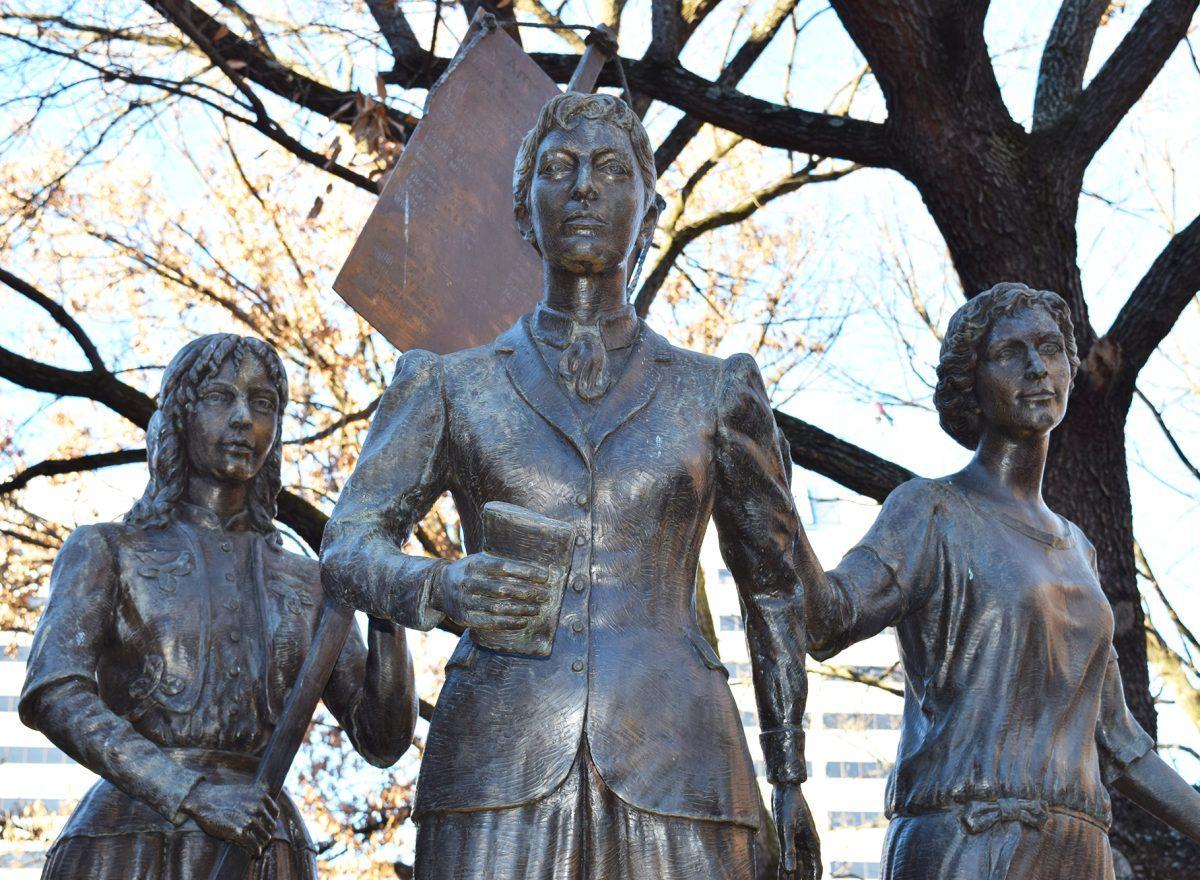
Now immortalized in The Woman’s Suffrage Memorial in Market Square, the life of Knoxville’s Lizzie Crozier French permeates local record as one the city’s most prominent sparks of change.
This spark perhaps shone its brightest in her 1912 speech to the all-male Tennessee Bar Association urging for closer examination of Tennessee’s laws governing voters’ rights.
As recorded in the July conference’s proceedings, French’s appeal as a conscientious citizen and mother rings loud and clear:
“Bullets and ballots are not companions,” French said. “But ballots in the hands of people are supposed to be a substitute for bullets in the hands of hired agents … Thanks be to God that in giving women the crown of motherhood he made her the giver, not the taker, of life. Woman has no greater claim to the rights of the ballot than that she is a producer, not a destroyer, of life.”
Such eloquence, Cotham pointed out, would contradict the centuries-old expectations of French’s female counterparts, making her civic-minded campaigns all the more progressive.
“Women were supposed to be at home with their families and not taking part in public life,” he said. “What was changing in the 19th and early 20th century was that there were women who became involved in various causes. That didn’t mean they didn’t have a fine home life necessarily or that part of their life wasn’t still there, but by speaking on big issues, mainly temperance and suffrage, (their goal) was to improve society – make it a better place.”
French’s accomplishments as local trailblazer still inspire awe today.
She would go on to serve as President of Knoxville Equal Suffrage Association. She was the first woman to address and run for office in City Council and a charter member of Knoxville’s Ossoli Circle, one of the country’s oldest women’s clubs to date.
But for Shannen Williams, a first year professor of history at UT, a prolonged struggle for equal voting rights raged on for African Americans and other minorities after the right to vote was granted to women. Williams described it as a more subtle, yet equally discriminatory “struggle of restrictions.”
“They did not think of people of color as citizens or even human beings, and I would say the same for women as well,” Williams said of citizens living in the time period. “It’s wonderful to celebrate how far we’ve come, but we must also pay attention to the attempts to limit access for women, and particularly for people of color and women of color.”
Williams emphasized a need to recognize the pioneers not often associated with the American suffrage movement, such as Frances Harper, Ida B. Wells and Mary Church Terrell, just to name a few.
A more modern pioneer, Williams said, is professor emeritus Cynthia Griggs Fleming whose 32 years of service are to be honored at an upcoming reception on Feb. 6, at the Black Cultural Center.
A seventh-generation alum of Knoxville College, Griggs has been a trailblazer as the first African-American professor in the history department, the first African-American woman to receive a Ph.D. from Duke University and one of the first five African-American flight attendants to be trained by Delta Air Lines Inc.
“Knoxville has a wonderful tradition of civil rights activism and activism around democratizing access to the vote,” Williams said. “Tennessee in itself has a wonderful civil rights history. It’s the state that gave us the language of ‘separate but equal,’ of Jim Crow, but it was also the place that gave us Highlander (Research and Education Center) and women like Wells and Terrell as well.”
Nearly 100 years after the Constitution was amended to grant women the right to vote, the fight for equal rights and access continues.