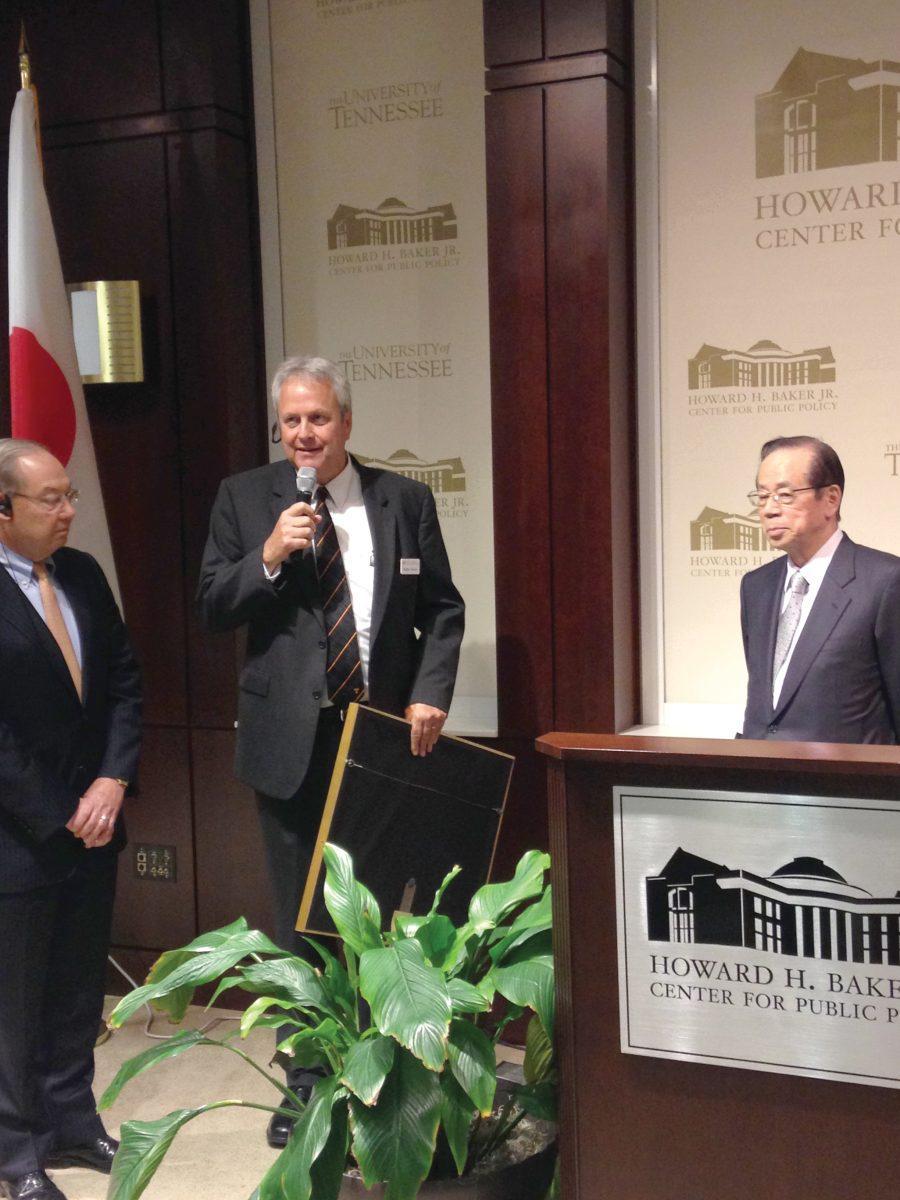
It was a Japanese holiday and most of the restaurants were closed, yet then-Prime Minister Yasuo Fukuda decided to accompany then-Japanese ambassador Howard Baker out for dinner anyway. Instead of fine dining, the ambassador opted for a humble, run-of-the-mill tonkatsu restaurant, essentially the equivalent, Fukuda recalls, of going “to Wendy’s on Thanksgiving” in America.
Mixing moments of levity and seriousness, former Japanese Prime Minister Yasuo Fukuda discussed both his memories with Tennessee native and Japanese ambassador Howard Baker, along with issues affecting Japan and its relations with the United States.
American opportunities in Japan
Noting the need for increased student exchanges between the two countries, Fukuda expressed his and the Japanese government’s desire to double the number of foreign exchange students studying between America and Japan by 2020. Acknowledging the general preference in the Japanese market for foreign English teachers rather than other foreign skilled workers, Fukuda maintained the Japanese commitment to cooperating with foreign skilled workers in order to increase mutual economic productivity.
Japanese-Chinese relations
In light of recent political tensions with China, both near the disputed Senkaku Islands and in the South China Sea, Fukuda maintained that “healthy” negotiations between the two countries still remain a necessity. Alluding to the controversial island building by the Chinese government in the South China Sea, Fukuda said that when considering China’s role in Asia, the world community must consider the positions of the Philippines, Vietnam, South Korea and other Asian countries in order to establish a better balance of power.
North Korea
Viewing current North Korean dictator Kim Jong-Un as generally “more inexperienced” than his predecessors, Fukuda still stressed the necessity for the U.S. to establish proper policies in order to deter destabilization in Asia. As he sees it, while the distance between the United States and North Korea may be immense, the effects that North Korean aggression towards Japan and Asia would have upon the United States would be far reaching.
Future of Japanese politics
In September of this year, Japanese politicians broke out in a massive brawl after the passing of a bill that would allow Japanese troops to fight abroad for the first time since WWII. In response to a question from the audience as to whether the ruling Liberal Democratic Party, led by current Prime Minister Shinzō Abe, still represented the voice of the Japanese people, Fukuda focused on the limitations still set in place on Japan by its constitution. As representatives of the people, Fukuda believes it is their responsibility to represent their will, yet he did not feel on the whole that the threat of an increased Japanese military was a serious one, given how politically restricted Japan is in conducting military operations. Shinzō Abe’s approval ratings stands at 41 percent, according to a July poll.
Future of Nuclear Energy
In 2011, Japan experienced one of the worst natural disasters in its history after an offshore earthquake caused a tsunami to strike the mainland, causing widespread destruction and the meltdown of the nuclear power plant in Fukushima. Expressing hope that one day Japan and the rest of the world at large might develop a form of energy without harmful effects upon the environment, Fukuda maintained that nuclear energy was still a necessity in Japan given its immense energy needs, at least until an alternative source could be developed.
After attending the event, Tennessee State Sen. Richard Briggs commented on the high status of having a former Prime Minister from Japan. “The University of Tennessee and the Baker Center should feel very honored to have someone of his stature coming to this lecture,” said Briggs. He further noted that while the event was informative, he couldn’t help but notice the highly guarded responses delivered by the former Prime Minister. “He has to be very careful with what he says … and I don’t mean that in a negative fashion.”
Jian Roachell, senior in supply chain management, asked Fukuda directly how Japan planned to improve their economy without destroying the environment. While he wasn’t completely satisfied with his answer, Roachell still relished the experience overall. “I didn’t really get exactly what I wanted, but he sort of indirectly answered (my question),” said Roachell. “It was such an awesome opportunity to even get exposure to a former prime minister.”