“Bill, Bill, Bill, Bill, Bill, Bill!”
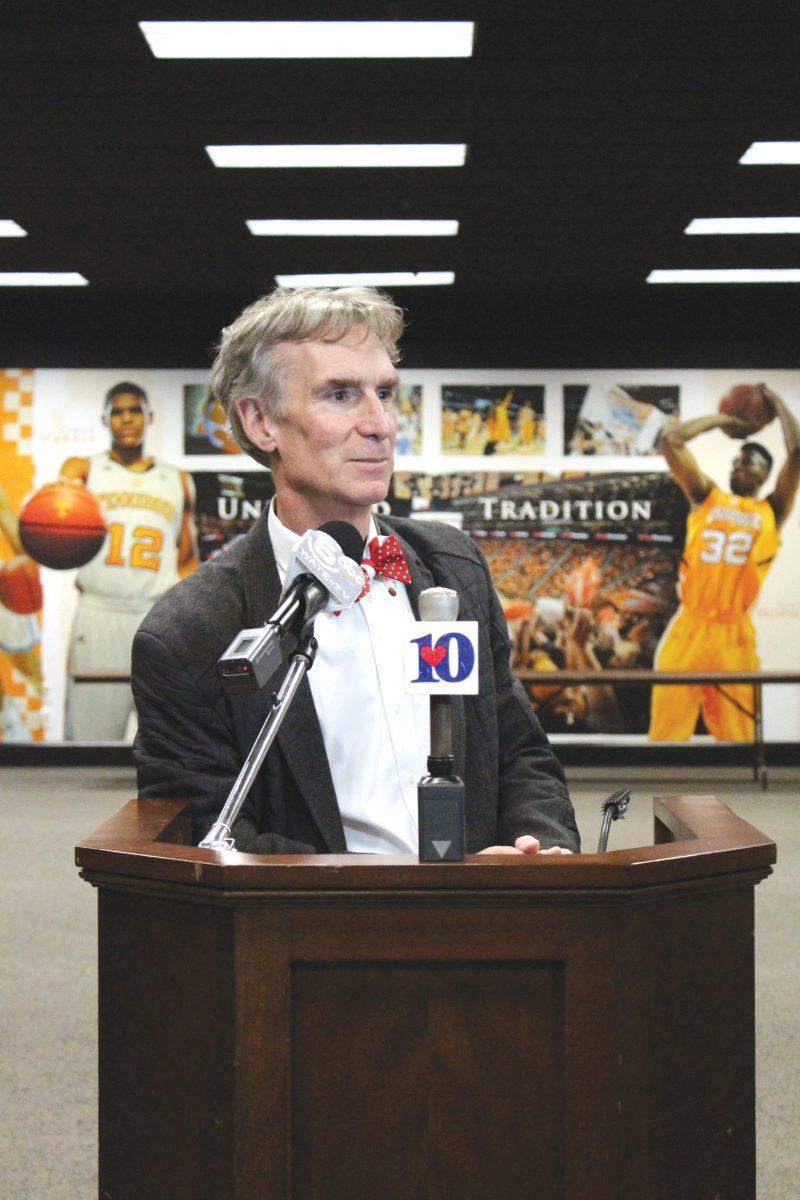
Though his beloved television show hasn’t aired since 1999, this was the greeting Bill Nye received from hundreds of attendees, eager to listen to the man who spoke to countless classrooms and living room televisions.
But as speaker for the inaugural Mossman lecture and one of the most recognizable members of the scientific community, Nye’s visit to UT involved topics of discussion more complex than building home-made terrariums — namely climate change and the importance of voting for climate-minded policies in the U.S. government.
“If we get together on this and focus on climate change,” Nye said, addressing the crowd on Thursday, “we could solve this problem in a few decades.”
In his talk, Nye highlighted the two major reasons for why discussing climate change as a community is such a vital topic for politicians and citizens alike.
For Nye, the first reason is the thinness of Earth’s atmosphere — a reason, true to his form, supported by a practical example to help put the issue into perspective.
“If you were to get in a car and drive it straight up into the air at sixty miles per hour, you’d be in outer space in an hour,” Nye said. “Not only that, but you’d be out of the breathable atmosphere in five minutes.”
The second issue, the CEO of The Planetary Society explained, is the population of earth itself.
In a 2013 study conducted by the U.S. Environmental Protection Agency, the U.S. alone emitted over five billion metric tons of CO2. With an ever-increasing seven billion people living on Earth, climate change isn’t going to be fixed, Nye argued, without a conscious effort by everyone.
Harnessing power from renewable resources like wind, solar power, hydroelectricity or geothermal energy are just a few ways Nye suggested as methods because there is enough “to power the entire continent of North America five times over.”
Although the technology exists to utilize such energy, Nye said that it isn’t enough, emphasizing the need for drastic changes in policy and how government views resources when handling issues of climate change.”
“The deniers (of climate change) have to be skated off the play,” Nye explained. “In baseball, we’d tag them out. In politics, we wouldn’t vote for them.”
Still, Nye said he is optimistic for the future generation in their abilities to think critically while in the classrooms and engaging with science from a young age until they reach full-fledged career.
“I hope (the attendees) leave the lecture feeling like they can change the world, each and every one of them,” Nye said in a press meeting before the lecture. “And that’s for the better, because we’re already changing the world.”
At the end of the speaker’s concluding remarks, Nye called fellow scientist and friend Neil deGrasse Tyson, astrophysicist and host of Cosmos, to answer a question posed by an audience member about the Bill Nye-Ken Ham debate over Creationism in Kentucky last year — “what would it take to change (their) mind?”
“It’s not about just the individual,” Tyson responded. “If we don’t all start treating the rest of the universe as our back yard, we may as well go live in a cave, ‘cause that’s where we’re headed.”
Attendant Caroline Dobbins also questioned Nye on his stance on the defunding of Planned Parenthood to which Nye responded in stern opposition, emphasizing that the government has no role in ruling choices made by women about their bodies.
“I consider myself a strong feminist and I just wanted to see, as a scientist, what his opinion was on it,” Dobbins said, as to why she asked. “You always hear politicians talk about it, but scientists know what they’re talking about.”
Another women’s issue brought up was their underrepresentation in STEM fields, which Nye said was a preventable loss of talent and promise.
Elizabeth Geist, freshman in music, considered Nye’s discussion of women’s issues in the lecture and related the issue back to the lecture’s topic.
“It’s just like climate change, if enough people talk about it, then eventually things will change,” Geist said.