Just give me a sign.
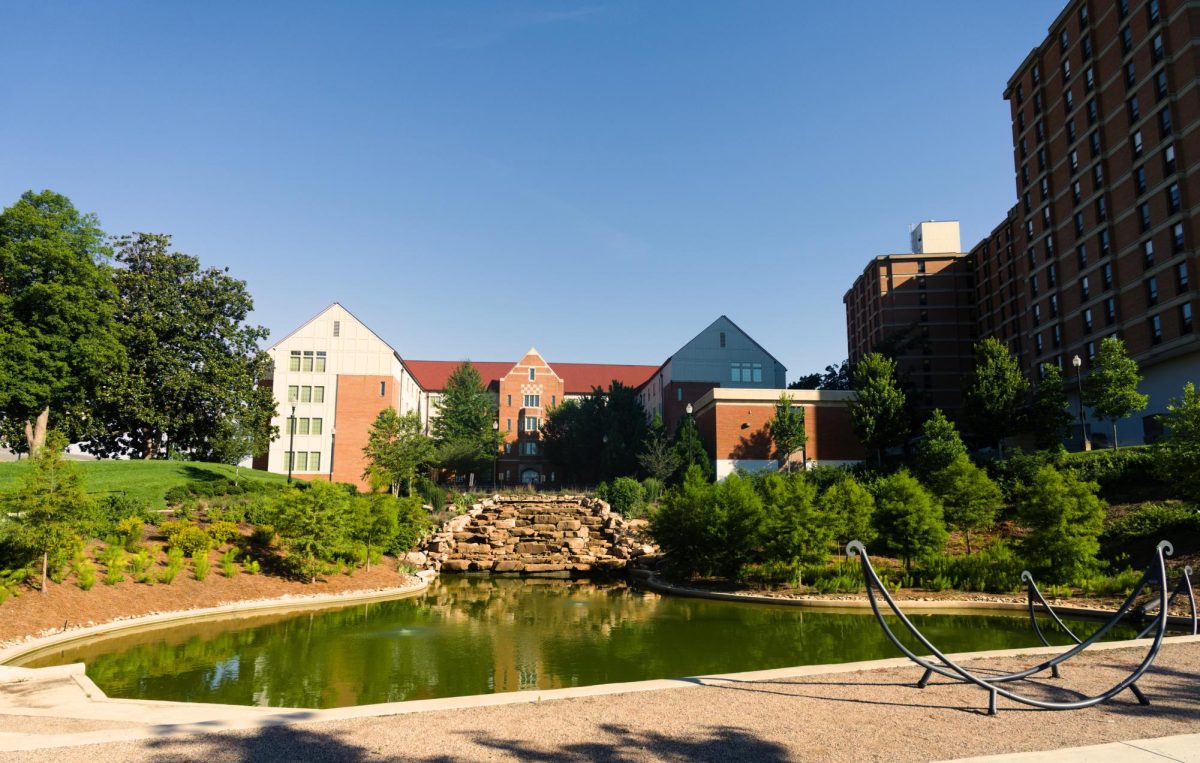
On the second floor of the Bailey Education Complex, students in UT’s educational interpreting program make the most engaging conversations effortless with an array of facial expressions and body movements.
Amid a few unusually silent hallways, Maggie McLaughlin, junior in interpreting, spends her days with her interpreting peers practicing and perfecting an alphabet known as American Sign Language.
“Before I thought it was just English translated, but it’s really not,” McLaughlin said. “It’s a whole other language just like you would be translating Spanish or French.”
The National Institute on Deafness and Other Communication Disorders describes ASL as “separate and completely distinct from the English language.” Interpreters like McLaughlin emphasize facial expressions and visual cues to converse fluidly with others.
“In English, people can raise their voice or they can lower their voice or change their pitch. The way they talk changes the meaning of what they say,” McLaughlin explained. “The expression in ASL really translates the meaning through your body and you can just reverse a sign completely by doing your eyebrows differently or your mouth. You have to use that with everything.”
Due to this heavy reliance on visuals, McLaughlin said most within the Deaf community evoke a characteristic candor in conversation.
“It’s really just a whole culture shift, so the way they describe people, what they’re thinking, anything that might be awkward, they’ll sign it,” McLaughlin said. “I think it’s just their way of having full communication. It is very normal for them to ask a very personal question or comment on how you look.”
Carol LaCava, coordinator for UT’s educational interpreting program, has an extensive knowledge of this intimate method of communication, coming from 25 years of interpreting experience and as a graduate from Maryville College — the first college to develop a bachelor’s degree program for educational interpreters in the United States.
Today, Maryville College and UT are currently the only four-year interpreting programs offered in the state of Tennessee.
LaCava said she has witnessed a greater integration of the Deaf community from residential schools like Knoxville’s Tennessee School for the Deaf into the local, public education in the last 20 years.
“Since an interpreter is in the classroom everyday and all the other hearing students are seeing this and hearing this and learning from the interpreter, there’s just a lot more awareness,” LaCava said. “We get students that grew up with a deaf student and an interpreter, so they knew early on that interpreting was a profession, [that it’s] an option.”
Like most interpreters, LaCava can work professionally in a variety of settings including hospitals, nursing homes, mental health facilities, business offices, courtrooms, schools, universities and entertainment venues, like Clarence Brown Theatre.
An interpreter’s flexibility in such environments, LaCava explained, makes for the most successful interpreting in these professional fields.
“You can find yourself in any number of situations,” LaCava said. “You can be in an emergency room with blood and guts everywhere and then you’re gonna go interpret for the governor or interpret for a class.
“It’s always challenging. It’s never boring, but you do have to be very flexible and get along with people because things change at a moment’s notice.”
Among these challenges is the delicate process of earning the Deaf community’s trust as an interpreter and mediator between the hearing and deaf realms.
For Calvin Farley, an ASL instructor and member of Knoxville’s Deaf community, establishing a fundamental trust between a Deaf person and interpreter is necessary to ensure the best results.
“When an interpreter comes in, I may think they’re strange, but I need to trust them,” Farley said. “There’s that leap of faith. You’ve got to be able to trust the interpreter, know that what they’re saying, what the hearing person is saying is properly interpreted.”
Farley, however, noted that an interpreter will never be able to fully integrate and understand the Deaf culture while still being a hearing person.
“Even a child like [my son] a CODA, a child of a deaf adult, they will understand about 90 percent, but they will not fully understand because they are hearing,” Farley said. “They will certainly understand the signing aspect of it, but a hearing person, even a CODA, they aren’t as dependent on things like sight like a hearing person is.”
For McLaughlin, the gap can be bridged with available technologies like Video Relay Services, a Skype-like program that connects Deaf individuals and interpreters, as well as long-term friendships within the Deaf community.
“I think you just kind of realize it’s happening when they start seeing you not as one of them, but as a part of their culture,” McLaughlin said. “I don’t think they would ever say ‘I appreciate you talking with me,’ but it’s a trust that’s implied.”
Special thanks to Mallory Corzine, sophomore in educational interpreting, and Victoria Baker, junior in educational interpreting, for assisting in the interview with Calvin Farley.