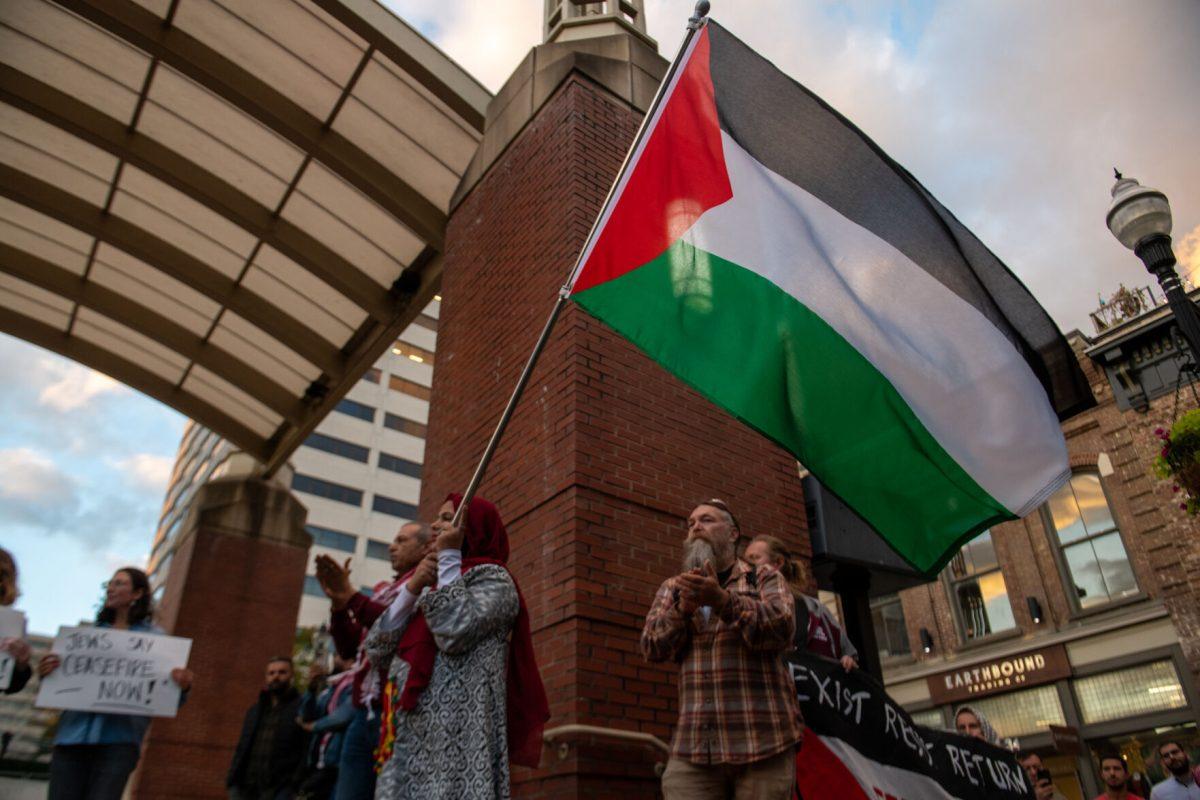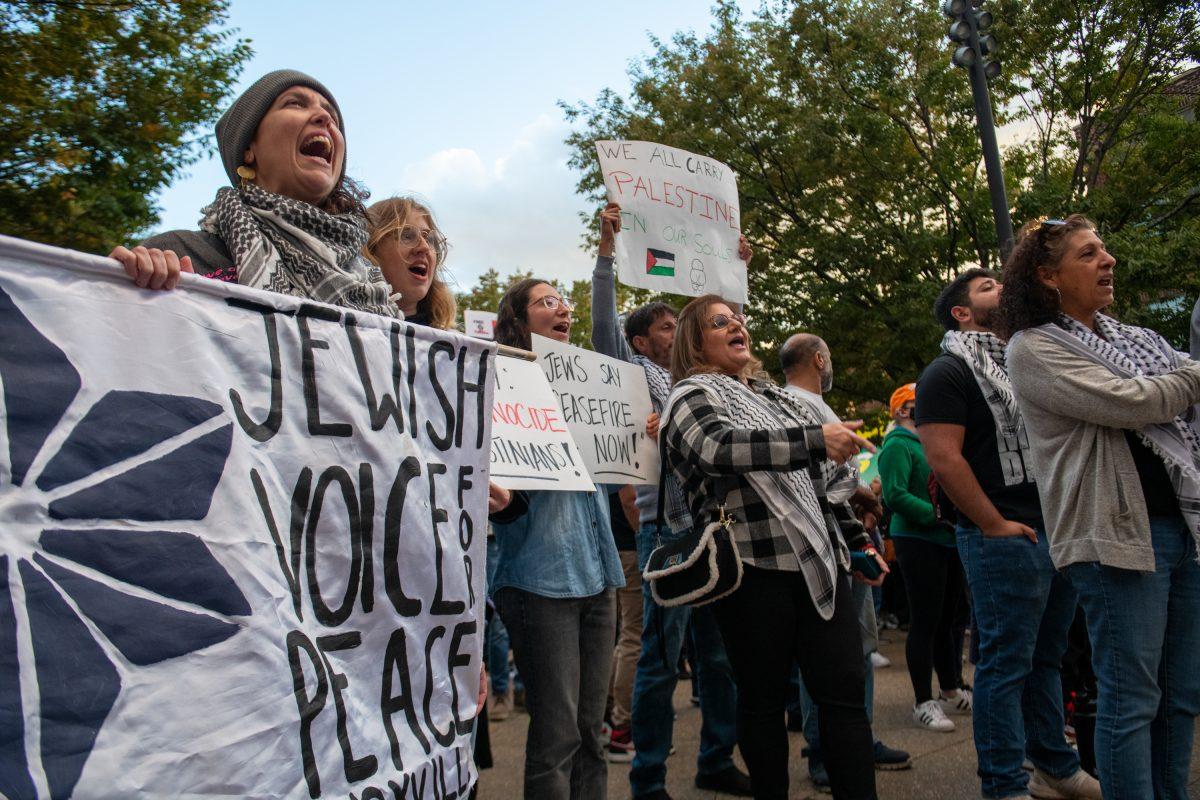
On Friday, Oct. 20, a rally for the Free Palestine Movement was held in Market Square organized by the Muslim Community of Knoxville, the Local Alliance for Mideast Peace, Knoxville Area Women in Black and Jewish Voices for Peace Knoxville. The rally, in response to the humanitarian crisis in Gaza, called for an end to the violence.
“We demand a ceasefire now,” Hasan Atatrah, one of the rally’s organizers, said. “We demand an end to the genocide. We demand an end to the blockade.”
On Oct. 7, Hamas, the group that governs the Gaza Strip and is designated as a terrorist group by the U.S. State Department, launched an attack on Israel, who in turn laid siege to Gaza, which is located on the Eastern coast of the Mediterranean Sea. Gaza, a densely populated area has been called an open-air prison as Israel has imposed a land, air and sea blockade on the Gaza Strip for years. After the Oct. 7 attack, Israel blocked Gaza’s access to water, food and electricity.
Israel’s control of the Gaza Strip and its conflict with Palestine goes far beyond the last two weeks of conflict. In 1917, the British government issued a public statement supporting a national home for Jewish people in Palestine. Waves of Jewish immigration to Palestine began in the late 19th century, with Jewish populations coming from Russia and later fleeing from countries controlled by Nazis.
Zionist forces declared Israel’s independence, which was followed by the first Arab-Israeli war in 1948, during which more than 700,000 Palestinians were forced to flee their homes. Amnesty International and Human Rights Watch have designated Israel’s control of Palestine as an “apartheid.” Israel denies that designation.
The rally in Market Square joined together people supportive of the Free Palestine Movement. Palestinian flags waved in the air as children and elders in a community inherently displaced came to grieve their people and call for peace.
Jewish community members and representatives from Jewish Voices for Peace were also present to support the Free Palestine Movement and to show solidarity.
Renée Jubran, a Palestinian elder in the Knoxville community who is now 86 years old, was only 11 when she was forced out of her home.
“I miss my Palestine, my home in Palestine,” Jubran said. “I close my eyes, and I can see my garden in Palestine.”
She recalls living in Palestine in peace with a Jewish neighbor, a Muslim neighbor and her childhood best friend: a Jewish girl with whom Jubran is still in touch.
Jubran helped to create an organization called Women in Black, a network of people worldwide who are committed to peace and opposed to war, militarism and violence. The organization was brought to Knoxville in 2002.
Maha Ayesh, the president of the Muslim Community of Knoxville’s Shura Board of Directors, spoke at the rally about the consequences of dehumanization.
“When our leaders fail to acknowledge the violence perpetrated against Palestinian civilians and instead express unqualified support for Israel, they send the message that they do not value Palestinian lives,” Ayesh said.
Atatrah, a UT junior studying psychology and minoring in political science, stressed the importance of action. He recalled the story of his own father, who fled to caves in 1967 when Israeli soldiers raided his village.
“We in this country have the privilege of voices,” Atatrah said. “We have the ability to place pressure on genocidal administrations.”
As of Monday, Oct. 23, over 5,000 people have been killed in Gaza since Oct. 7, according to reports from the Gaza Ministry of Health.
Along with the Palestinian and Muslim communities in Knoxville calling for peace, Jewish and Christian speakers joined in the cause.
Representatives from Jewish Voices for Peace, an organization that fights for the liberation of all, spoke on their support of Free Palestine’s cause and on ceasefire. Father R.J. Powell, a chaplain at the Lutheran and Episcopalian ministry Tyson House on UT’s campus, also spoke in support of Free Palestine.
“Palestinian does not mean Muslim only. There are Palestinian Christians, and there are Palestinian Jews as well,” Powell said. “We will not forget them. When we stand up for justice and demand an end to violence for Palestinians, we stand up for justice and an end of violence for all people.”
During the course of the rally, through the chants of “Free, free Palestine,” “Ceasefire now” and “From the valley to the sea, Palestine will be free,” the speakers stressed their three demands in their own words: an immediate ceasefire, an end to the blockade and an end to the genocide. The rally started and ended in prayer.
“A lot of us have been speaking for years about the daily killing of Palestinians at the hands of either settlers or Israeli occupation forces,” Atatrah said. “And for our family in the West Bank … these past two years have been the deadliest, two deadliest years for Palestinians … in the past twenty years.”
Atatrah continued to stress the importance of action at times like this, and through the rally, resources were handed out for people to stay in touch with the cause and help with support. Those looking to help can fill out a form to stay in touch with the Knoxville movement or look through the resources compiled by the U.S. Campaign for Palestinian Rights.
On Oct. 17, UT provided a reflection space for students to process the conflict in the Middle East but has otherwise provided no statement on the conflict. An interfaith meditation space in the Student Union is open to students.
“Our people need us now more than ever in our lifetime,” Atatrah said. “The goal we have here is critical, and we must realize the power of our collective voice.”
Editor’s note: This article has been updated to provide more background on Israel’s designation as an apartheid state.