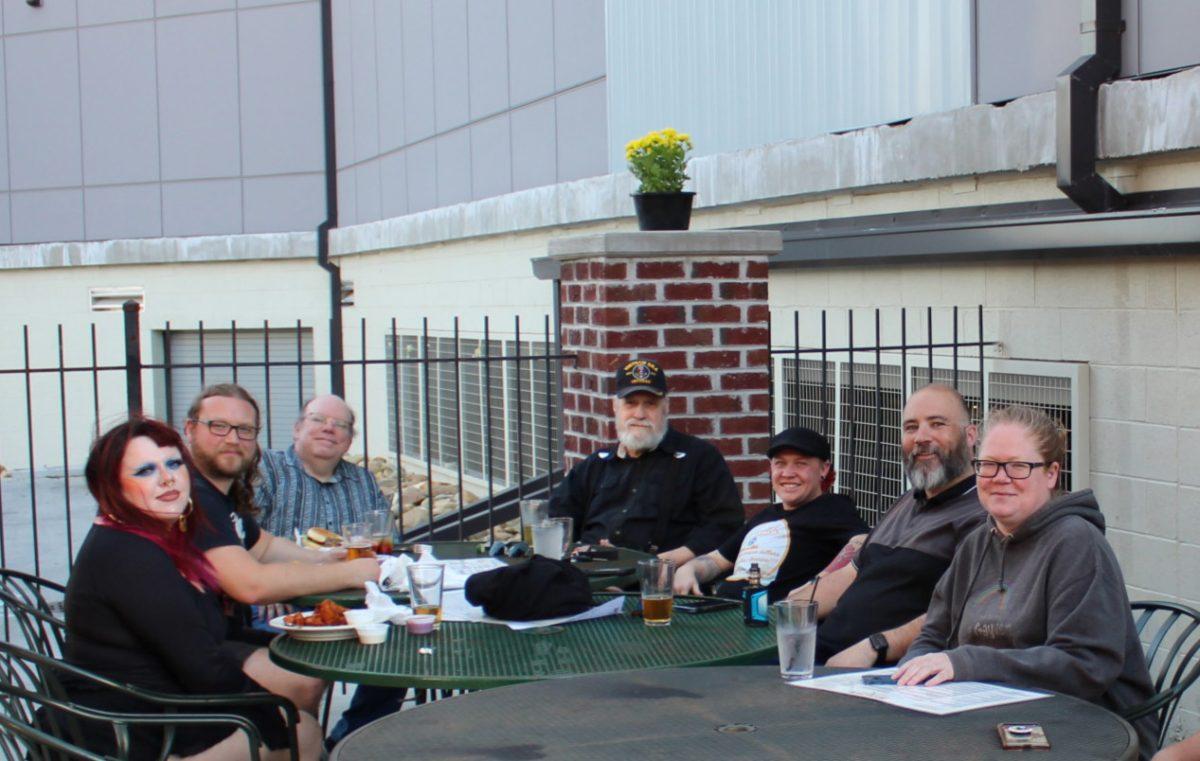
The Atheist Society of Knoxville, or ASK, lives up to its acronymic name. At the group’s weekly 5:30 p.m. meeting at Barley’s Taproom and Pizzeria on Tuesday, they ask questions of each other, of those who believe in supernatural things and, of course, of God himself.
“If God supposedly made me who I am, and gave me a brain that is capable of questioning him, why would he punish me for using it?” Alistair Elliott, a local activist and the group’s president, asked on the patio off Jackson Avenue. “And if he didn’t want me questioning him, why would he give me a brain capable of questioning?”
On this particular night, there are about a dozen members in attendance and the founder has joined them. His name is Larry Rhodes, and he is a Vietnam War era veteran with a black belt in karate. He wears all black, like he did when he used to visit campus and sit at the intersection of Pedestrian Walkway and Volunteer Boulevard with a sign reading “Ask an atheist.”
Spurred to action by the jingoistic aftermath of 9/11, where one act of violence set off others in a chain of global interreligious violence, Rhodes placed an ad in a local paper in 2002 to see who might join him at a Starbucks in West Knoxville.
At the first meeting, no one came. At the second meeting a month later, no one came. But at the third meeting, the second member of ASK showed up. This man, along with nearly 1,200 others, make up ASK’s current meeting group.
“When everyone thinks you’re a pariah because of what you don’t believe, it’s nice to have other people,” Rhodes said.
Rhodes, who graduated from UT in 1975, converted to atheism while he was in college, but he stayed in the atheist “closet” for 30 years. Nearly every member present at the table spent some time in that closet. It’s a period of time between when a person is disabused of ideas that have abused them, and when they are prepared to face another kind of abuse.
Stephanie Igo, the group’s secretary, lived in California when she first came out to her friends and family as a nonbeliever. Suddenly, members of her community cut her out of their social lives.
“Our kids had played together. We had all done group events together. And they just pulled themselves out of my life and out of my child’s life,” Igo said. “That first few years can be really rough.”
There are phases to losing belief, and the first is marked by grief at the loss of community. ASK provides a space for local atheists where they can reclaim the communal practices of religion without having to subscribe to a set of supernatural beliefs or credos.
“We break bread together every week,” Elliott said. “That’s what keeps so many people tied to religion, even if they start doubting. They’re scared of losing their community, and so this group gives them community. We support each other. If somebody’s going through a hard time, we’re going to come together to make sure they’re taken care of. That’s what churches do, if you’re part of their community.”
The second phase of losing belief involves a great deal of anger – at parental indoctrination, at conservative Christian politicians and the people who vote for them and at religious people and organizations that don’t live up to their own principles of lovingkindness. Even though its members gather to have fun and build community, ASK provides a space to vent this anger, too.
To live in Tennessee as an atheist is to be perpetually reminded of your minority religious status. Though roughly 3 in 10 Americans and 4 in 10 Americans between the ages of 18-29 identify as religiously non-affiliated, only 14% of adults in Tennessee identify as unaffiliated. Of these, only 1% identify as atheist.
In a state whose constitution still contains a provision prohibiting a person “who denies the being of God” from holding public office, members of ASK feel that Christianity in particular is a malignant force in political and public life.
As conservatives around the country increasingly see Tennessee as an ideological destination and right wing media sources like The Daily Wire have staked themselves in Nashville, the group doesn’t see the political landscape improving just because more Americans are losing their faith.
“We would not have the political trouble that we have if the most people would actually stand up and do something about what’s happening,” Sam Goeltz, a videographer and ASK member, said. “The people who have been moving here have been moving here because they see it as some Republican bastion of Christianity.”
ASK gained 501(c)(3) status in 2018, and per Tennessee law, nonprofits must have a board with at least three members. With new bylaws drafted, Elliott serves as president of the board and Dustin Stout, a regional manager of a local bank, serves as vice president.
Stout, Elliott and Goeltz wrapped up the ASK podcast “Apostates on the Fringe” in March, a show where they had discussed local issues, left-wing politics and nonbelief since 2021.
Stout grew up Southern Baptist in Indiana and lived for a time with his father and stepmother, a devout Jehovah’s Witness, in Texas. Like most members of ASK, he grew up in an evangelical Christian milieu, and came to see the rational cracks in Christian beliefs about God and the supernatural.
“I got into counter-apologetics pretty hard during my angry atheist phase,” Stout said. “I wanted to learn how to counter them. The arguments were all the same, so it’s not really hard to do that.”
Though they broadly share an identity as rationalist humanists on the political left, ASK members came to atheism from all different directions.
For some, reading the work of “New Atheist” writers like Christopher Hitchens and Richard Dawkins – men who began a movement not only to espouse nonbelief but to forcefully critique religion – was particularly meaningful.
For others, it was media like the Dogma Debate, a radio show and podcast hosted by David C. Smalley. Even meme culture on Reddit made some feel comfortable with adopting the name “atheist” for the first time.
Some members have recently moved to Tennessee and others have lived in the state or in Knoxville for decades. The anger they feel at fellow Tennesseans is compounded by anger at conservatives who move to the state looking to uphold and maintain its conservative culture.
As they have fought to make the state more open to change and less overtly religious in its politics, they have been frustrated at how outsiders have defined Tennessee.
“This has been my home for 12 years. Tennessee in general has been for 27 years,” Elliott said. “F*** these people from the West Coast moving out here and being like ‘not in our holler.’ Motherf***er, this is our holler! I was here first, you know? Why do you get to stake claim on my home?”
ASK has been meeting regularly for over two decades, and they’ve switched around their meeting locations. Barley’s has been the spot since 2019, though the COVID-19 pandemic interrupted in-person meetings for two years.
Before COVID, the nonprofit organization hosted a range of events, such as a Bible trivia fundraiser at the Fort Sanders Yacht Club. They have also led philanthropic efforts that benefitted the Second Harvest Food Bank of East Tennessee and the First Aid Collective Knox.
Before the pandemic, Larry Rhodes would often come to campus and talk to UT students about belief and nonbelief. In 2015, he published a book titled “Atheism: What’s it all about?” a collection of his blog posts on the subject. Well versed in counter-apologetics, he often took students to task on their own supernatural beliefs.
He claimed the UT campus is also implicated in anti-atheist sentiment.
“When I came on campus, they told me I had to sit on the main drag, but don’t go over by the dorms or any of that stuff. But I’d be sitting there on the main drag looking down at the dorms and there’d be religious groups down there, with their tables set up, with their tents, talking to people, giving out books, and all this other stuff,” Rhodes said.
Some students would tell Rhodes to go to hell, and others would sit and have a thoughtful discussion with him.
Now, over two decades since he founded ASK, he’s seen it multiply and survive a pandemic. It’s a group open to anyone and seeking new members. It’s also a community that is vitally important to the people who call it home.
“This group is the only family I have in Tennessee,” Stout said. “This group is my only family. And I come here every Tuesday to visit my family.”