Taking a stand for your identity can be something deeply moving and difficult to accomplish. Our world shouts a message of conformity and analogousness. Suddenly everyone is wearing the same trends and saying the same phrases.
History has seen a number of individuals who took their identity and made a stand with it.
Looking at others’ steps and following in their footsteps can give us support and strength to not be afraid to be ourselves.
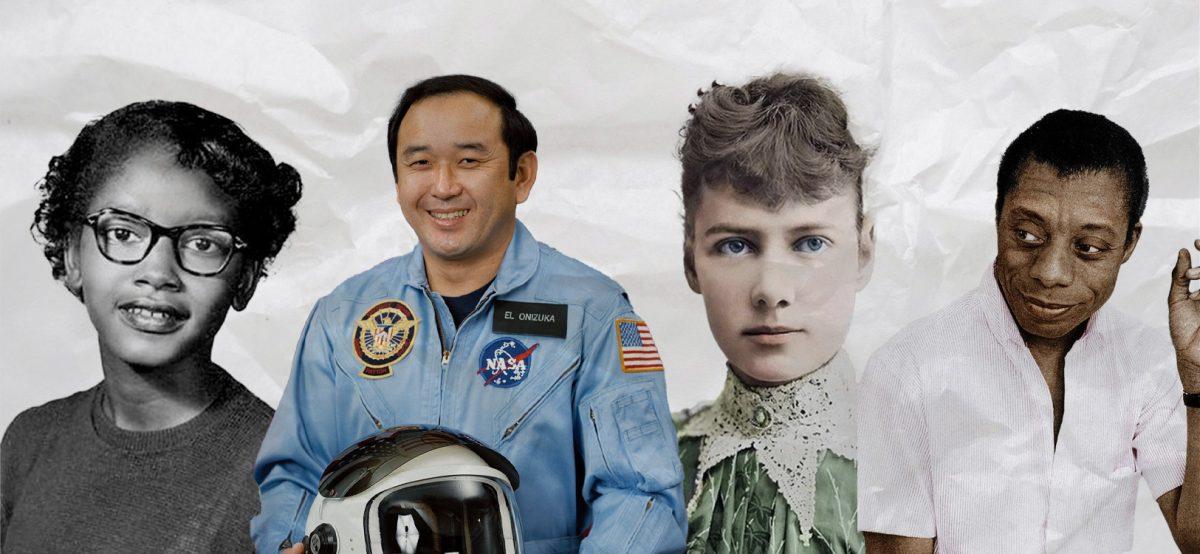
While some names are immediately recognizable — like Martin Luther King Jr. — others are less known yet equally impactful. Here is a look at a few trailblazers for identities.
The first Rosa Parks
Rosa Parks’ name is commonly recognized. She was the woman who famously took a stand (or a seat, rather) on a bus in Montgomery, Alabama, where there were “white” and “colored” sections on buses. When the “white” section had filled and a woman complained there were no seats left, the bus driver ordered Parks to leave her seat. Parks refused and was arrested. The NAACP championed her in the following boycott of many buses.
However, Parks was not the first colored person to lay claim to their seat on a bus. Claudette Colvin was. At just 15 years old, and nine months before Parks, Colvin refused to give up her seat.
“History had me glued to the seat,” Colvin said in an interview with Democracy Now!
Fueled by her recent learning about the African American people and the Constitution in school, Colvin remained seated and was arrested. Her case eventually landed in the Supreme Court. Parks and Colvin met through the NAACP Youth Council and 42-year-old Parks was inspired to the same bravery.
“It felt like Sojourner Truth’s hands were pushing me down on one shoulder and Harriet Tubman’s hands were pushing me down on another shoulder, and I could not move,” Colvin said.
Mental health meets pseudonym meets feminism
You may have heard of Nellie Bly. You probably haven’t heard of Elizabeth Cochran.
They were one and the same: born Elizabeth Cochran, “Nellie Bly” was a female journalist for Joseph Pulitzer’s New York World in the late 1800s. She had been previously turned down by several papers for being a woman, or assigned to society columns and consequently quit.
Bly was able to gain admission to Blackwell’s Island insane asylum for women on pretense that she was insane. Bly spent 10 days at the asylum. Once let out, she wrote one of the first reports on women’s mental health and how it is treated.
Blackwell’s Island was a horrible place for a woman to call home. The food was almost inedible, and the cold was often unbearable. There was no real test for insanity back then — it was often someone else’s word against yours. The nurses were unkind and knowingly cruel to the patients. In the event of a fire, no one would bother to let the patients out of their locked rooms, leaving them to a gruesome fate.
Bly’s article produced from this experience gave her a permanent position with the World newspaper, and she wrote a book on her time at the asylum as well, entitled “10 Days in A Mad House.”
Blazing trails in space
Space saw its first Asian American in Ellison Onizuka.
As a NASA astronaut, engineer and test pilot for the Air Force, Onizuka contributed to multiple NASA missions and worked as a manager for engineering support at an air force base in California, registering over 1,700 flight hours there.
On January 24, 1985, Onizuka was launched along with the space shuttle Discovery and spent 74 hours in space. Onizuka was also the first person of Japanese origin to be in space.
Tragically, Onizuka’s next mission on the Challenger resulted in death for all seven crew members when the liquid hydrogen fuel tank ruptured 73 seconds after launch.
Onizuka was promoted to colonel after his death and received the Congressional Space Medal of Honor. A moon crater and asteroid were just two of many named objects in his honor.
NEA gives the Ellison S. Onizuka Memorial Award to “a nominee whose activities in Asian and Pacific Islander affairs significantly impact education and the achievement of equal opportunity for Asians and Pacific Islanders.”
The true brooding poet
James Baldwin was not afraid of hard questions.
The 1900s were filled with some of the most difficult movements the world has ever seen, centered around race, sexual identity and justice. Throughout this scene, Baldwin wrestled with his identity through essays, novels, plays and poems.
As the gay liberation movement swept through America, Baldwin was writing and composing works that pushed ideas already blooming in others. Baldwin — who was himself gay and African American — searched for his identity while encountering masculinity and homosexuality. He also explored themes like antisemitism and Black America.
At 24, Baldwin realized he was headed for the often-traveled road of despair other African-American men like himself experienced.
“To be a Negro in this country and to be relatively conscious is to be in a state of rage almost all of the time,” Baldwin said in an interview in 1961.
Baldwin moved to Paris, France, attempting to escape the hopelessness of American life at that time. It was there that his work “Go Tell it on the Mountain” was published in 1953; it was ranked as one of the top 100 English language novels by Time magazine. His collection of essays “Notes of a Native Son” was published soon after.
Baldwin eventually returned to New York and continued to produce works in which homosexual themes were prominent. He advocated for social justice and became a professor and public figure, while continuing to publish numerous writings. His death in 1987 fell just hours before his novel “Harlem Quartet” won the French-American Friendship Prize.