Since the ratification of the Bill of Rights in 1791, newspapers, magazines and other publications have exercised their right to the freedom of the press granted in the First Amendment. This civil liberty protects the press from laws that would restrict free communication and expression in the media.
The freedom of the press has limitations, however, to protect citizens from harm. One such limitation — or form of speech in the press that is not protected — is libel, the written form of defamation. Libel occurs when an individual or a publication publishes a false statement that harms a person’s otherwise good reputation.
For a statement to be considered libelous, it must meet five conditions:
- It must be false.
- It must harm the person’s reputation.
- It must be published — anything written by a person and read by two or more people is considered published.
- It must identify a person — if the description of the person is specific enough that one could narrow it down to 25 people, then it is considered identification.
- The writer must be at fault — meaning they were either negligent or reckless.
Over 200 years, the freedom of the press has been threatened by a number of libel lawsuits. Several of these cases became landmarks in press history, and their rulings have contributed to the state of press freedom today.
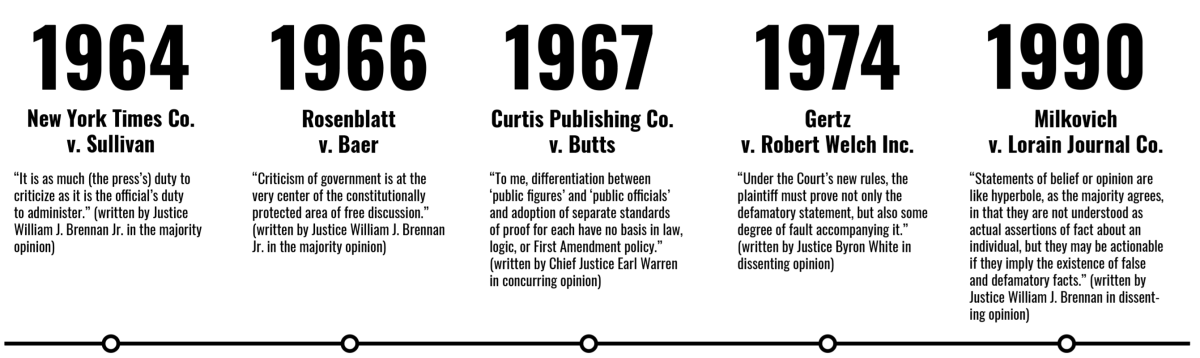
New York Times Co. v. Sullivan (1964)
Considered one of the most significant libel cases in history, this landmark Supreme Court decision established the actual malice doctrine. In 1960, The New York Times published an advertisement that called attention to the oppressive treatment of students of color by Alabama police.
The Montgomery public safety commissioner, L.B. Sullivan, filed a libel suit against The Times claiming that the ad wrongfully criticized him as the head of the police force and contained factual inaccuracies. In accordance with Alabama’s libel law at the time, the lower courts favored Sullivan.
When the Supreme Court brought the case up, however, a unanimous decision was made in favor of The Times, and the “actual malice doctrine” was established. The actual malice doctrine held that public officials, like Sullivan, must prove that a writer acted with “actual malice” by publishing a known falsity or by recklessly disregarding the truth.
The Supreme Court recognized that minor inaccuracies are inevitable in a fast-moving field like journalism and that without proof of “actual malice,” public officials do not have standing in suits of this nature.
The significance of this decision lies in that it established a new protection allowing the press to continue holding public officials accountable through criticism. It was ruled that the previous Alabama law compelled people to not publish criticism for fear of being sued. To rectify this, the court wrote that “it is as much (the press’s) duty to criticize as it is the official’s duty to administer.”
Rosenblatt v. Baer (1966)
Just two years later, a libel suit between Frank Baer, a public official in New Hampshire, and Alfred Rosenblatt, a columnist for a local newspaper, was brought before the Supreme Court. Baer argued that Rosenblatt’s editorial statements criticizing the performance of the governmental group Baer oversaw directly defamed his personal performance.
Citing New York Times Co. v. Sullivan, the Supreme Court ruled that Baer, though he held a lower position in the governmental hierarchy, was, in fact, a public official and, therefore, needed to prove actual malice.
In the majority opinion of the court, Justice William J. Brennan Jr. held that “criticism of government is at the very center of the constitutionally protected area of free discussion. Criticism of those responsible for government operations must be free, lest criticism of government itself be penalized.”
This ruling further sustained the First Amendment’s protection of the freedom of the press, allowing citizens to act as watchdogs toward the government and uphold ideals of democracy.
Curtis Publishing Co. v. Butts (1967) & Associated Press v. Walker (1967)
In these cases, the actual malice standard was set to apply to public figures, not just public officials. In Curtis Publishing Co. v. Butts, two SEC head football coaches brought a libel suit against the Saturday Evening Post for alleging that the two had rigged the outcomes of games based on information received from a questionable source.
The Supreme Court decided that the actual malice doctrine applies to any public figure — official or not — and ruled in favor of Wally Butts, one of the coaches and a public figure because the magazine made its allegations with reckless disregard for the truth.
In Associated Press v. Walker, the Supreme Court honored its decision from Curtis Publishing Co. v. Butts — this time in favor of the publication. Since the AP acted in “good faith” in quickly reporting on a newsworthy riot and Edwin Walker was considered a public figure, the Supreme Court decided that there was no actual malice and favored the AP.
While the former case favored the figure and the latter favored the press, both were instrumental in establishing the actual malice standard for public figures and protecting the freedom of the press.
Gertz v. Robert Welch Inc. (1974)
In this case, lawyer Elmer Gertz sued writer Robert Welch for libelous statements accusing him of being a “Communist-fronter.” When the Supreme Court brought the case up, it ruled in favor of Gertz because he was neither a public official nor a public figure and, therefore, needed only prove negligence, not actual malice. However, the court also decided that the burden of proof of falsity and fault, which for a private figure is negligence, lies on the plaintiff.
This decision meant that a private person suing the press for libel must be able to prove both that the allegedly libelous statements were false and that the writer acted negligently. Consequently, the press is protected from libel claims against content published in good faith — or honest intent.
Milkovich v. Lorain Journal Co. (1990)
When an opinions column was published alleging that a local wrestling coach lied at a recent hearing, the Supreme Court made a landmark decision regarding opinions in the press. The court decided that articles of opinion are held to the same standard as other articles with respect to provable claims. Statements capable of being proven true or false are to be held accountable just as they would be in a non-opinions article.
This did not necessarily add a protection for the press, but it set in place the standard for publications to follow when publishing opinions. It also upheld the fair comment doctrine which allows the press to publish opinions provided that they are based on facts.