Clothing is a human right, as declared in the Universal Declaration of Human Rights. The right works alongside safety, dignity and the freedom of expression. In local communities, access to free or affordable clothing is often difficult to find or not provided, but spaces around Knoxville and UT’s campus work to fill the need.
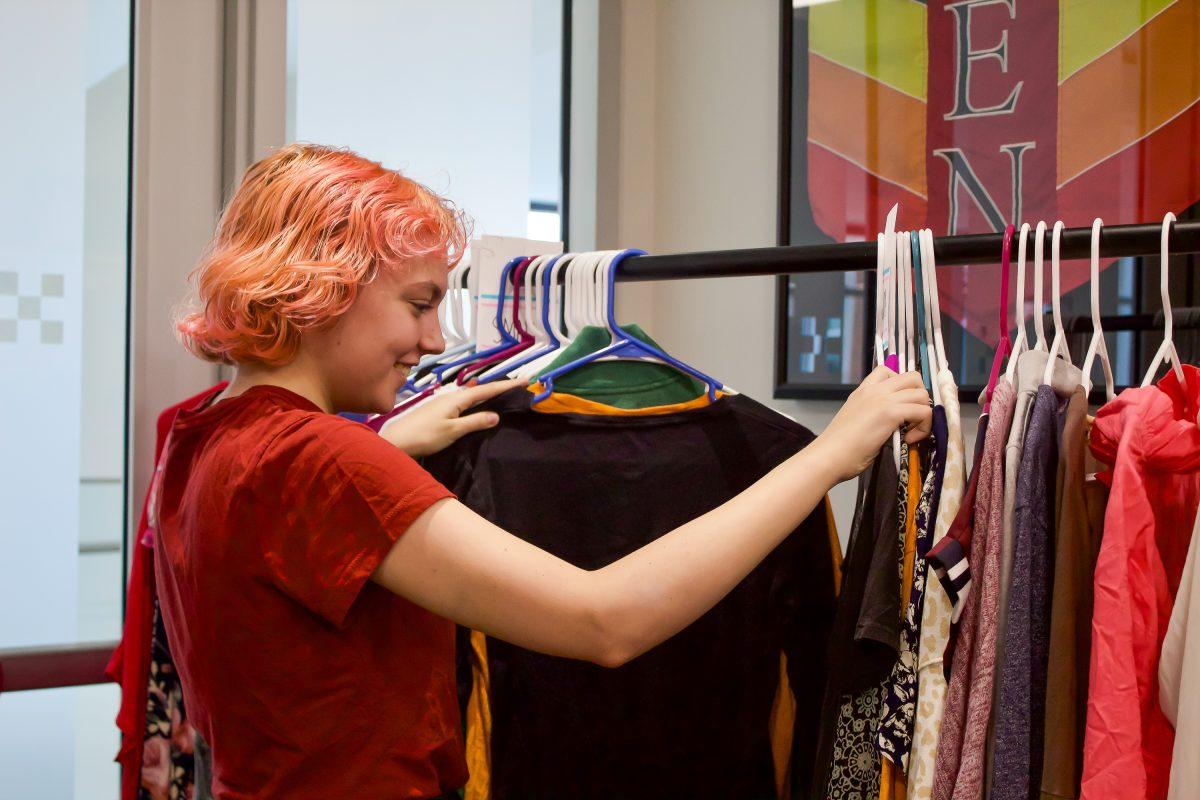
The Free Store, an initiative under UT’s Office of Sustainability, is open every weekday and provides clothing for free to UT students. The initiative, which started in 2017, opened a physical store in 2022 to provide more accessible and constant help. Maggie Atchley, the social impact coordinator for UT’s Office of Sustainability, works with projects that divert waste and serve the student community, of which the Free Store is a major part.
“Having clothing enhances your ability to succeed in classes, to access all of the other opportunities that being at a university provides you,” Atchley said. “But lacking that basic need makes that, like, that much more difficult.”
Smokey’s Closet, another university initiative through the Center for Basic Needs, provides business casual and professional clothing to students. Open throughout the week in the Student Union, students are welcome to shop for what they need.
Smokey’s Closet fills a niche of professional clothing, which although often necessary for students and workers, can be expensive. This type of clothing is often required for students. Career fairs, interviews and networking events provide opportunities for students, but without the proper clothing to fit the dress codes, they can be inaccessible.
Donations to the Free Store and Smokey’s Closet come from all over the community, including faculty and staff, but a lot of the donations come from students, which creates a circular economy of clothing.
“That’s one area where I think that it’s important to have this as a community space on campus because it really incentivizes secondhand shopping, builds a community space where secondhand shopping is normalized and celebrated,” Atchley said. “Which also, in a sense, helps to destigmatize poverty.”
At UT, there are diverse levels of socioeconomic status. The Free Store brings in people of all backgrounds and allows them access to clothing without looking down on the need.
Nathaniel Pfeiffer, a junior studying sustainability and a student assistant at the Free Store, noted that other jobs he has held were feeding into unsustainable practices.
“I wasn’t really serving my community in a way that I wanted to,” Pfeiffer said. “And so by being here I feel like I’ve filled a much more productive niche for social good instead of just for profit.”
These spaces on campus fill the need for students. Outside of university settings, free clothing can also be accessed at ministries and organizations.
Knoxville Dream Center offers professional clothing free of charge through their Fresh Start Clothing Store. Community members need to provide proof of an interview or job they have secured before accessing the clothing. Angelic Ministries International allows people to shop every 30 days for free clothing and hygiene products, and First Aid Collective Knox will hold pop-ups with free clothing.
Many other religious-affiliated organizations provide clothing, but Atchley pointed out that religious institutions can sometimes be exclusionary or triggering to certain populations.
Around Knoxville, there are spaces that provide free or cheap gender-affirming clothing to community members. UT’s Pride Center holds a pop-up called the “Qloset” several times a semester, where students can shop for gender-affirming clothing for free. Binders are also often provided for students.
Knox Pride’s Thriftique provides gender-affirming clothing for under $8 with the stipulation that it is free to anyone in need.
Clothing is the way a person presents themself to the world. It can be either dignifying or dehumanizing. Self-expression, including gender expression, is shown by what people wear. Gender-affirming clothing can be found in secondhand shops, and Pfeiffer noted that the Free Store doesn’t categorize clothing by gender.