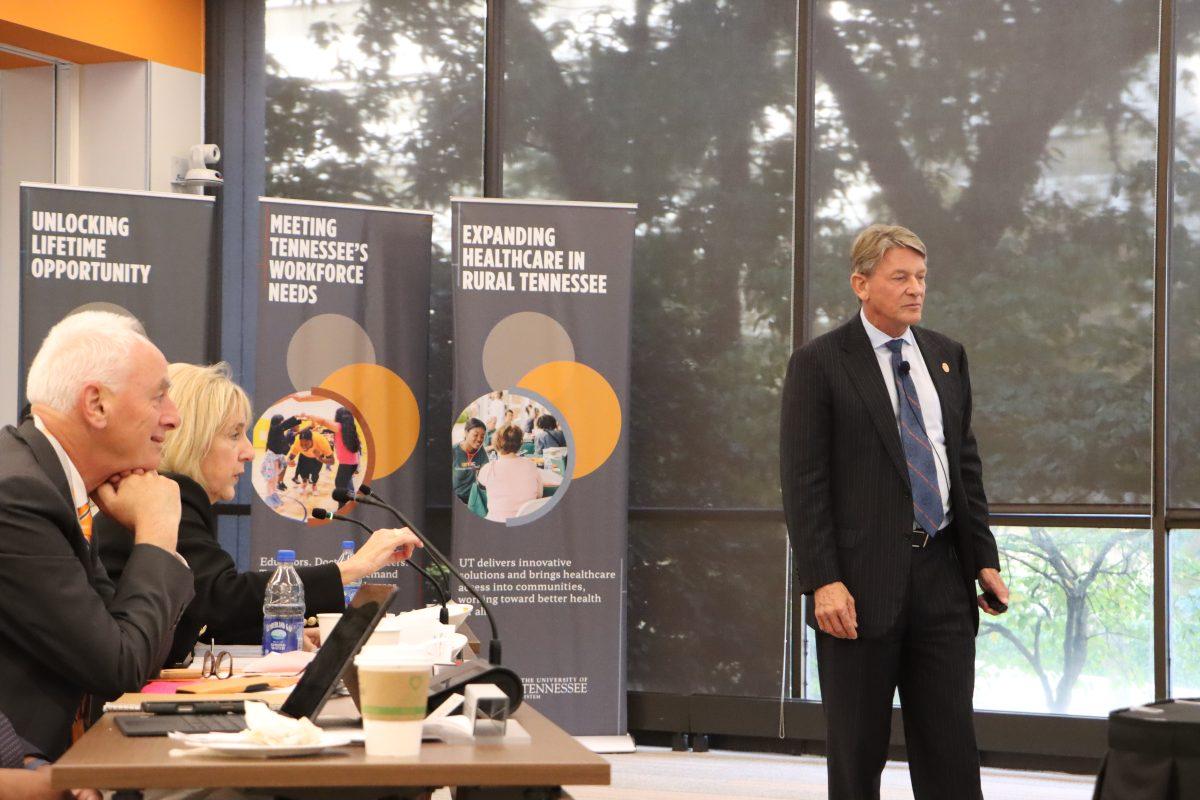
The week’s Board of Trustees session culminated in a final meeting Friday morning, directed by UT System President Randy Boyd.
“This will be the greatest decade in the University of Tennessee,” Boyd said. “It’s a commitment, and we’re well on our way.”
AAUP treasurer addresses board with faculty concerns
After a brief moment of prayer, Paul Gellert, UTK professor of sociology and treasurer of UT’s chapter of the American Association of University Professors, kicked off the meeting by addressing the board on behalf of the AAUP asking for a united front to protect academic freedom.
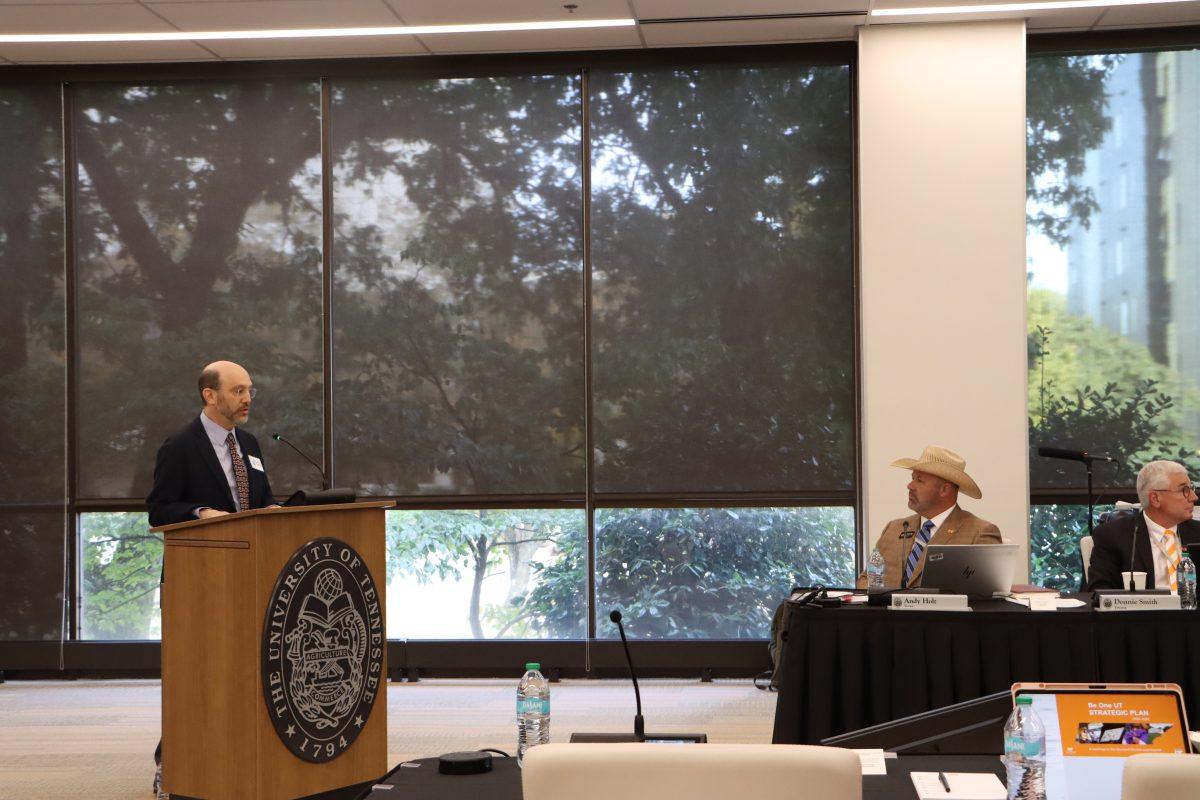
Paul Gellert addressing the Board of Trustees on behalf of the AAUP on Friday, Oct. 24.
“The provost stated at a recent forum that the line between acceptable and unacceptable speech is moving, but to where, he could not specify,” Gellert said. “Such statements add to the uncertainty, and the uncertainty is causing fear. … Many are unwilling to speak publicly about higher education at UT, and yet they persevere everyday in all corners of the university.”
Gellert diagnosed the climate of uncertainty and fear on campus as “not healthy.”
“Although the university greatly values civility and mutual respect, concerns about civility and mutual respect must not be used by the university as a justification for closing off the discussion of ideas — however offensive, unwise, immoral, indecent, disagreeable, conservative, liberal, traditional, radical or wrong-headed those ideas may be to some students or faculty,” Gellert said, citing UT Board of Trustees policy.
Gellert asked the board to reaffirm their commitment to freedom of expression at UT, and he warned against UT joining the Trump Compact.
“This compact is a misguided attempt at thought policing and threatens America’s world leadership and new leadership in science, technology, innovation and healthcare,” Gellert said. “We stand for education, for science, for our students and for freedom.”
UT System President Randy Boyd responded to Gellert’s address.
“We are committed to following all university policies, all state and federal laws and to the protection guaranteed by the first amendment,” Boyd said. “Our campuses remain places where ideas can be shared and debated.”
UT’s strategic plan
Boyd discussed the creation of UT’s strategic plan, which involved the hiring of Deloitte consultants. The strategic plan’s creation involved hundreds of stakeholder interviews.
Boyd took time to highlight the new advertisement initiative, “Everywhere you look, UT,” reporting that it was ahead of schedule and a cost-effective marketing strategy.
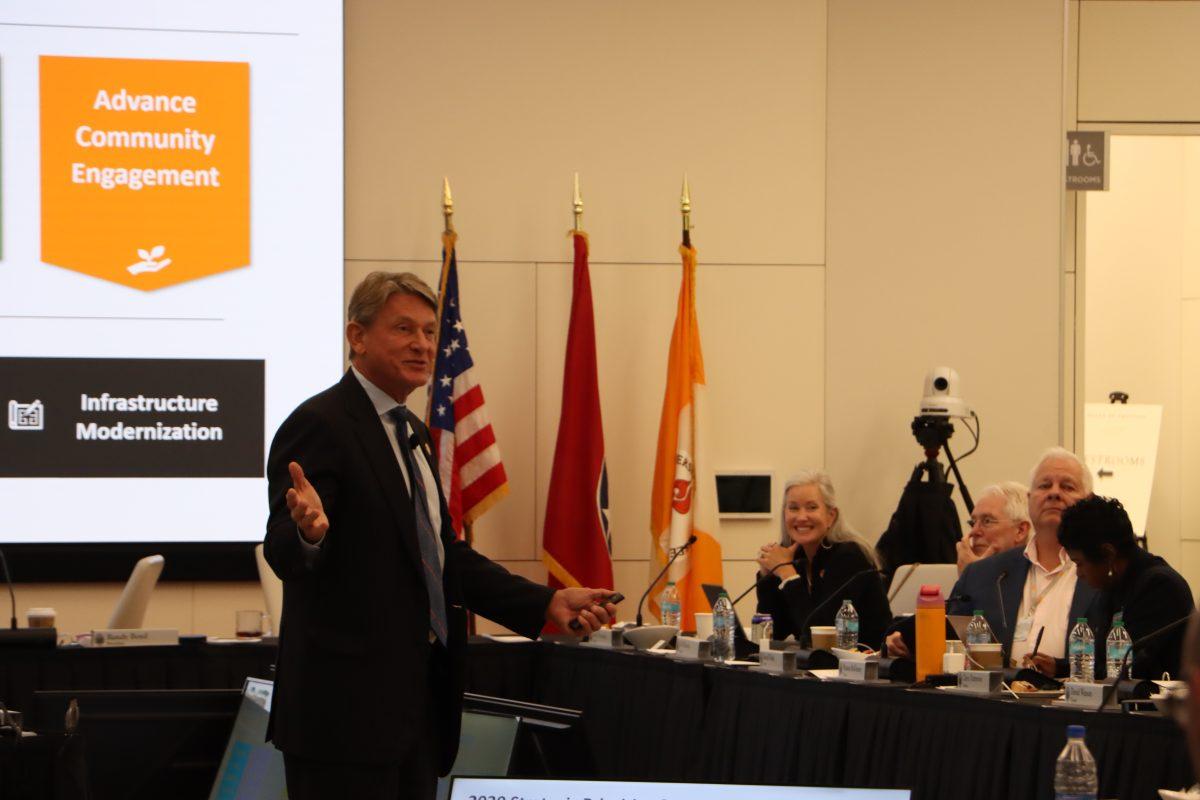
President Randy Boyd addressing the Board of Trustees on Friday, Oct. 24.
Student debt and transfer processes
While discussing numbers, the board emphasized the importance of limiting student debt. Currently, the average graduating debt for in-state students is $23,738 and $42,939 for out-of-state students.
“That’s a really important one, of all the (key performance indicators) on the page, it was the most important. We continue to make it more affordable for more students,” Boyd said.
The board talked about encouraging greater cooperation between the different UT campuses on student transfers.
“We would be better improving articulation agreements between our campuses,” Boyd said. “Sometimes I’m told it’s easier to transfer from Pellissippi State to Knoxville than to transfer from Chattanooga to Knoxville.”
Increasing research and alumni involvement
Boyd reviewed 2025 baseline and 2030 target KPIs for the university’s devotion to driving research and innovation, stressing missions to increase total research expenditures from the baseline $524.1 million to $730 million.
UTK Chancellor Donde Plowman responded that undergraduate research leads to higher retention rates and benefits student engagement. Aligning research with state needs, she said, is a natural part of the process.
“On our campus, we think of it as one of three critical mechanisms for increasing engagement of students,” Plowman said.
On the topic of alumni engagement, trustee Donnie Smith brought up the low amount of UT alumni who donate to the university. Of the over 480,000 alumni system-wide, only about 50,000 donate to the university. Plowman nodded her head at this comment.
“People invest in people,” Smith said.
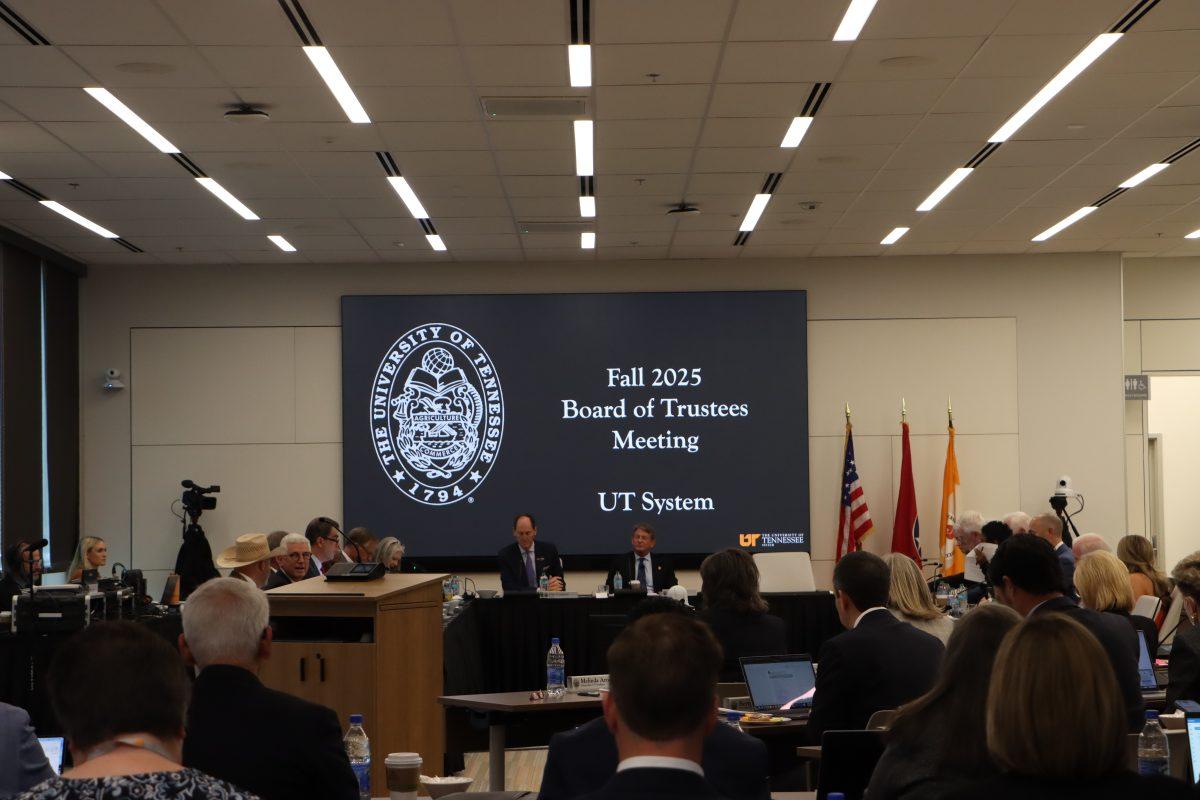
The Board of Trustees meeting on Friday, Oct. 24.
Online efficiency projects
The board is planning to update the student information database, building a new cloud-based student information system for administrative reference.
“This helps us improve student success, helps us build a report better, helps us strategize better,” Boyd said.
Though the board is currently struggling to implement the Oracle Cloud ERP (enterprise resource planning) system, board members agreed that having a new student information system is worth taking on another software project.
“I know the board will make better strategic decisions as a result of it,” Jamie Woodson, chair of the Education, Research and Service Committee, said. “And I think it will be helpful to all of the campuses.”
Conclusion and the path forward
Wrapping up the meeting, trustee Bill Rhodes asked board members to look forward to how board decisions will pay off in the future.
“During our tenures in this role, as trustees, there will be three, four, five big decisions that we get right,” Rhodes said. “I wonder what those three, four, five in here are that are going to be the ones we look back a decade from now and say, ‘Wow, we did that, and we made a difference for our state.’”
Student trustee Ashlee Mallon, a UT Martin finance major, also thanked the board from a student perspective for the work they were doing.
“I’m very encouraged by the work that everybody in the UT system does, especially getting to see that firsthand, and your work is working, especially in my life,” Mallon said.
The Board of Trustees will hold their winter meeting at the UT Health Science Center, Feb. 26-27, 2026.