Clouds of incense fill the air with the hopes and wishes of New Year’s celebrants. Colorfully dressed crowds bustle around the imposing Kaminarimon, or “Thunder Gate,” the entrance to a Buddhist temple in Tokyo, excited for the possibilities of a new year.
Ethan Garnier sees the shot he wants — an older man briefly turning to face his lens — and captures a winning image.
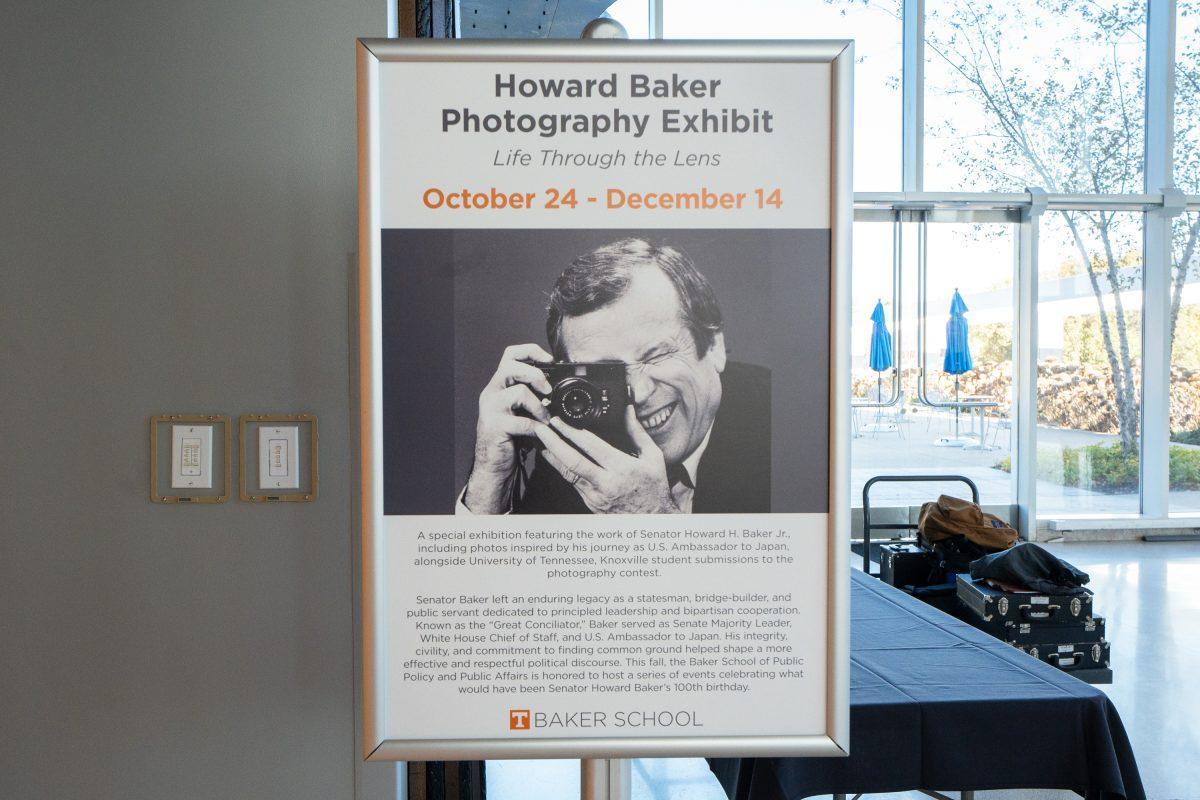
Garnier’s and other students’ photography currently features alongside some of Baker’s photographs of Japan at the Knoxville Museum of Art, where they are being displayed together until Dec. 14 as part of the Howard Baker Photography Exhibit. The Howard H. Baker Jr. School of Public Policy and Public Affairs hosted the contest and exhibition as part of its celebration of what would be Baker’s 100th birthday.
Eleven students in total won the Howard H. Baker Jr. School of Public Policy and Public Affairs’ Howard Baker “Life Through the Lens” Student Photography Contest. Those students are:
- Gwen Aguilar, a senior studio art major
- Blaine Atkins, a junior management major
- Evely Baker, a senior art major
- Jed Baso, a sophomore finance major
- Lilian Renee Call, a senior studio art major
- Ethan Garnier, a junior biological sciences major
- Miles Alan Lineberger, a sophomore business management major
- Jen Martinex Mendez, a senior geography major
- Robert Campbell Row, a senior cinema studies major
- Ava Sabatini, a junior ecology and evolutionary biology major
- Venetia Zhu, a graduate student studying fine arts
Faculty judges from the University of Tennessee School of Art selected the winning images, and each student photographer was awarded $200.
Garnier said he was ecstatic to learn he was selected in the contest.
“Seeing like, holy crap, one of my pictures got selected, it was a really cool feeling,” Garnier said.
Garnier said part of what drew him to take his winning picture was his love of people. He remembered the massive crowd of people that January day, their lively mood and their interesting outfits. He was eager to get a picture of the spectacle when an older man wandered into the center of his frame.
Garnier said he wasn’t sure why he submitted that photo specifically, but he had no clue that the Baker exhibition would highlight a collection from the senator’s U.S. ambassadorship to Japan.
Garnier expressed gratitude for being able to attend the exhibition’s opening night.
“I’m just really grateful for the opportunity to have been there,” Garnier said. “Going to the opening night reception, I actually knew a lot of photographers who were there and I got to meet people.”
Garnier said he felt humbled for the opportunity to connect with other photographers and see his work on the wall next to Baker’s and the other student winners.
“I have a lot of work to go, a lot of work to do, a long way to go,” Garnier said.
Miles Lineberger, another contest winner, submitted a photo from his time interning for a sports media organization over the summer. While Lineberger said he enjoys the constant movement of soccer photography and being able to anticipate the action, he was drawn to submit a photograph he took pregame at a Charlotte FC match.
“I was up in the concourse on the upper deck of Bank of America stadium, and I looked over and these guys were sitting there, they were the only two people in the section and they were enjoying their food and their drinks before the game … and I just really thought it showed a lot of community for the game,” Lineberger said.
Lineberger said he appreciated the chance to showcase his work at the exhibit and hopes that he can leverage the exhibit into future opportunities.
“One of my goals was to work with Charlotte FC next summer on their media team,” Lineberger said. “I think that having something like this to talk about in an interview, show that I’ve shot Charlotte FC before, and this is what I did and this is how I was recognized, I think that’s a super important talking point for something like that.”
Lineberger, like Garnier, said he was grateful for the chance to see his work in a museum, especially early in his career.
“That’s a pretty rare experience for anyone,” Lineberger said.
Lili Call, a third contest winner, emphasized how her photo being selected was an especially validating experience for her because of being showcased next to a renowned UT alum.
Her photo depicts her partner’s bare shoulder as he’s lying in bed, cast in early morning glow.
“I’m just trying to capture that idea of when you first wake up, and you’re next to somebody, and the intimacy of that moment without having to be anything else,” Call said.
Many of Baker’s pictures displayed in the exhibition focus on people. Call said there are two ways to take pictures of a foreign culture.
“You can do it to where you’re on the outside looking in,” Call said. “or you can submerge yourself in the culture and the people and you can take pictures of them in a more intimate or respectful way, and I feel like that’s what Howard Baker does.”
Call said she takes pictures of people in a similar way to Baker.
“I feel like the pictures I take of my partner are like, ‘I’m there,’ and I’m not taking pictures of him in an observer kind of way. I’m in the moment too,” Call said. “I think that we’re similar in that way.”
Baker, who graduated from the University of Tennessee College of Law in 1949, served in many positions — he was a Navy man, a three-term Tennessee senator and a political diplomat, among other roles.
In his free time, he was an accomplished photographer, which the Baker School sought to highlight through this exhibit.
Bruce Cole, assistant professor of practice in the School of Art, once worked at a now-defunct photography store in Knoxville that Baker visited frequently. He remembered Baker’s strong presence every time he came to the store.
“He was not a terribly big man, but the way he carried himself established a pretty amazing presence that I think probably only comes if you’re a senior statesperson,” Cole said.
Cole said that Baker’s photography covered a variety of interests, from birds to day-to-day life as a government figure. His photography was emblematic of how Baker lived his life, according to Cole.
“If you look at his work, he was curious about everything, and I think that’s exactly the kind of quality that it takes to achieve the political positions that he was able to gain over the years,” Cole said. “He was obviously a very intelligent man, but he was also, as most politicians are, a very emotionally intelligent man, and I think that comes through in his photography.”