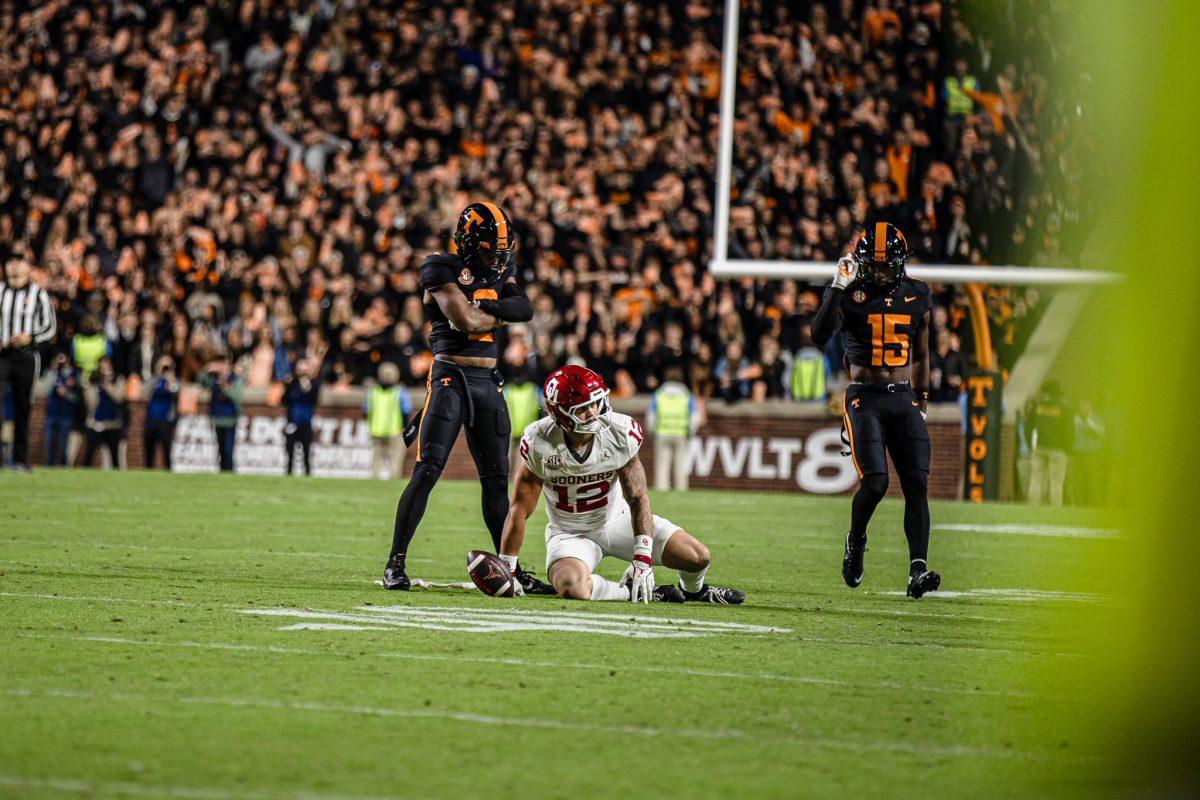
When it entered the halftime locker room, Tennessee’s defense felt as good as it had all year.
The Vols had allowed just nine points outside of R Mason Thomas’ defensive score, by far their lowest mark in a conference game this season. The unit that entered Tennessee’s 33-27 loss to Oklahoma possessed a mission to be better, and it showed. Tackling and fundamental play appeared cleaner for the group that sat as the second-worst in the SEC when it came to points allowed per outing. The Vols’ weakest unit all season long showed it wouldn’t be a liability in the biggest game of the season.
“We came in with a chip on our shoulder,” Edrees Farooq said. “Everybody was telling us that we can’t tackle and stuff like that, so that kind of motivated us to tackle better and just play hard.”
Looking at the numbers, one would be silly to suggest the Sooners would be in the lead after the first two quarters. Tennessee’s defense held the visitors to a mere five first downs and 99 yards of total offense. Oklahoma quarterback John Mateer often found himself under duress, lacking early rhythm as the often-knocked Vols’ secondary held up in coverage. Even with veteran linebacker Arion Carter in a restricted role, Tennessee dictated the pace.
“We just went back to the basics,” Edwin Spillman said. “Learning how to go out and just go perform and do your thing, especially on little things like tackling, it’s just all technique. We went back to the drawing board, picked up technique, and that was it.”
The results on the scoreboard still didn’t show. With a 16-10 deficit at the midway point and a majority of the numbers on the statsheet still in their favor, the Vols needed to find some kind of resilience. For the first time this campaign, the offense owed the guys on the other side of the football.
“First half, thought defensively we played extremely well,” head coach Josh Heupel said. “Offensively, move the football, don’t get points in the red zone, turn the ball over, give them 16 points in the first half, and just can’t win that way.”
Defensive coordinator Tim Banks knew he had a tall task in defending Mateer. Regardless, his contingent allowed only one explosive pass play of 25 yards. The depleted defensive backs didn’t allow the splash plays through the air. Mateer’s legs caused an issue during the second half, a timeframe that saw the junior rack up two rushes of over 20 yards. He rattled off a backbreaking 21-yard scamper on a third down and very long. The same third-quarter drive later resulted in a bigger play on Farooq’s forced fumble.
“Early, I thought we did a good job,” Heupel said. “As the game went on, he made some plays with his feet. Out of gaps a couple times, and sometimes he made just a good play. Third and 16, we let him escape and pick up a critical first down.”
The pass rush made a return against the Sooners, three sacks filling Tennessee’s ledger after a series of weeks where opposing signal callers stayed clean. The Vols forced their almost expected pair of turnovers by this point in the year, but it wouldn’t do.
Tennessee never expected to play perfect defense – it just needed an effort good enough to have a shot to win. So far in 2025, the Vols could get away with a below-average showing due to the caliber of their offense. On an evening where one of the SEC’s top attacks sputtered, an inability to put a complete game together cost a bid at a College Football Playoff birth.
“I feel like guys went out there and contributed,” Spillman said. “Did their job to a high level. I mean, you got to continue carrying that from the first half to the second half, all the way until that clock hits zero. Just taking that next step and finishing.”