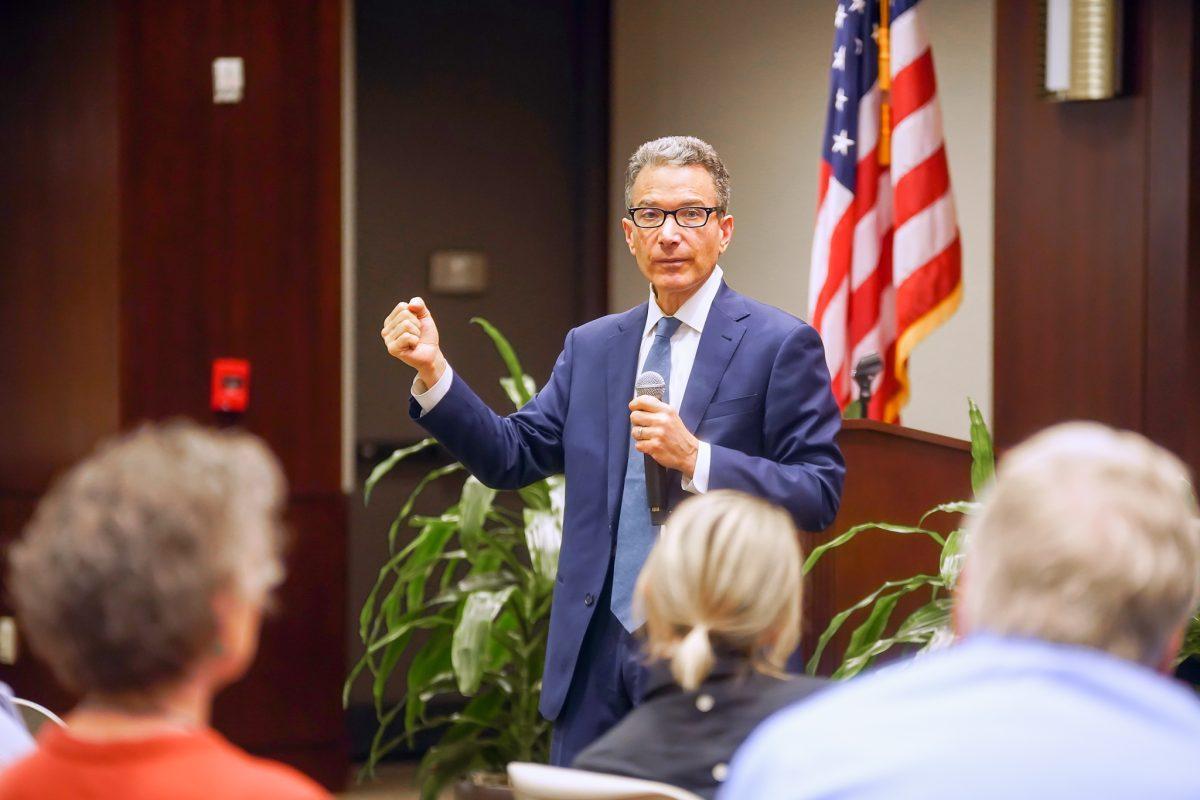
On Tuesday, Sept. 20, the Howard H. Baker Jr. Center hosted Jeffery Rosen, President and CEO of the National Constitution Center, for a lecture entitled “The Right to Vote.” Based out of Philadelphia, the center is a nonpartisan organization whose mission is to educate and raise awareness about the Constitution. Their goal is to create discourse about the Constitution and how it applies to laws and decisions being produced.
This lecture is a part of the Fall 2022 “Listen. Learn. Lead” week, and serves as the finale of the “Constitutional Conversations: Finding Common Ground”lecture series being held at the Baker Center.
Katie Cahill, director of the Leadership and Governance Program for the Howard H. Baker Jr. Center for Public Policy, emphasized the importance of the National Constitution Center. She believes that their nonpartisanship makes their speakers more forward thinkers on the subject at hand.
She explained the need for more insightful conversations about the Constitution.
“We have to remember that the right to vote is not explicitly guaranteed in the Constitution,” Cahill said.
Cahill said that she hoped that those attending, and anyone who comes in contact with Rosen, can gain from his speaking and his ideas on how voter rights came about and how they are represented and protected in the modern day.
Rosen emphasized that the framers of the Constitution did not formally outline a right to vote, but instead wanted to create a discourse. His goal is to bring back Madisonian discussion and have discourses across the aisle about the Constitution and how it relates to our rights.
“They were more interested in deliberation than putting a ballot in a box,” Rosen said.
In his speech, Rosen gave the attendees a rousing history of the Constitution and explained how it has never explicitly outlined what the right to vote is.
He emphasized that the background of voting rights is not simple.
“It is a story of peaks and valleys, agreement and disagreement,” Rosen said.
Rosen highlighted the battles that have been waged over the right, and how they continue today. He presented in detail how minorities, specifically African American people and women, were brought together to gain this right.
He explained Elizabeth Cady Stanton’s work in bringing women together in Seneca Falls, New York, to start the women’s suffrage movement and Martin Luther King’s ability to rally a movement to eliminate barriers to African Americans voting.
Rosen also gave the crowd the why behind these happenings. He said that because the Constitution is a vague document, the states were left to determine what voting looks like for certain groups. Poll taxes and literacy tests were not regulated until they were explicitly challenged in the state courts. He then furthered this idea by explaining how we see voting in the modern day. Battles are being fought against gerrymandering and politicians are put registration barriers in place to determine who can vote or how to vote.
Rosen aims to increase discourse about the Constitution. He wants to bring together scholars to further the general understanding of the Constitution and what can be changed about it or how it can be interpreted in the future.
He provided insight into how this is happening with a virtual constitutional convention that the National Constitution Center hosted. In this convention, organizers brought together specialists in three groups of opposing viewpoints. Surprisingly to him, they agreed on lots of things.
From that mock constitutional convention these individuals produced five amendments to the Constitution. Those being, term limits for the Supreme Court Justices, a restructuring of the Electoral College, the elimination of the natural born requirement for the presidency, making it easier to ratify amendments to the Constitution and making it easier to convict a government figure during impeachment.
Rosen’s insights were brought forth hoping to encourage discourse and deliberation and to aid in reigniting Madisonian deliberation within the United States. He hopes to increase understanding of the Constitution and to make sure the public understands that it does not guarantee the right to vote, but allows states to determine what voting rights look like. Rosen hopes that his goals are brought to life and that individuals can reach across the aisle for this discussion.