Ty is an intimidating dog.
A pit bull, his body is lean and muscular, with an oversized head and powerful jaws. He’s got a clipped canine tooth and a poorly stitched scar on his leg, signs betraying life in a dog-fighting ring. By the looks of him, he was a winner.
As he wriggles to the ground and flops his prodigious hind legs into the air, he betrays the sign of his new life – under the care of UT professor and dog rescuer Stacy Cihak.
“He’s the best dog ever,” she says, rubbing his belly as his tongue flops shamelessly out of his mouth. “Aren’t you, Ty?”
Cihak teaches in UT’s College of Education, instructing future special education teachers. In her free time – if you can call it that – she rescues dogs. Since she moved to Knoxville in 2005, she estimates she’s found a home for more than 200.
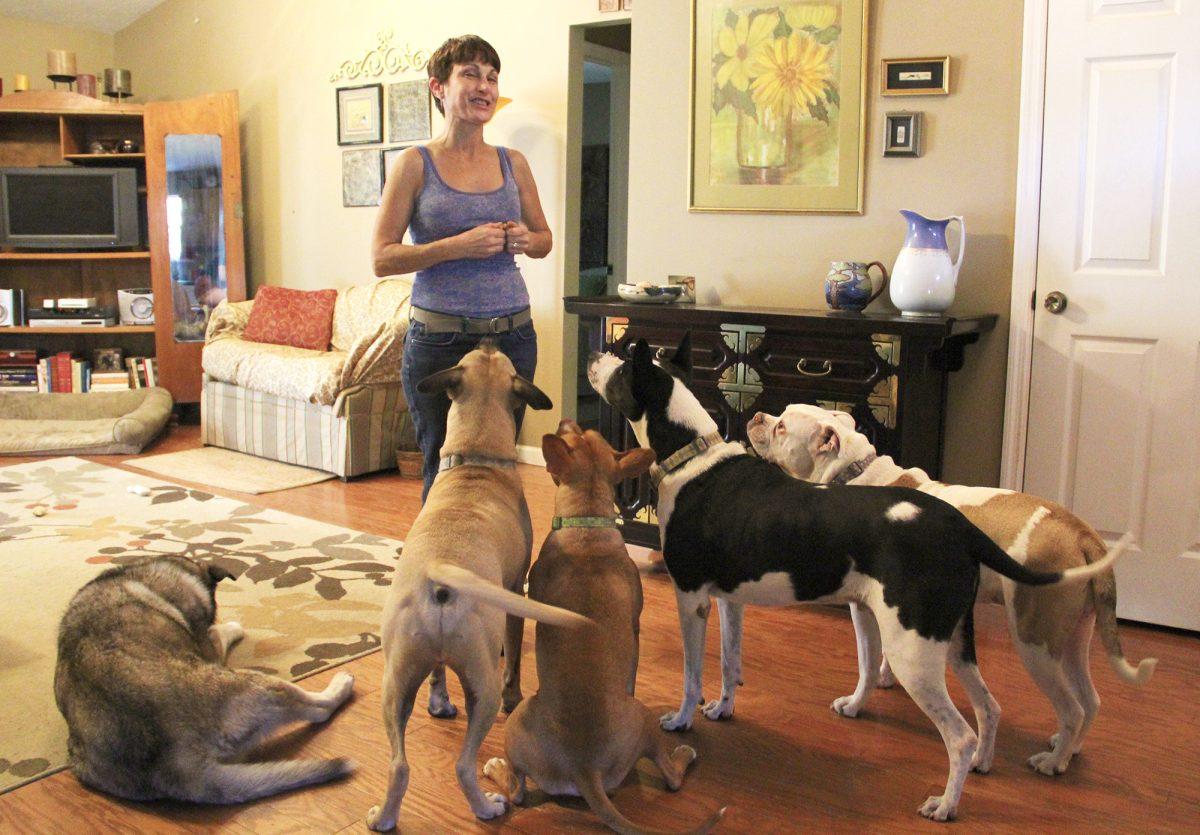
If that sounds like a lot, imagine the five dogs roaming around her living room.
She calls them her “pack” – there’s Roo, a former bait dog and the youngest in the pack; Patton, a rescue from Union County; Poochie, a funny-looking bulldog from Cocke County that Cihak suspects was inbred; Rosco, the blind alpha male and her oldest dog; and of course, Ty, who she calls “Mr. Wonderful.” (There’s another dog in the garage, but she’s dog aggressive and Cihak doesn’t bring her out.)
Like so many of her dogs, Ty’s story begins in a shelter. While volunteering at a shelter in Newport, Tennessee four years ago, Cihak watched countless would-be owners pass over him. For six months, he languished.
“A lot of people had their trepidation about adopting a dog from a shelter,” she said. “He had run out of time – he would’ve been killed.”
“So, I took him home.”
Initially, she had intended to get him adopted out, but having no luck, she eventually decided to keep him. The dog that no one wanted became part of her pack, and Cihak saw potential in Ty’s kind demeanor and affectionate personality. In conjunction with the Human-Animal Bond in Tennessee program, she secured him a spot as a therapy dog. This semester, he begins working in a field far removed from the bloody chains of dog-fighting – serving Knox County students who have behavioral disorders.
Cihak’s peculiar hobby began in 1989, when she was studying for her master’s degree at Georgia State University. As part of a grant program to help ex-convicts find jobs, she formed a relationship with a felon whose pregnant dog had just had a slew of puppies.
“I wish I would’ve known then what I know now, because I would’ve insisted on getting that momma dog fixed,” she says. “But I did take those four puppies. I took them and got them vetted and found them homes. That was my first ‘rescue.’”
For a long time, she only rescued occasionally, finding homes for stray dogs every six months or so. But when she and her husband, David – who also teaches in the special education field within the College of Education – moved to Knoxville in 2005, she began to rescue more and more dogs.
Citing a lack of education and resources, Cihak believes that the many people in the South don’t understand how to handle orphaned pets. In Tennessee, it’s both culturally and legally acceptable for dogs to live in dangerous situations, such as chained to a tree.
“Within a five mile radius, I could have identified 25 different dogs who were living being tethered to something or living in a backyard in total isolation, with a leaky plastic dog house,” she says. “It was just in your face and something that you could do to make a difference. You can take a dog off a tree and change their life completely.”
Ten years later, Cihak maintains an extensive network of foster homes and dog shelters. She says she receives 20-30 emails per day – particularly regarding bulling breeds – from sources who have dogs that need help. Once she finds a dog, she undertakes all the financial obligations; spaying/neutering, surgeries and chip implants cost her an average of $500 per dog. Between sorting her emails, going to the vets and the shelters, and delivering dogs to homes, she estimates she spends 30-40 hours per week on dog rescues.
Sylvia Turner, the assistant director of the Haslam Scholars Program, adopted a dog from Cihak this year. Her family had recently lost a rescued Anatolian to cancer, so a mutual friend connected Turner to Cihak, who happened to have an Anatolian mix looking for a home.
“She’s great with kids,” Turner says about Leela, the newest addition to her family. “I don’t think we paid anything for her. I think Stacey took care of everything.”
Turner’s story resembles the stories of hundreds of other pet owners who have adopted their dogs through Cihak. There’s a family in Texas who adopted Barney; a retired english teacher who adopted Sugar; a future music teacher who adopted Odin.
Cihak’s dedication raises the question – why does she devote so much of her time and money to rescuing these hard-to-place dogs?
Initially, she cites the 3-5 million dogs euthanized each year in the United States. She points out that only 20 percent of American dog-owners adopt their dogs from shelters. She focuses on statistics and the scope of the national crisis, but then she pauses.
“I guess it was just a calling,” she says. “How could I not?”
If you are interested in serving as a foster home for Stacey, or in adopting a pet, she can be contacted at [email protected].