Nickels and dimes may sit forgotten in your pocket, but those copper coins are historic treasures to Kenneth E. Harl.
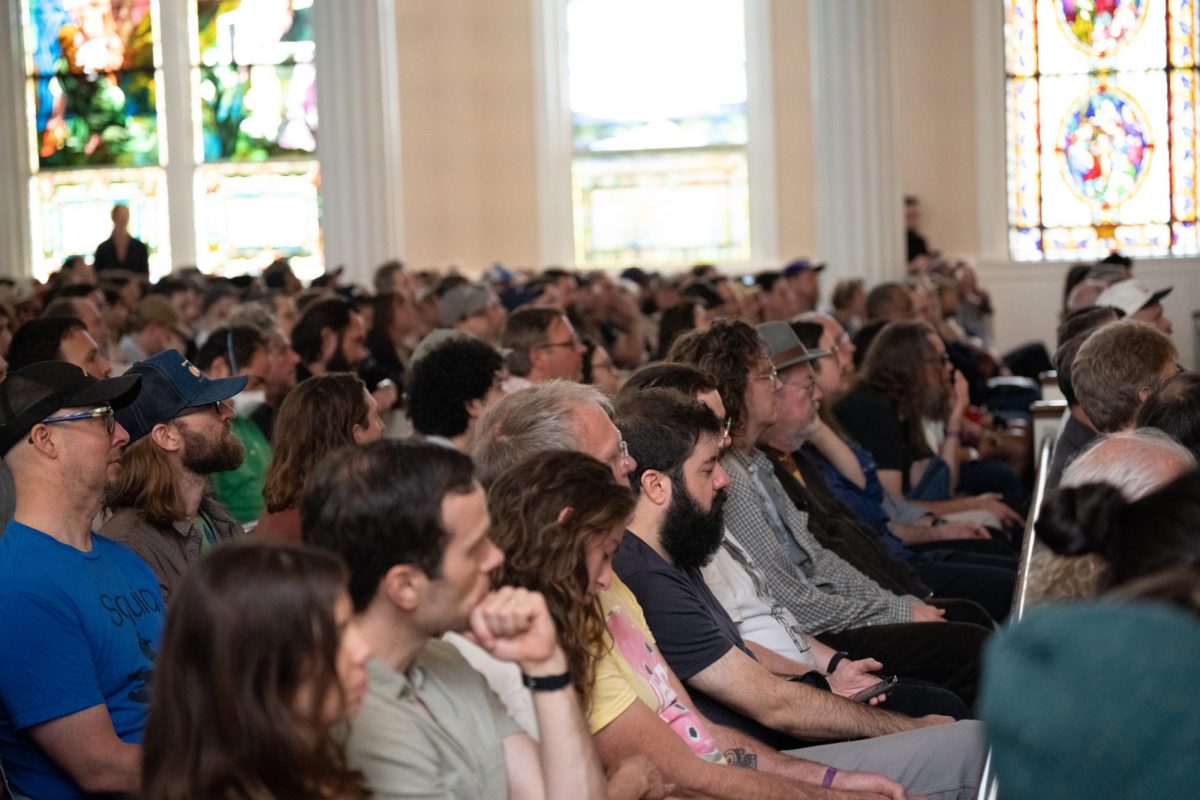
Harl, a classics professor from Tulane University, delivered his lecture titled “Make Haste Slowly: Constantine, the Coinage, and the Conversion” at the McClung Museum Auditorium last night for a mixed audience of UT students and the “classically-minded.”
The numismatist, or scholar of currency, from New Orleans prefaced his lecture by stating he had a goal of reconstructing a portrait of Constantine, the man who introduced Christianity as the dominant faith of the West, for the audience.
Though Harl admitted his fascination is more of a “socially acceptable obsession,” his study of coinage after the Constantine’s victory at the Battle of Milvian Bridge in 312 AD provides a more concrete timeline of an event that lacks detailed documentation.
“If you read some of the texts, they argue that (Constantine) only converted on his deathbed,” classics professor, Aleydis Van de Moortel, said. “That is sort of the standard version, but as an archaeologist, I know that texts can lie.
“Coins don’t lie.”
Van de Moortel, a member of the East Tennessee chapter of the Archaeological Institute of America, selected Harl as one of two lecturers provided by the Boston office for this year’s circuit.
As a faculty attendee at the lecture, she noted how well Harl captured the “essence” of Constantine and how the iconography displayed in the coins offers an alternate perspective on the emperor’s conversion.
“In archaeology, it’s all about patterns, and he was able to show how the pattern of the coins changed for both the emperor and the ‘protector,'” Van de Moortel said. “Then soon enough, all the coins are about Constantine, not the Roman gods. It was very convincing argument that I had never seen before.”
Harl also noted how such patterns in iconography, like displaying an emperor’s portrait, mimics the heroic style of renowned Western rulers like Caesar Augustus and Alexander the Great.
Harl said this move on Constantine’s behalf was very deliberate and shows a fundamental shift from a pantheon of Roman gods to Christianity as an emerging religion.
For Sierra Moses, sophomore in anthropology, the lecture appealed to her interest in the classical period.
“Constantine represents a great shift in Western development and he’s a point of contention for a lot of historians because not everybody understands when he converted,” Moses said. “I wanted to attend the lecture to get a better perspective on the historical point of view of Constantine and, to be honest, I was interested into how the coinage was going to factor into it.”
Moses said she studies ancient cultures and maintains that classical history and currency minted in the ancient Mediterranean still holds weight for Westerners today.
“It is a mark in our society,” she said. “We are still considered the West in the United States and we have been considered the West since Rome divided.
“But it’s relevant to people, especially, because it gives this timeline of what we know, what evidence we have and how we can trace everything back to a certain point.”