Staring into a skull’s empty sockets can be a little spooky.
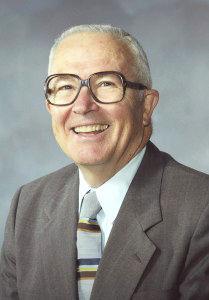
But for Smithsonian alum and professor emeritus William M. Bass, examining these human remains is just part of a day’s work.
Bass, a former UT professor of anthropology and founder of UT’s Forensic Anthropology Center, will be honored in a reception hosted by Hodges Library Friday evening to celebrate an addition to the special collection at UT, the Dr. William M. Bass III Collection.
The collection includes Bass’s donated materials such as
handwritten field notes and a semester-long lecture recorded in 1994 when Bass was a professor at UT. These notes have all been digitized and will now be accessible for
future generations of scientists and curious minds.
For Alesha Shumar, an archivist for UT libraries, Bass’s extensive field notes documenting excavations from 1956 to 1970 are one of highlights of the collection.
“Those notes correspond to different boxes with Smithsonian field dates on them, and so they see the notes and they can go look at the specimens at the ARC,” Shumar said. “It was hard to get to those beforehand because they were on paper, in binders in the anthropology department, but now they can see them online anytime they want. And they also don’t out of order, so it’s great.”
So far, 60 boxes of original material have been sorted through, making the collection open for public research as Bass continues to donate and expand the compilation.
“You sort of think of anthropology in the abstract, but to really see what they’re writing and see what they’re doing, it really brings it to life,” Shumar said.
This hands-on experience is a critical one for Sara Poarch, sophomore in anthropology, who interned her freshman year at the Forensic Anthropology Center.
“I got to see bones that scientists and doctors three times my age have never dreamed of,” Poarch said. “It was a mind-blowing experience.”
Poarch said she plans to attend the lecture Bass will be giving following his reception in the Lindsay Young Auditorium at 6:30 pm. Bass will detail his work excavating human skeletons in the
Great Plains in conjunction with the Smithsonian Institute during his presentation, and Poarch noted she is more excited to hear about Bass’s scholarly research rather than the story of the Forensic Anthropology Center’s origin.
Director of Development for UT Libraries, Erin Horeni-Ogle, said while the center is Bass’s claim to fame, the scientist makes a passionate effort to educate others about current research in forensic anthropology field. Particularly, Bass’s popular detective novel series known as the “Body Farm” novels helps educate readers about the science behind criminal investigations as well as promote publicity for UT.
“I think the Body Farm has so much popular interest from his novels he writes with Jon Jefferson, that I think it’s just brought some good ‘pop’ reference to UT which is always nice,” Heroni-Ogle said. “The more people who know about the university, the better we are.”
As the smallest portion of donated material, Bass’s detective novels are also on display at Hodges’ special collection, further chronicling the man whose legacy in the anthropology world stretches beyond academia alone.
Bass and his writing partner Jon Jefferson, a veteran journalist published in the New York Times, Newsweek, USA Today and Popular Science, plan to release a new addition to their series sometime early next year.
Heroni-Ogle said their writing partnership is an “interesting one.”
“(Jefferson) writes a lot of the story line, and Dr. Bass fills in a lot of the science, so they write in that way,” she said. “They are a fun pair because of their different backgrounds and they work really well together, and who knows what the next novel will have in store.”
For a student like Poarch, these novels and the newly organized collection in Hodges allow her to make a career out of what she calls “little obsessions.”
“Anthropology is everything to society,” Poarch said. “It’s about who we were are and will be. It’s about understanding the most complex puzzle that has ever been: human beings.”