Where can one find the third best printmaking program in the nation?
Some might be surprised to find it’s here at UT.
The printmaking studio rests on the second floor of the Art and Architecture Building, tucked into the back right corner with a cutout arrow suspended from the ceiling to announce its presence.
After filing past the numerous art displays and curious works-in-progress that line the walls and fill the spacious main lobby of the building, the wooden doors enclosing the printmaking studio hold the promise of further surprises within.
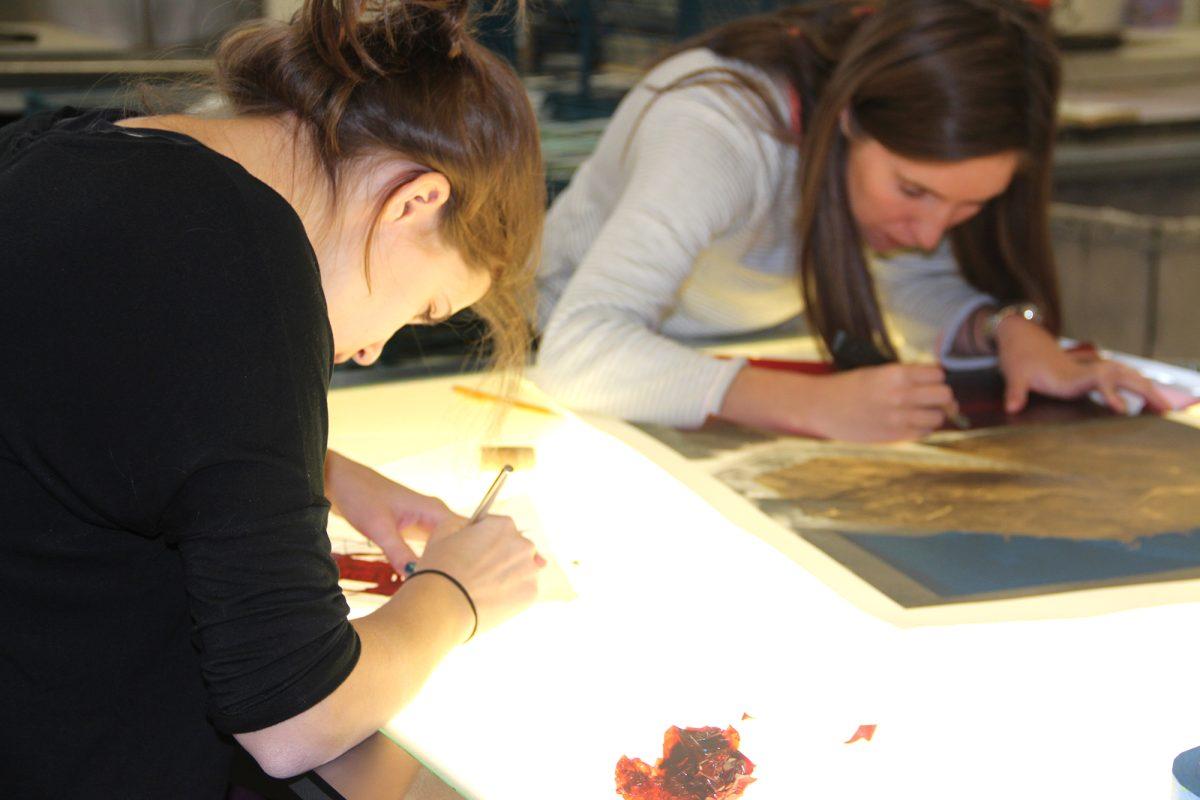
In this room, numerous students work on communal presses as a soft hum of activity fills the air. Associate professor in the School of Art, Koichi Yamamoto, can be found in his office, not grading papers but in an apron contemplating his next work.
Yamamoto has his own description for the scene taking place here. It’s a jam session, and he said it’s quite fun.
“There’s a great energy here. I think this program — we are ranked nationally No. 3 — has contributed,” Yamamoto said. “It had a lot to do with gathering the right people and putting them in the environment to create the dialogue. Also, there’s some healthy competition a little bit, especially among the graduate students.”
Despite the mild competition, the communal nature of printmaking leads to a close knit community among the students.
“I think that’s the thing, that the studio is a communal studio,” Yamamoto said. “It’s not like it’s a ‘your’ or ‘mine’ own studio; it’s our studio which forces us to interact and communicate and share and also take care of the studio too.”
An interactive spirit among the artists seems to be a part of printmaking itself. Due to its interdisciplinary nature, printmaking serves as what Yamamoto described as the “crossroads” of the art disciplines.
“People from different backgrounds such as illustration, comics, public arts to performance arts even come to printmaking,” Yamamoto said. “I think that’s the unique nature of this medium— the diverse disciplines that people bring. It’s kind of like a campfire setting.”
Three professors run the extensive program, and each of them began their art careers specializing in a different medium. Yamamoto and Beauvais Lyons got their start in ceramics, while associate professor Althea Murphy-Price was in three-dimensional media.
Yamamoto described their shift to printmaking as “a lot of 3D elements crashing into the 2D as a final product.”
The art of printmaking has a long history of a wide range of applications and influences. Dan Hood, senior in printmaking, spoke on his view of the diversity of printmaking.
“Printmaking started out as a means to reproduce text. It started out that way and has a lot of history in industry and in being able to create multiples and disseminate information,” Hood said. “So printmaking is one of those disciplines in which it has to take from other disciplines because its process is based in matrices … It offers so much because you can create so much.”
This begs the question: what is the process behind printmaking? Yamamoto compared it to a cross-country road trip. There are many different routes to the final print and many possible stops along the way, and in the end it’s the journey that shapes the finished product and not the destination. There’s a delay in the production from the beginning to the end, Yamamoto said.
“For instance painting or drawing — pretty immediate. You have paint and a paintbrush. Apply it on the canvas and you make a painting out of it, but this process in printmaking, there’s a lot of filters you go through,” Yamamoto described. “Some are kind of indirect. Some people it will drive crazy to do that, but at the same time this can be a wonderful opportunity to make strange things happen in between. It’s very process oriented, and this process can change the content.”
Printmaking is built on the foundation of other forms of art that help make the layers of the process. Painting, drawing, sculpture and other skils may be necessary to finish an artful print.
“It takes from so many different practices while still encouraging growth in those areas as well,” Hood said. “The history is so rich and so multifaceted in terms of art it makes sense that printmaking is so interdisciplinary.”
What distinguishes printmaking is the continual evolution and life in the program. Students and professors alike are continually working and pushing the boundaries of their field.
Lyons was unavailable for an interview because he has been in Poland for the past week, meaning he’s also been away from his students. However, they don’t seem to mind.
“It’s frustrating and awesome that Beauvais is out of town for the week in Poland doing this artist-in-residency thing,” Hood said. “How cool is that? A professor is out actually doing stuff.”
The professors share equal admiration for their students.
“I’ve been doing printmaking for 20 some years, but when I see young people come up with come brilliant ideas and do some fascinating idea process of many combinations, it’s a wonderful learning experience,” Yamamoto shared.
Then there are the students with a dedication to the art. Hood’s personal goal is to perfectly capture the versatility and vision of printmaking.
“My kind of philosophy with making art is learn as much as you can to figure out how to utilize your artistic vision in a way that satisfies what you are trying to accomplish,” Hood said, “whatever that may be.”