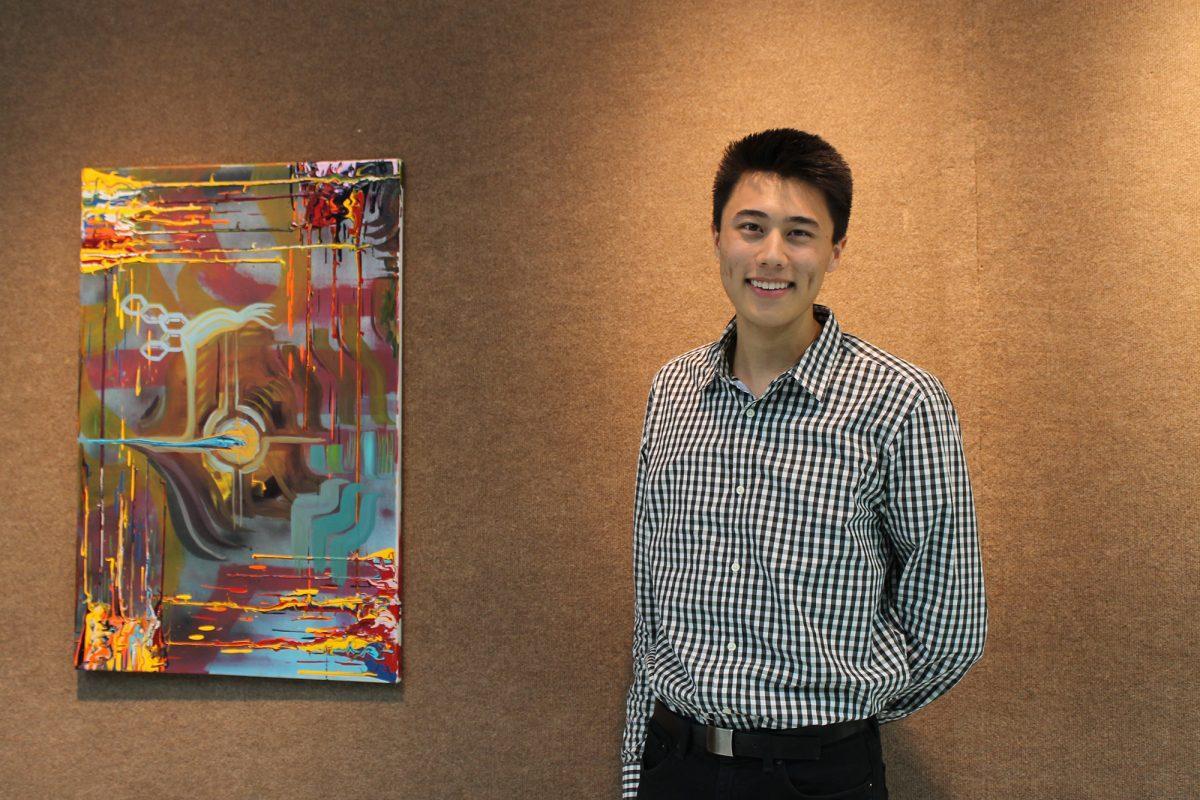
Alex Houck beams as he talks excitedly about his recently-won Fulbright grant and the project it will permit him to conduct in Spain after leaving UT.
Among the most competitive national scholarships available to U.S. students, the Fulbright Program awards grants to only 1,900 applicants each year.
“I put all my eggs in one basket,” Houck said, “and it ended up working out.”
Houck, a senior in College Scholars studying neuropathology and neurolinguistics, will use the grant to fund his research of the proteins that cause Alzheimer’s disease. Drawing upon his prior research experience in Argentina and his neurobiological research in Knoxville, Houck will conduct his study from a molecular neurobiological lab in Madrid.
“I chose Spain because I’m interested as a future physician working with a Spanish-speaking population,” Houck said.
In many Spanish-speaking communities, testing for Alzheimer’s and other neurodegenerative diseases is administered in English, often complicating diagnosis for non-English speakers. Moreover, Houck said the disease itself is not as widely researched or understood in the Spanish-speaking world.
Houck has also proposed taking classes in Spanish and volunteering in a hospital in addition to his time researching in the lab.
He is not alone in his success with the Fulbright Program. After graduation, Avery Dobbs, senior in political science, will participate in a Fulbright English Teaching Assistant Program in Bulgaria, where she will instruct high school students.
“I thought it was kind of a long shot,” Dobbs said, “but it all came together in the end.”
Of the five types of grants awarded by the Fulbright Program, ETA is one of the more common awards. At the suggestion of a friend, Dobbs communicated with the Office of National Scholarships and Fellowship and decided to apply for the prestigious grant.
“I was shocked that I was named a finalist in January,” she said.
Dobbs, whose interest in Eastern European culture first began after befriending a Slovenian exchange student in high school, said a visit to Slovenia the summer after her freshman year at UT sparked a love affair with the Balkan countries. When considering which nation she wished to take her work to, she chose Bulgaria for its climate of political transition and changing national ideology.
She believes the Fulbright grant will help her better actualize her dream of one day working for the U.S. Foreign Service.
“Now, I’m still in shock,” Dobbs said. “But I’m very excited.”