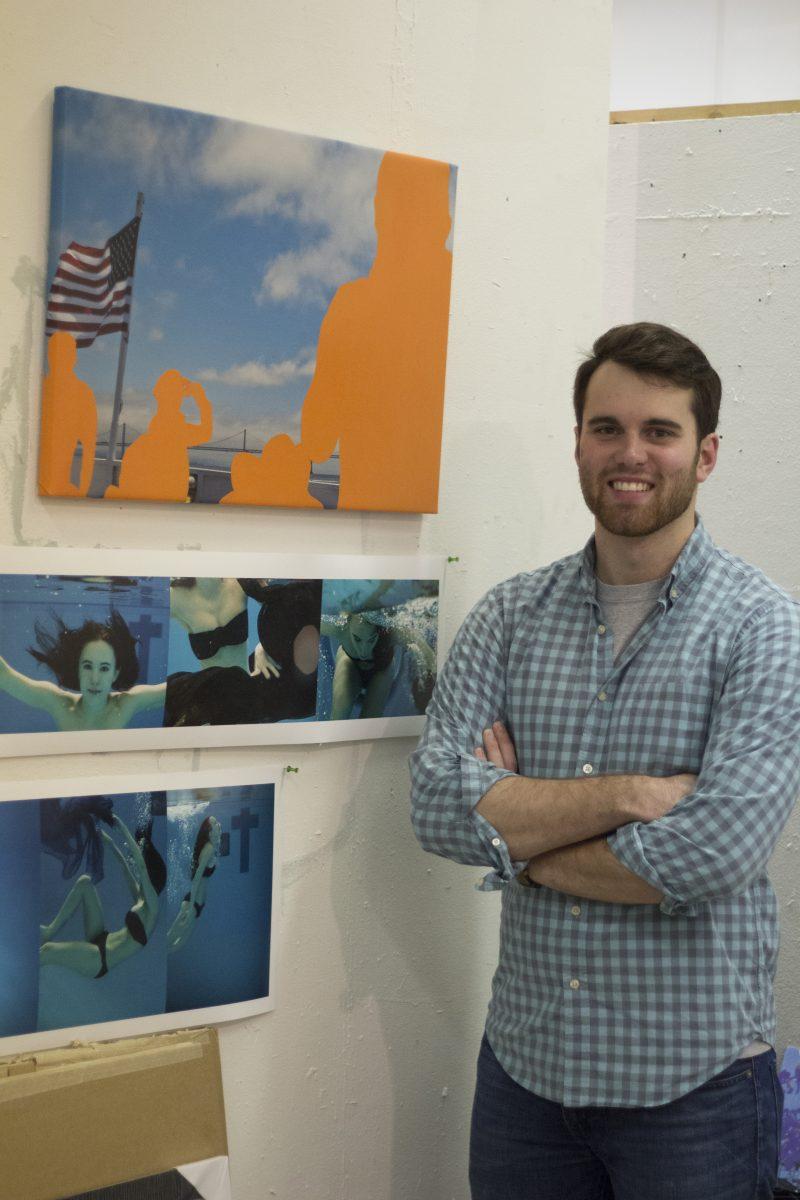
Shannon Herrron, a senior in two-dimensional art, won a scholarship at the UT School of Art which took him to San Francisco this past summer.
The work he created during his stay was displayed at the Gallery 1010 in downtown Knoxville, eventually leading to 23 of his pieces being sold.
But somehow, the tall, brunette art student still feels the occasional vulnerability of having his work displayed.
“I think letting people look at your work is really difficult,” Herron said. “You do art so people can look at it, but when it’s really personal and you put it up on the wall — you really don’t know what people think about it. You may think one thing but they’re reading it completely differently. Sometimes I feel very exposed.”
While his focus is photography, Herron also adds different colors and patterns to his work to create a certain image or place focus on a particular element.
In one piece from his time in California, Herron captured a picture of buildings from the San Fransisco Museum of Modern Art. He transformed the window panes into hot pink parallel lines bordering a picture in an effort Herron said to “accentuate the two-dimensionality of the piece and de-emphasize the illusion of depth by bringing the attention to the surface.” From there, the picture was transformed to a backlight film and put in a light box for display.
“I try to make work that is just as aesthetically pleasing as it is conceptual, so that it can be appreciated just as much by an engineering major as a studio art major,” Herron said. “I know my audience and I want to make workthat they can relate to and get excited about.”
Herron started art in high school, but when he arrived at UT, he never expected to make it a career path. Similar to other students, he wandered through college major limbo, never quite finding a subject that piqued his interest until his sophomore year when he officially became an art major. He dabbled in various art techniques until he settled in two-dimensional art.
“You have to take a lot of introductory classes so you get to explore each medium,” he said. “I was drawn most toward drawing and photography.”
So where does he get his ideas? It really depends, he said.
“A lot of it is just my life and growing up in the South and growing up specifically as LGBT in the South,” said the Maryville, Tenn., native.
But it’s not just what’s going on around him that he uses as inspiration. Herron said he also uses personal muses for his work, such as John Baldessari and professors in the art program.
“(Professors) push your concepts really hard,” Herron said.
Baldwin Lee, professor of art in the photography component of photo/media concentration, has worked with Herron in three courses from introductory to an independent study class.
“It was clear from the outset, because of obvious talent, tenaciousness and originality, that Shannon was unlike other students,” Lee said. “Rather than fulfilling the requirements of assigned projects, Shannon saw the assignments as an opportunity to explore the depths of his abilities and an occasion to showcase his imagination and inventiveness.”
And he does work. During the week Herron spends about 15 to 20 hours huddled in his personal studio.
“A lot of that time is brainstorming,” Herron said. “Even if you don’t have an idea, you just have to work … You really have to self-motivate. It’s really difficult sometimes.”
Currently, Herron has been applying for graduate school, hoping to continue his studies in fine arts and eventually become an art professor. As far as family support, Herron said he didn’t receive the cliche parent reaction to a child art major.
“They told me to do whatever I wanted to do as long as I do something,” he chuckled.