The Baker-Atchley campaign wasn’t the only winner in this semester’s SGA elections, as the Graduate Student Senate has its own set of new faces.
Martin Walker and Damien Pitts are the new president and vice president of GSS, respectively. Both have been actively involved with GSS in the past (Walker for two years, Pitts for one) and have worked on different resolutions and activities carried out by the organization.
Walker was a key player working on GSS projects. These projects got him involved with past GSS presidents and made him what he called a GSS “legacy member.” When the time came for the previous GSS president, Amanda Sanford, to step down, becoming the president himself just seemed like a natural step.
Pitts’ bid for vice president of GSS began when someone jokingly suggested he run for president. Pitts initially brushed off the idea but gradually warmed up to it, although he wasn’t looking forward to spending the excess money on campaigning.
Once he was aware that Walker also had intentions of being president, the two talked and soon realized that they both had very similar hopes and plans for GSS. Walker suggested that Pitts serve as vice president, which Pitts described as a “perfect” idea.
“It’s not about who is in charge, or who holds the office of the president,” Pitts said. “It’s a matter of can you get stuff done. I’m very willing and able to work with Martin and serve as vice president.”
Walker also thought that the arrangement would work well, describing the sit-down meeting that cemented their decision to work together.
“We agreed that it’d be easier to run together because we were on the same page on a lot of the things we wanted to do,” he said.
Both Walker and Pitts ran unopposed during SGA elections, which is not uncommon for GSS; the past two presidents and vice presidents also ran unopposed.
A Disconnection
One problem that Walker and Pitts want to work on internally is increasing participation and unity within GSS, both to create a better environment for the grad school as well as get the word out on GSS’ involvement.
Walker believes that GSS is in a bit of rut where some students question its relevance, something he hopes to reverse.
“I know that some graduate students really appreciate (GSS),” Walker said, “but I don’t know how many know truly what we’re doing or that we’re trying to work for them.”
Every department in the graduate school can have a representative on GSS. However, Pitts said that not every representative fully participates in GSS, and sometimes departments simply don’t elect a representative. Pitts sees this as the main problem.
He described a recurring conversation he’s had with graduate student friends outside of his department. They often do not know about GSS events, despite having representatives.
“We can blame whoever we want, but it’s our own fault,” Pitts said.
To help fix this occasional lack of communication and participation, Pitts suggested that he and Walker would go to each department and discuss GSS plans, encouraging said department to send a representative.
Walker agreed that going to each department could be a viable plan.
“We want to get out there and get representatives,” the president said. “And that means we’re going to go door-to-door, department-to-department and say, ‘Hey, where’s your rep?’ … ”
The two new executives also want to encourage lackluster representatives to get involved with their constituents.
“It’s not the executive officers’ job to tell the whole graduate school what’s going on,” Pitts said. “There’s a reason you have representatives. … You hold this position, do something. We’re going to hold elected representatives responsible, more so.”
Graduate Student Orientation
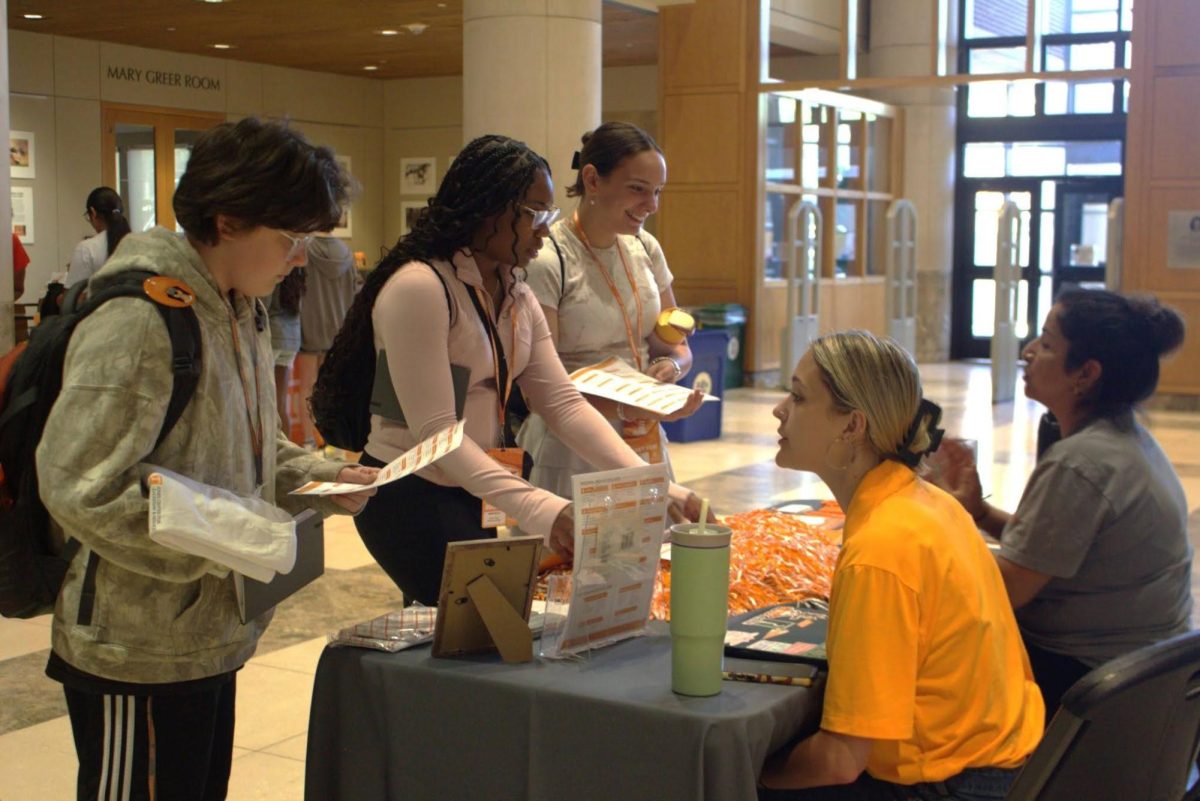
In terms of the immediate future, GSS’ next big project is to coordinate the first graduate student orientation this summer.
This will be the first summer where there will be an orientation for all first year grad students. In the past, there have been orientation programs offered from individual departments, but there hasn’t been one for the entire incoming grad student community that showcases the entire campus, much like the one undergrads participate in prior to their freshmen year.
Walker said that the idea for orientation originated during a fall luncheon between SGA and Chancellor Jimmy Cheek. A student suggested an orientation for grad students, prompting Cheek to ask who else wanted the orientation. Walker said that about 90 percent of the room raised their hands.
Since then, setting up the orientation has been supported by the UT administration and is all but set to happen once summer begins.
“Most of the infrastructure is already there,” Walker said. “It’s mostly just getting the manpower to get the tours out and get people to come talk to them. But I think it’s going to be great. … It’s kind of just come together because everyone feels it’s necessary and worthwhile.”
Pitts shared Walker’s sentiment and stressed that the graduate orientation was designed to show incoming grad students the ins and outs of UT while not stepping on the toes of individual departmental programs.
“We really want to make a good impression on these first year students,” Pitts said. “We’re not taking away from what the departments do, but when the departments have their orientation it’s normally department specific. It’s not, ‘Here’s where you need to go to get your ID card.'”
GSS: A Tool for the Students
Ultimately, Walker and Pitts are a part of GSS because they believe it can be an instrument that graduate students can use to get their voices heard.
“It’s definitely a tool to make change. …” Pitts said. “I think that the Graduate Student Senate is the perfect tool for us to … be an outlet for grad students to have their issues and we can present to (the administration).
“GSS is definitely out there for graduate students, and I just want people to know that.”
Walker echoed that sentiment.
“The main thing for GSS, I think, is that we are the voice of graduate concerns to the administration,” Walker said. ” … If people bring concerns to GSS, we immediately follow it up, and therefore the administration knows the concern of graduate students.”