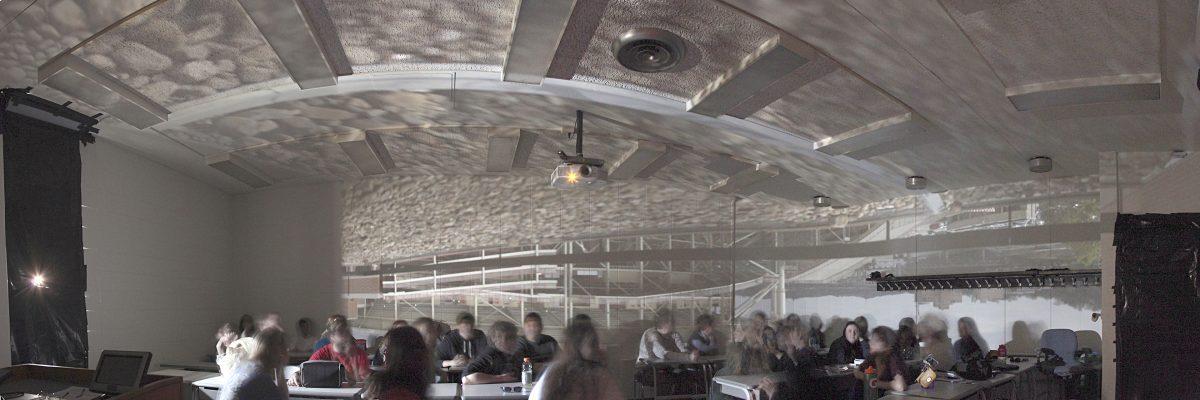
With the windows covered in black tarp, 30 students sat in silence in Professor Rob Heller’s classroom. Every four seconds, the sound of a closing shutter captured the students inside the room.
The only light revealed within the dark classroom streamed through a nickel-sized hole in the tarp.
After waiting fifteen minutes for their eyes to adjust, the students began to “ooh” and “ah” at the sight of Neyland appearing upside down on the wall.
These Journalism and Electronic Media 390 students were experiencing a life-sized simulation of the inside of a camera.
“At the beginning of every semester, I teach students how a camera works,” Professor Heller said. “But there’s something about being inside and truly experiencing the inner workings that really helps them understand.”
The view from the main window in Communications Building Room 317 reveals Neyland Stadium and a glimpse of the Tennessee River. Through the small hole of the tarp — the “aperture” of the classroom — this outside view was inversely reflected onto the opposing wall in the classroom.
Anna Lewis, a senior in journalism and electronic media, felt as though the learning exercise aided in her understanding of cameras.
“I am a very visual person and I need to see things to understand every aspect of a lesson,” Lewis said. “Professor Heller went above and beyond to help us understand the roots of photography, not just a few facts from a textbook.”
Professor Heller explained the purpose of the activity was to show students how quickly a camera captures an image. It takes the human eye more than 10 minutes to adjust to the lack of light. After their eyes adjusted, students could view the projected image on the wall.
“I learned, oddly, a lot about our eyes and what we think we see and what we actually see and how much adjustment and lighting have to do with an honest perspective of photography,” Lewis said. “It was neat to realize a camera can capture instantly what the eye would take hours to see in that much darkness.”
The upside-down image of Neyland, to the students’ eyes, was black-and-white. Professor Heller said it would take hours, if ever, for a human eye to recognize colors in the simulation.