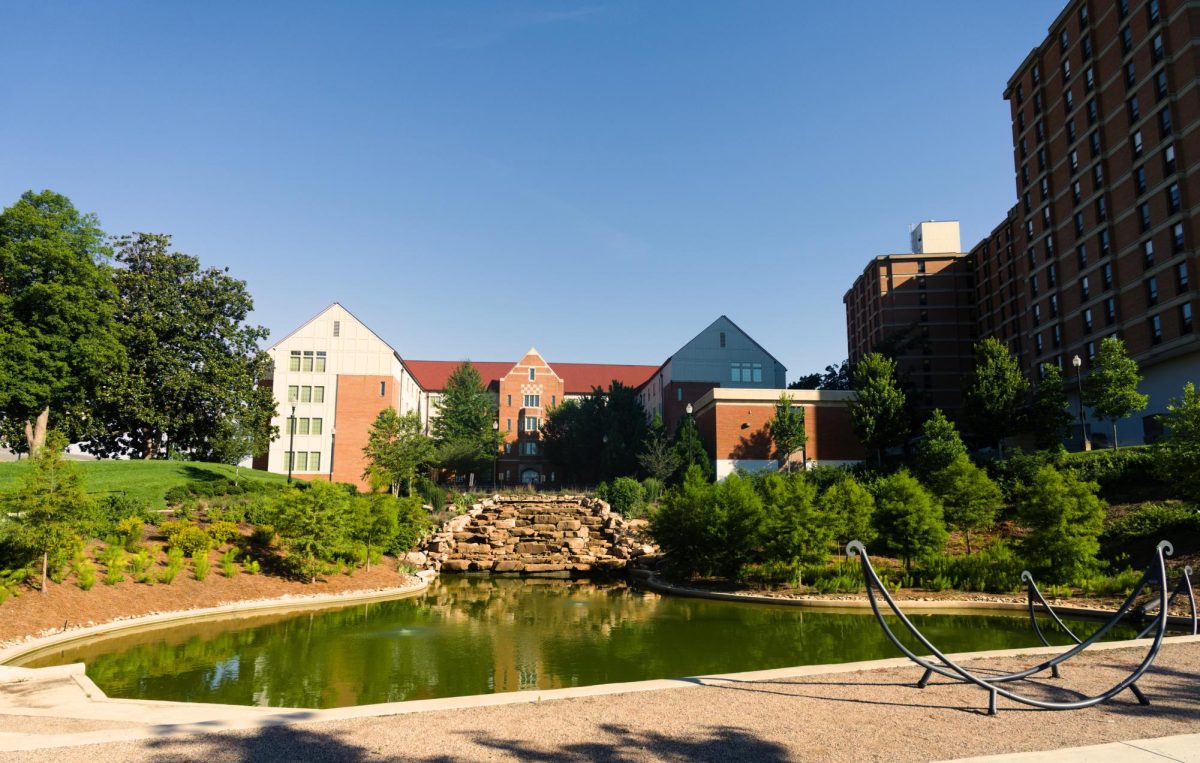
Not too far from the monotonous traffic of the Alcoa Highway near the University of Tennessee Medical Center lies a two-acre plot of land that looks to be nothing out of the ordinary. The only structures are a garage-like building and a small storage shed. However, under this plot of land rests a few dozen bodies, slowly rotting away.
This is the Anthropology Research Facility, popularly known as the “body farm.”
Founded in 1981 by Dr. William Bass, a forensic anthropologist and former head of UT’s anthropology department, the facility studies the decomposition of the human body – research that can help criminal investigations.
It is the only facility of its kind in the world.
“The research facility has two purposes,” Dr. Richard Jantz, professor of anthropology, said. “One is decomposition research. It permits us to observe the process of decomposition under controlled conditions. We can systematically vary things – buried bodies versus surface bodies, clothed bodies versus unclothed, bodies underwater as opposed to dry land. The point of all this is to assist us in making estimates of time since death – a very difficult but important proposition.”
The second purpose is “to skeletonize remains so that the skeletons can be accessioned into our collection for research,” Jantz said.
A body is kept in the facility for roughly one year before it is placed in East Stadium Hall for storage in humidity-controlled containers.
Obtaining new skeletons for study allows anthropologists to compare the modern human frame to earlier ones, observing any changes in skeletal structure that may occur over time. Today there are about 400 skeletons at East Stadium Hall.
“What we’re trying to do is perform research that will set a gold standard for other people that don’t have the luxury of having a facility to do this work,” Dr. Murray Marks, a UT professor of anthropology, said. “There’s nobody else watching bodies rot in a natural setting.”
Currently, the research facility is studying the decomposition of bodies in sunlight versus shade, changes in body mass during decomposition (this is calculated by weighing), effects of insects on decomposition, ground penetrating radar studies of buried remains and a study that assesses the early (first two weeks) stages of decomposition.
The research conducted at the facility is spread via academic publications and anthropology and pathology conventions, and it is taught to law enforcement personnel by the National Forensic Academy. It was established by the Knoxville Police Department and UT to teach law enforcement officials how to improve the collection and preservation of evidence.
“The whole tempo of an investigation can hinge upon the anthropologist saying how long the person has been dead – a week, a month or a year,” Marks said.
At any given time, there are approximately 25 bodies at the facility – all of which are at different stages of decomposition. All these bodies are either donated by the deceased or their family. “These people have a vision that is different from the majority of the public, and they want to contribute something of themselves,” said Marks. “We are very respectful.”
On average, the facility receives one donation a week, and it can see 40-50 donations in a single year.
The families of the deceased, whose skeletons lie in storage, are able to claim the remains for burial or cremation at any time. “Sometimes people have a change of heart,” Marks explains.
Out of respect for those who donate their bodies to science, Marks, Jantz, and the rest of the anthropologists, pathologists and law enforcement personnel that work in conjunction with the Anthropology Research Facility try to dissuade the use of the name “body farm.”
“We don’t grow people,” Cathy Haden, a forensic pathologist, said.
“Body farm,” however, will probably be the popular name for a long time, especially since the release of Patricia Cornwell’s Body Farm in 1994, a murder-mystery in which a pathologist uses the research from The Forensic Anthropology Center.