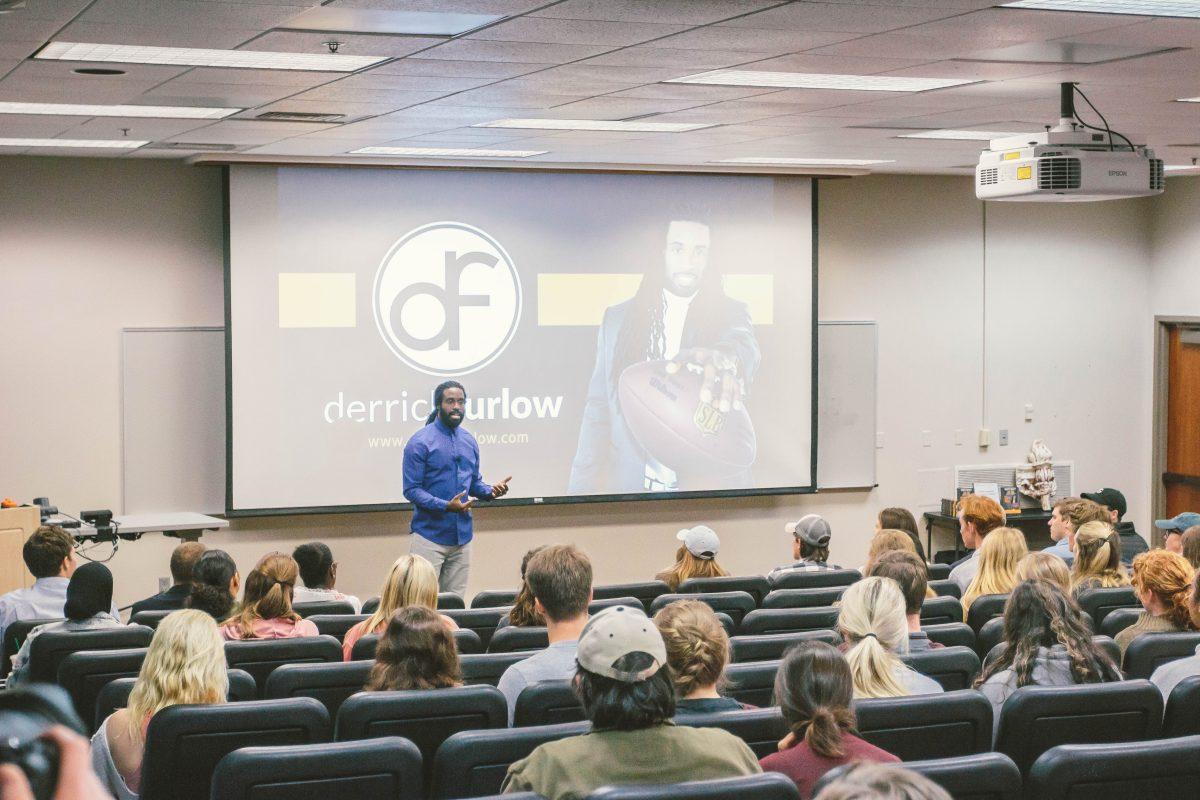
Derrick Furlow, former UT football player, entrepreneur, community servant and author of acclaimed book “What’s Next? How to Transition Like a Champion,” spoke to the Leadership Studies Academic Community about leadership, pursuing a vision, and leaving a legacy beyond college.
Derrick opened his talk speaking about his childhood. Growing up in the southwest Atlanta projects, Furlow and his two siblings were taken care of by their mother. Struggling weekly with having to make choices like paying to eat or to have heat, Derrick talked about how the term leadership was not a word he heard a lot during his youth.
Furlow and his family then moved out from Atlanta to the Griffin Georgia suburbs after his mother met her boyfriend and future husband. While the family still struggled with money at times,. Derrick explained how he soon went from being hopeless to hopeful, because he was able to live somewhere for multiple years, make friends, play sports in high school and make an identity for himself.
However, after having to move to Crossett, Arkansas, a town with two stop lights and one stop sign, Furlow felt like his identity was taken away from him and became angry and lost.
“I felt like I was back at ground zero,” Furlow said, explaining how he felt like the odds were stacked against him.
Furlow then made his “Get Out of Arkansas” Plan, in which he would make his new Arkansas high school football team go undefeated in order to get a full-ride scholarship to the University of Georgia.
After motivating a team that had never won anything to work out, run and play football together, Furlow realized his leadership skills.
While the team finished their season 10-0, they lost in the semi-final game; however the team was put under the D-1 microscope, being considered a power house by several scouts
.
However, unexpected tragedy hit Furlow when he tore his ACL during offseason workouts for the University of Arkansas at the beginning of his senior year in high school. All the offers he got from other colleges were pulled except one: UT.
Furlow explained how UT offered for him to earn a scholarship if he could get back to playing like he did before he tore his ACL.
After two seasons, Furlow still didn’t have his scholarship and was getting discouraged. After getting involved with Fellowship of Christian Athletes (FCA) and learning how to better serve others, Furlow explained how his life turned around and eventually earned his scholarship.
While he had achieved his former objective, Furlow now had a new goal: to impact, inspire, and empower people.
Furlow graduated college in four years, earned a Master’s degree in sports psychology, worked as a salesman at Vacation Ownership and ran his own online company.
In all his jobs, Furlow used what he learned in sports to help solve other people’s problems, describing how he was able to be flexible, make quick adjustments and be observant with all of his customers.
Through his experiences, Furlow learned that leadership isn’t just given to someone; it is earned.
Several attendees discussed what they learned from Furlow’s lecture.
Dillion Brodeur, senior in accounting, had invited Furlow to come speak and spoke on his relationship with him.
“I met Derrick through a peer named Jimmy Smith and we met him at Scarecrow, a non-profit organization where Derrick is the chairman of the board,” Brodeur explained. “Knowing Derrick was a UT alum, I knew he would jump at the opportunity to speak. I think that speaks a lot to Derrick. Him coming back to help out his school and just show who he is as a person. Also what it means because of what he stands for and what this leadership studies minor stands for and how those combine together to make a powerful force.”
Karen Boyd, associate professor in leadership studies, was “incredibly thankful” for Furlow’s visit and explained the significance of the lecture for the leadership program.
“Our (leadership) program prepares self authored, personal and socially responsible leaders who want to squeeze out as much as this university offers, and I think he embodies that. We want our students to take what Derrick said and do even more with it, so it means a lot that Derrick would come to help inspire the students of Tennessee,” Boyd said.
“(Furlow) is different from what most people think of a leader and that is exactly the point,” Boyd added. “Leadership comes in many forms. Leaders should not be cookie-cutter because the problems they face will not be cookie-cutter and they will need to manage whatever is in front of them and respect the differences in a way that they can get things done for the good of everybody.”
Furlow concluded his presentation talking about his determination to get to his goal ,or his “Mount Olympus,” and shared how much of an influence his mom had on him in this decision.
“My mom was my biggest influence because she never settled,” Furlow said. “Don’t settle.”