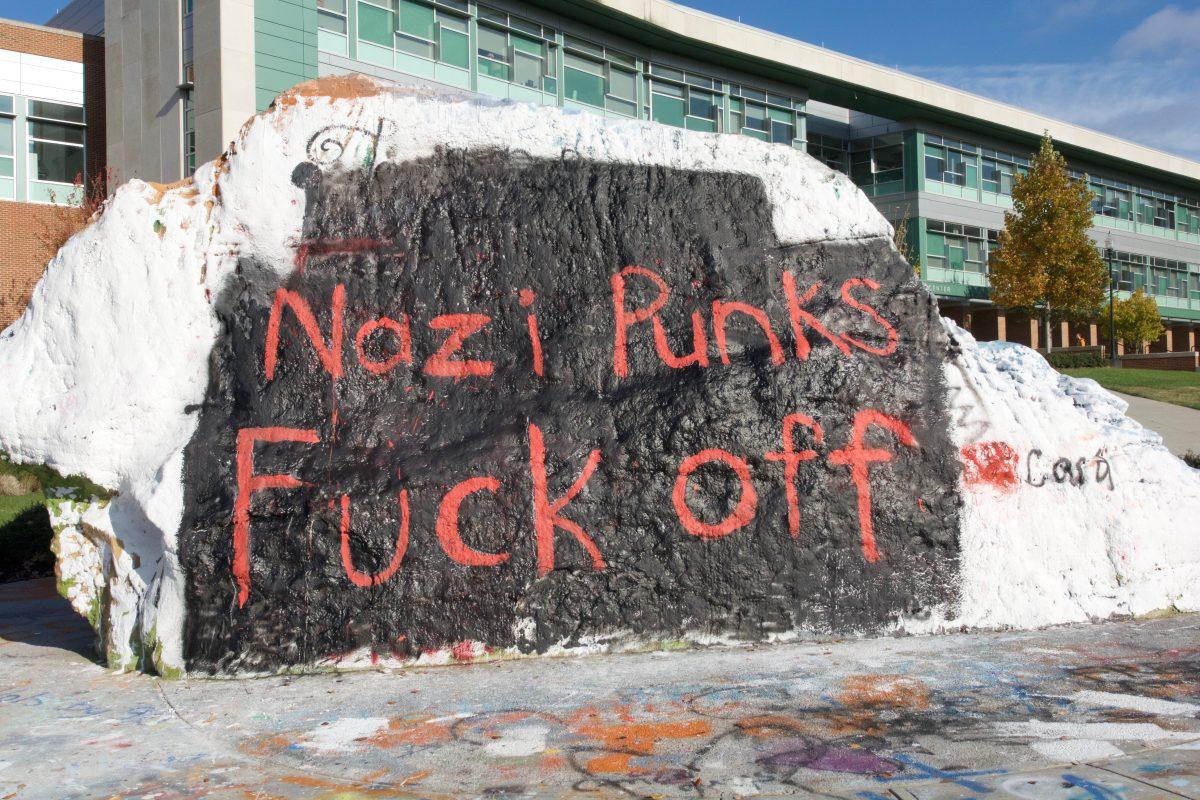
Two occasions in two weeks- swastikas and other historically hateful symbols and phrases covered other messages on the Rock.
Countless administrators have renounced the actions, but the question remains of what exactly can be done to keep hate speech off of the Rock.
‘It’s public space’
Criminal justice attorney and partner in Eldridge and Blakney law firm Tasha Blakney said she’s unsure “how much control the public or the university can reasonably exert over” the Rock.
Blakney drew on the example of a group protesting a funeral for soldiers killed in combat. As grieving family members attend the funeral, protesters outside of the funeral carry signs saying “Thank God for dead soldiers” or “God hates fags.”
“These are despicable, horrible comments, but the courts have routinely said that the first amendment protects that speech too,” Blakney said.
“And the picketing, even though I would dare to say the vast majority of us find that content of that speech to be absolutely appalling, but the picketers have the right to express those thoughts,” Blakney added.
The handling of this scene is no different than that of the Rock, even as it sits on a college campus.
“The fact that you’re in an educational community, I think, really just goes to show that you probably have an even more varied set of ideals and philosophies,” Blakney said.
“It should be a space where all viewpoints are welcome, even the ones that we don’t agree with, because that’s what the first amendment is supposed to do,” Blakney added.
Regardless, Blakney said the state and U.S. courts have grappled with how to draw the line between free speech and legal wrongdoing. Fighting words, which have historically been defined as words that would invoke immediate violent response, have been the most frequent cases, but they have often been problematic because of the difficulty to define what constitutes as fighting words.
“The reality is that our founding fathers, I think, would have wanted us to err on the side of caution and to say that, look, we might disagree with what you’re saying, but we will fight for your right to say it,” Blakney said.
“Short of literally shouting fire in a crowded theater, I think that it’s the safer side of prudence and caution to avoid regulating speech as much as humanly possible.”
‘Hateful acts’ that have stirred conversation on campus
Hillel, a Jewish student organization, gathered at the Rock on the evening of Oct. 31 to paint the Rock in solidarity with those affected by the shooting at a Pittsburgh synagogue the previous week. The message read “Stronger than Hate” and was complemented with the Star of David. Around 7:30 p.m. on Nov. 2, the message was replaced with “Stronger through Hate” and the Star of David was covered with a swastika.
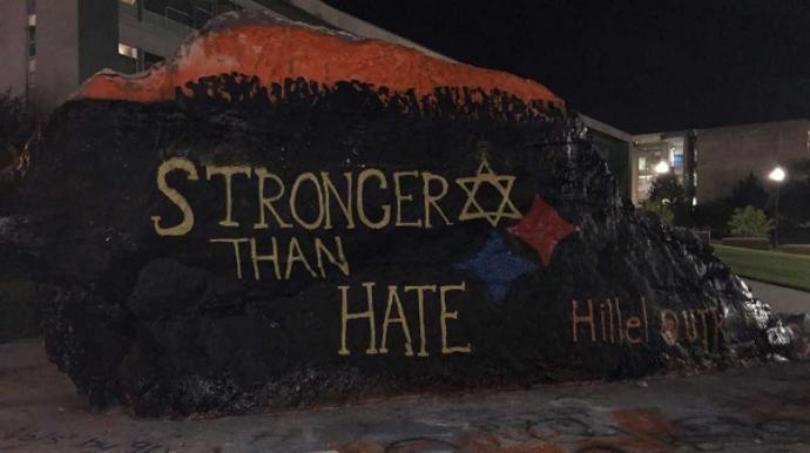
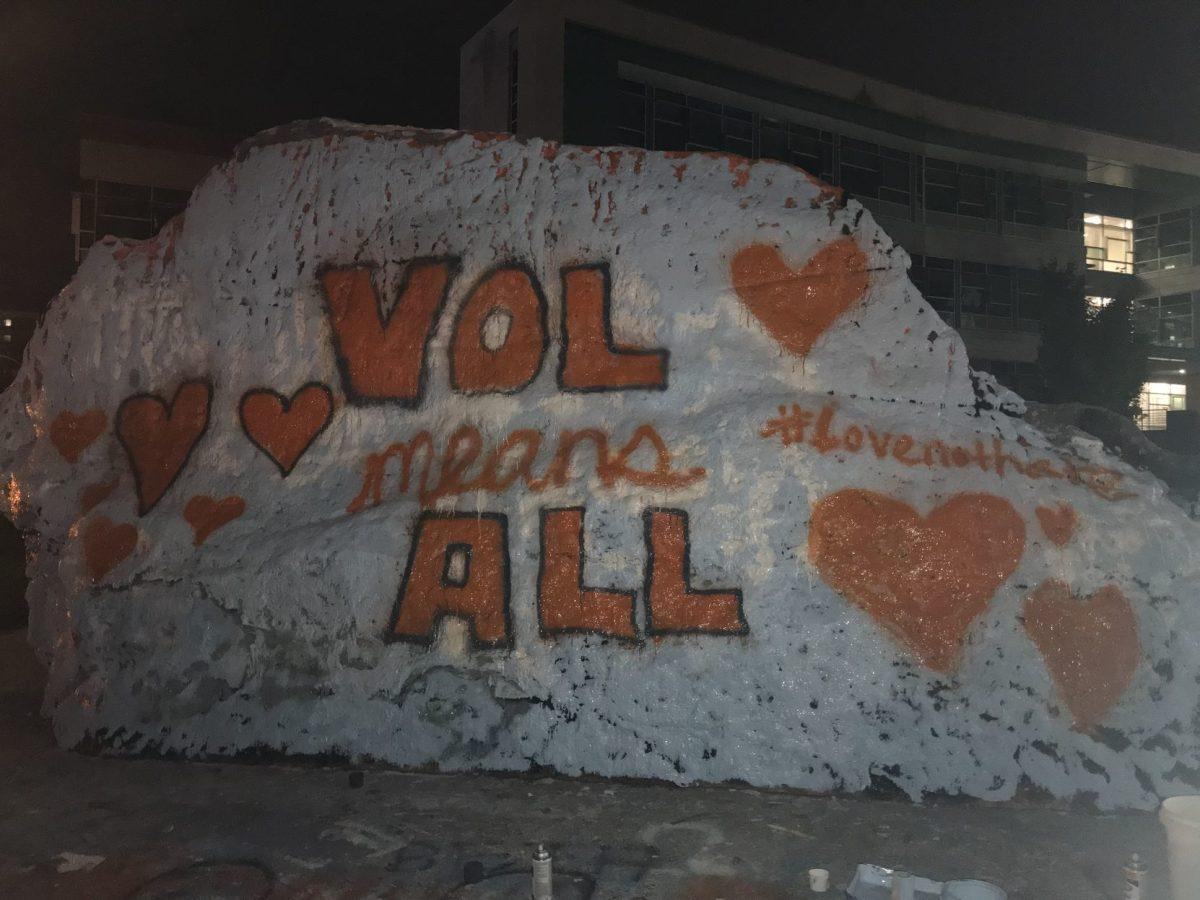
Volunteer community members painted over the message with “Vol Means All” and orange hearts.
“I am disappointed and deeply concerned, as are many members of our university community, that this symbol of hate appeared on one of our iconic campus landmarks,” Interim Chancellor Wayne Davis said in a campus-wide email on Nov. 9. “I want to make it clear that the university does not condone these actions or other acts of intimidation or intolerance. No one should feel unsafe because of their religious beliefs.”
Junior studying journalism and electronic media Kate Luffman routinely paints the Rock on Friday evenings in anticipation for home football games. That evening, Luffman left the Rock alone.
“I stood there and I saw the way that these messages affect those students and their beliefs and I was like, I can’t do that,” Luffman said. “I could tell it really affected them and they’re not going to care to see a football painting up there.”
“Vol Means All, that’s important,” Luffman said.
According to Luffman, the swastikas were not limited to the front of the Rock.
“I would be painting and somebody would go to the back of the Rock and be like, Kate, can you come over here and paint over this?” Luffman said. “They’ll get up high too so they think other people can’t reach it.”
A week later, Luffman painted the Rock with Smokey in a military cap and dog tags in honor of Veteran’s Day weekend.
Following the game against Kentucky, the Rock was once again met with swastikas and other markings and was painted over shortly after with “Love.”
“I love the Rock,” Luffman said. “I love that anybody else can go and paint on it and I like seeing what other people do on it. But the fact that that was done, especially to my work after 9 hours … it’s ignorant.”
“I’m hoping it will just die off,” Luffman added. “But with all this stuff going on in the news, it’s hard to tell.”
Campus community members respond to the incidents, look forward
In response to the second incident, UTPD Chief Troy Lane expressed his concern regarding “any hateful speech directed toward individuals or particular groups” and said UTPD is “committed to being more thoughtful” in their responses to such incidents.
To help combat the messages, UTPD has increased its physical presence in the Rock area and reviewed security footage from the area on Nov. 10.
“(We) are in contact with local, state, and federal partners to do everything we can within the law to follow up on these matters,” Lane said in a statement. “The safety and security of our students, faculty, and staff is my top priority.”
Lane encouraged campus members to continue to report incidents.
Assistant Vice Chancellor for Student Life & Dean of Students Shea Kidd Houze expressed her own concern in a video announcement released Nov. 12. Kidd Houze based her message on conversations with students and administrators.
“As administrators, we want to have all the answers and as community members, you likely want us to fix it,” Kidd Houze said in the video. “The truth is, we have to rely on one another to move to action.”
Kidd Houze said the next days, weeks and months will be dedicated to sustaining change and encouraged students to connect with her to move the conversation forward.
“We want to hear from you. We need you to help us,” Kidd Houze said. “I invite you to send me an email … if you’d like to continue this conversation, but I can’t stress the importance of us as a community being a part of the solution.”
As a community, Kidd-Houze suggested reaching out to students who feel hurt by the recent events at the Rock, to lean on one another and seek counseling or 974-HELP.
“Right now, though, the most important thing is that we’re taking care of one another,” Kidd-Houze said. “There are people in our community that are hurting.”
After conversations with students, faculty and staff in small-group discussions, the Office of the Chancellor collectively renounced the ‘hateful acts’ in an email on Nov. 16. The group of administrators announced their dedication to safety and security, education, effort coordination and ongoing dialogue.
“Hate does not belong on our campus. Anti-Semitism, racism, homophobia, and misogyny are harmful to us all and run counter to everything it means to be a Volunteer,” the email said. “We stand with those of you who feel threatened and intimidated in this moment and with those of you who feel that their university has let them down in recent years.”
Chair of the Faculty Senate’s Diversity and Inclusion committee and associate professor in the School of Journalism Amber Roessner said she was “horrified” to hear about “these abhorrent incidents of Nazi-inspired hate speech at our Rock.”
After the incidents, the committee met to offer recommendations for a campus response. Recommendations include, in the short term, enhancing monitoring and security at the Rock and encouraging instructors to briefly discuss the idea of balancing free speech and campus safety in their classes prior to Thanksgiving.
Along with these recommendations, the committee suggested the university invite an expert on free speech to moderate a town hall forum to address the two incidents at the Rock and Davis and incoming Interim UT President Randy Boyd reinstate a chief diversity officer prior to Jan. 1, 2019.
The final recommendation the committee proposed is to consider instituting content neutral or time, place and manner restrictions on the Rock which is in line with what is instituted for Pedestrian Walkway. This would not limit speech, but regulate the circumstances that paintings on the Rock could take place.
“Time, place and manner restrictions wouldn’t infringe on free speech rights in that it would not restrict what is written at the Rock,” Roessner said. “It would restrict the timing at the place and the manner.”
Roessner said this could help the issue as the persons who painted the Rock were masked and did so during the evening hours.
The committee also encourages groups on campus to engage in conversations and programming surrounding the issue.
“I know that much of that work is already beginning to take shape,” Roessner said. An event at the Rock has been planned for Dec. 5 for “messages of inclusivity and love” to be painted on it “in hopes for campus healing surrounding these two incidents.”
Various organizations on campus will also host “United at the Rock” on Feb. 20 as an anniversary event of the response to the Traditional Worker Party’s visit to campus last spring.
An open letter from the UT community spread across campus on Wednesday and received over 250 signatures in its first day. Community members can sign the letter here.
“I am heartened by the students who took it upon themselves to immediately paint over the symbol of hate out of care and concern for their fellow Volunteers,” Davis said in his Nov. 9 email. “By standing together and taking care of and respecting one another, we will ensure our campus is a community in which everyone feels welcome and safe.”
Managing Editor Tyler Wombles, Campus News Editor Cat Trieu and Senior Staff Writer Gabi Szymanowska contributed to this article.