Wednesday night was all about story telling at the McClung Museum.
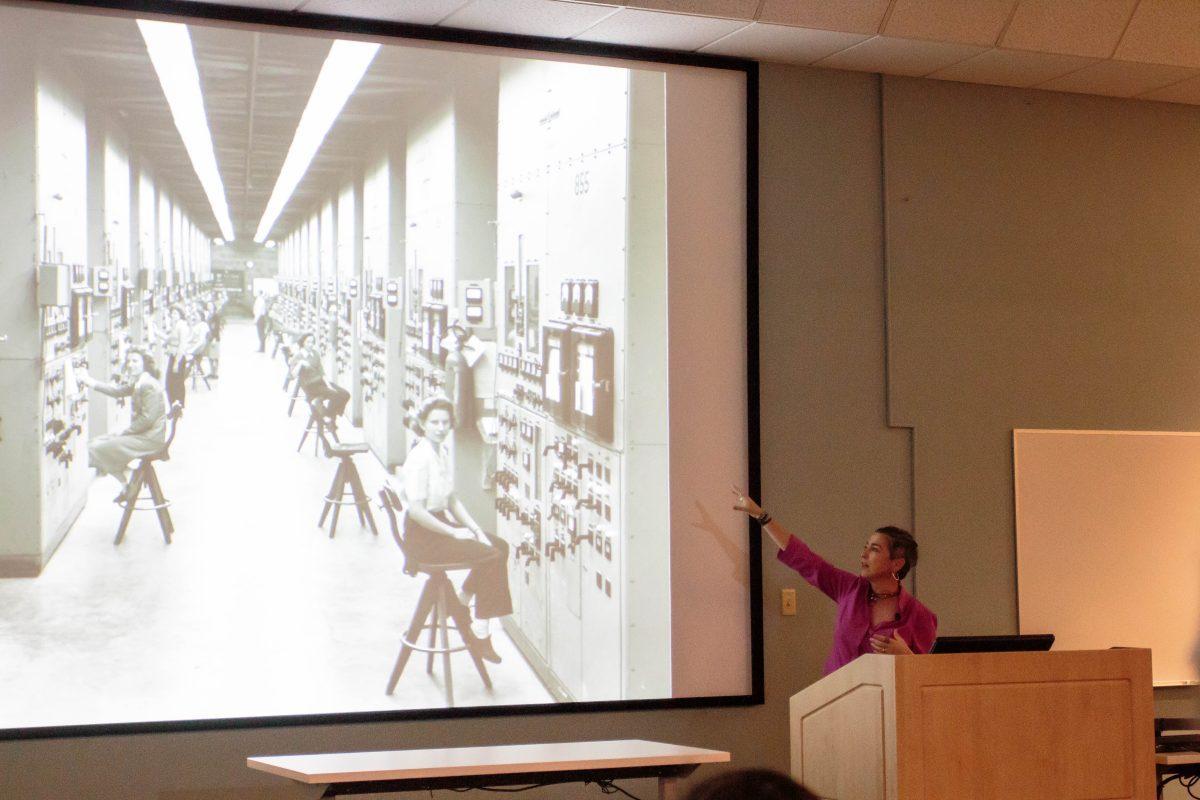
New York Times best-selling author of The Girls of the Atomic City Denise Kiernan spoke about the importance of sharing stories that might wind up remaining untold.
The book features stories of many women who were, in one way or another, involved in the construction of the world’s first atomic bomb in Oak Ridge, Tennessee in what would become known as “The Manhattan Project.”
All the women in the book had a few things in common, such as moving away from what they were familiar with and having loved ones in the war; most importantly, they were never told of what they were doing. According to Kiernan, the women knew their work was helping the war cause, but that was it.
Oak Ridge got bigger, and so did the mystery of what they were doing and what was going on. Many of the women that worked at Oak Ridge didn’t find out what they were involved in until they heard a radio broadcast from the president explaining the true work the government was having them help build.
One of the women, Jane, was a UT graduate who wanted to be an engineer. At the time, women weren’t allowed to study engineering, so she studied statistics and took a job in Oak Ridge that had her check over calculation and that put her in a management position. Jane’s story highlighted the struggle she faced as a woman during World War Two. She told Kiernan that she kept every record and when looking at one found a note she had written ten years prior that said, “Men under me, making more than me.”
Another woman, Elizabeth Edwards, left her head librarian position in New York and started Oak Ridge’s first library and mobile library. Rosemary, a nurse from Chicago, started the first emergency room.
A woman named Katie showed what life during the war was like for African Americans in Oak Ridge. Everything was segregated, and she had to live in a small hut. She was separated from her husband, and her kids were with her parents in Alabama. She couldn’t even cook in her hut. Katie convinced one of the welders at Oak Ridge to make her a couple of biscuit pans and managed to make some biscuits that she later used to bribe the guards with to let her see her husband. She still used those pans up until her death.
Kiernan said that she believes it is important, especially for the younger generations, to invest themselves in oral histories and sharing them with others because it could very well be as significant as some of the stories in her book.
Assistant professor in physics and astronomy, Nadia Fomin, put this event together, saying that since there is a physics conference this week at UT, Kiernan’s lecture would have let those attending the conference learn about some regional science history.
“Those of us living in the area know that (Oak Ridge National Labratory) played a vital role in the Manhattan Project, but I think few of us know exactly what that was, or have heard stories of the participants,” Fomin said. “Denise has interviewed many of the women involved and will tell us about their stories.”
Freshman in journalism and electronic media Nina Howard said that she never knew the regional history and involvement in the Manhattan Project before hearing about the lecture and described the lecture and book as intriguing.
“Obviously…like the amount of women that were a part of this and the fact that Oak Ridge, Tennessee…that’s right down the street,” Howard said. “When you think of World War Two, you think of Germany, you think of overseas, you don’t think of these things happening so close to where you live now and I just didn’t know that we played a part in what was going on back then.”