Zoo Knoxville will unveil its newest exhibits to the public March 5 as a part of the zoo’s ongoing process of animal conservation.
The new exhibits, with four silvered-leaf langurs — a first for the zoo — and white-handed gibbons, will have a ribbon-cutting ceremony and preview weekend before opening up to the general public.
The exhibit will have two gibbons: Georgie, who has been a long-time resident at the zoo, and Naomi, who comes from Little Rock, Arkansas. An older gibbon named Nipper will remain in the old gibbon exhibit due to her age and the potential stress of moving.
“I know a lot of our visitors have seen her, are attached to her and worried about her being by herself, but she is living the high life,” Jenn Kirkpatrick, a zookeeper at Zoo Knoxville, said. “She’s probably sleeping more than she ever has because she doesn’t have Georgie waking her up, so she’s doing fantastic.”
These exhibits are merely one aspect of the zoo’s long-term conservation work. Zoo Knoxville has a history of work with East Tennessee’s endangered bog turtle, mudpuppy and hellbender salamanders and Malayan tigers, among others.
An Association of Zoos and Aquariums (AZA) accredited zoo, Zoo Knoxville works with other AZA-accredited zoos and follows a Species Survival Plan (SSP) for all its animals. This plan, which is managed by the AZA, ensures the genetic diversity of captive populations so that they are on par with their wild counterparts.
Phil Colclough, director of animal care, conservation and education at Zoo Knoxville, is responsible for animals coming in and out of the zoo as well as for educating zoo visitors about the animal conservation. Colclough said AZA-accredited zoos are working to move beyond the image of zoos “being the place where you just go to see a monkey in a cage.”
“We still get the ‘animals shouldn’t be caged; they shouldn’t be in zoos; it’s bad for them,’” Colclough said. “And I think it’s really important for me in this position to share that message with the rest of the world that we are working to save animals from extinction these days. There are a number of animals that would not be on this Earth if it weren’t for AZA-accredited zoos.”
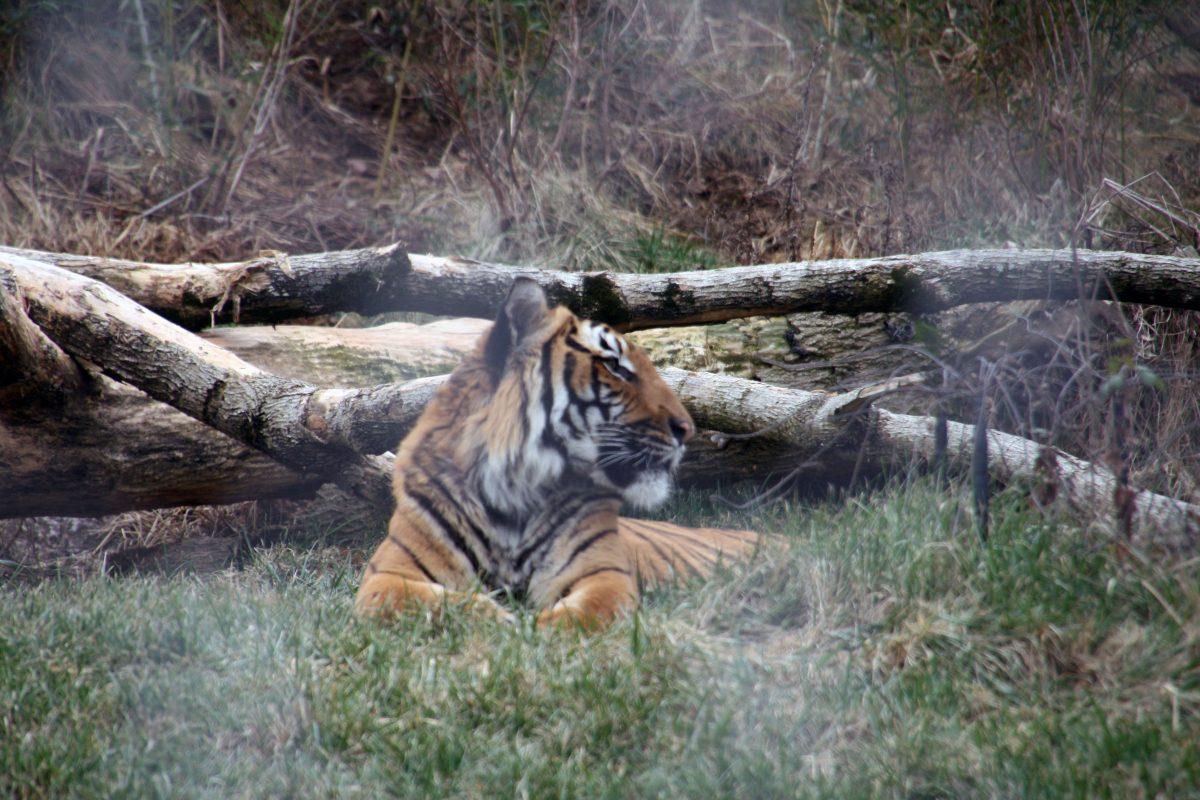
Native to the Malay Peninsula, Malayan tigers are classified as critically endangered as the population was estimated to be about 250 to 340 adult individuals.
“When you start thinking about numbers like that, it’s so critical what we’re doing to help save that species from extinction,” Tina Rolen, director of communications at Zoo Knoxville, said. “We’re on the edge, and every tiger counts.”
As a part of conservation, the AZA approves certain breeding projects, depending on the capabilities of accredited zoos. To help with genetic diversity, these animals can be moved from zoo to zoo based on the SSP when they’re ready to breed.
Zoo Knoxville houses three Malayan tigers: Brothers Tanvir “Tan,” Bashir “Bash,” and a female, Arya. Arya arrived from California in January 2017 as a breeding recommendation by the SSP for one of the two brothers.
Currently, there are four langurs: Walter, Teigen, Melody and a yet-to-be-named baby. Colclough estimated another langur will be coming from San Diego as a breeding recommendation to Walter in mid-summer.
Zoo Knoxville is also waiting for a breeding recommendation from the AZA regarding Georgie and Naomi.
To educate the public on the zoo’s conservation work, Zoo Knoxville incorporates direct talks with zookeeper staff and graphics to make learning more exciting and entertaining. Colclough said it’s important to the zoo to inform visitors about the impacts of human activity on these animals such as deforestation and monocropping. In the cases of gibbons and other species in Southeast Asia, millions of acres of rainforest are cut down for palm oil plantations.
“That’s a real responsibility in conservation, too, is making sure that people aren’t just coming to the zoo to see an animal,” Colclough said. “Even if it’s a beautiful exhibit, as our exhibits are now, it’s really so they’ll take some kind of consideration home with them and think a little bigger about what’s going on with them (the animals).”
At the back end of the zoo’s conservation efforts is the balance between non-profit and business.
When it comes to the animals, Colclough emphasized that the zoo, like other AZA-accredited ones, does not breed animals merely to increase revenue and attraction. While that can be a byproduct, these populations are carefully managed through the SSP to help save them from extinction.
The zoo has limited space which it must reserve for critically endangered animals like the Malayan tigers, langurs and gibbons.
“There are so many animals that need work that it’s not hard to make a decision of what to put there. There could’ve been any other combinations of langurs and gibbons and other species in there,” Colclough said. “We just felt they would work the best with the terrain that we had, with the messaging about the palm oil stuff, with the relationship to the tigers.”
Colclough understands the process of conservation is a challenging one and that you have to “celebrate your victories; you celebrate what you can do.” Sometimes, it must come down to prioritization, especially with so many endangered species.
“It’s frustrating because you can’t save them all. There are some things — I don’t want to paint a bleak picture — but there are some things we’re just not going to be able to save,” Colclough said. “So you have to prioritize what you have space for and what you have knowledge for.”
It takes a village to run a zoo, and it is a collaborative effort among all AZA-accredited zoos and community members.
“It’s a community of people that take care of all these animals. I’ve got a list of colleagues 10 miles long in this computer that, if we have any questions, then we ask,” Colclough said. “And it’s the same thing from us.”
But Colclough also emphasized that conservation work is not only done for more exotic species. There are a number of endangered species in East Tennessee, even if they are “less exciting” than tigers or gibbons, like endangered bog turtles.
“It’s backyard conservation,” Colclough said. “I think there’s value in that because you can have kids that think, ‘There’s no way in the world I can ever go to Southeast Asia to study tigers,’ and that’s okay. Maybe you can someday, but while you’re here right now, think about this bog turtle that occurs right here in East Tennessee and nowhere else in the world. Think about that, learn about that, study that … It can be just as exciting.”