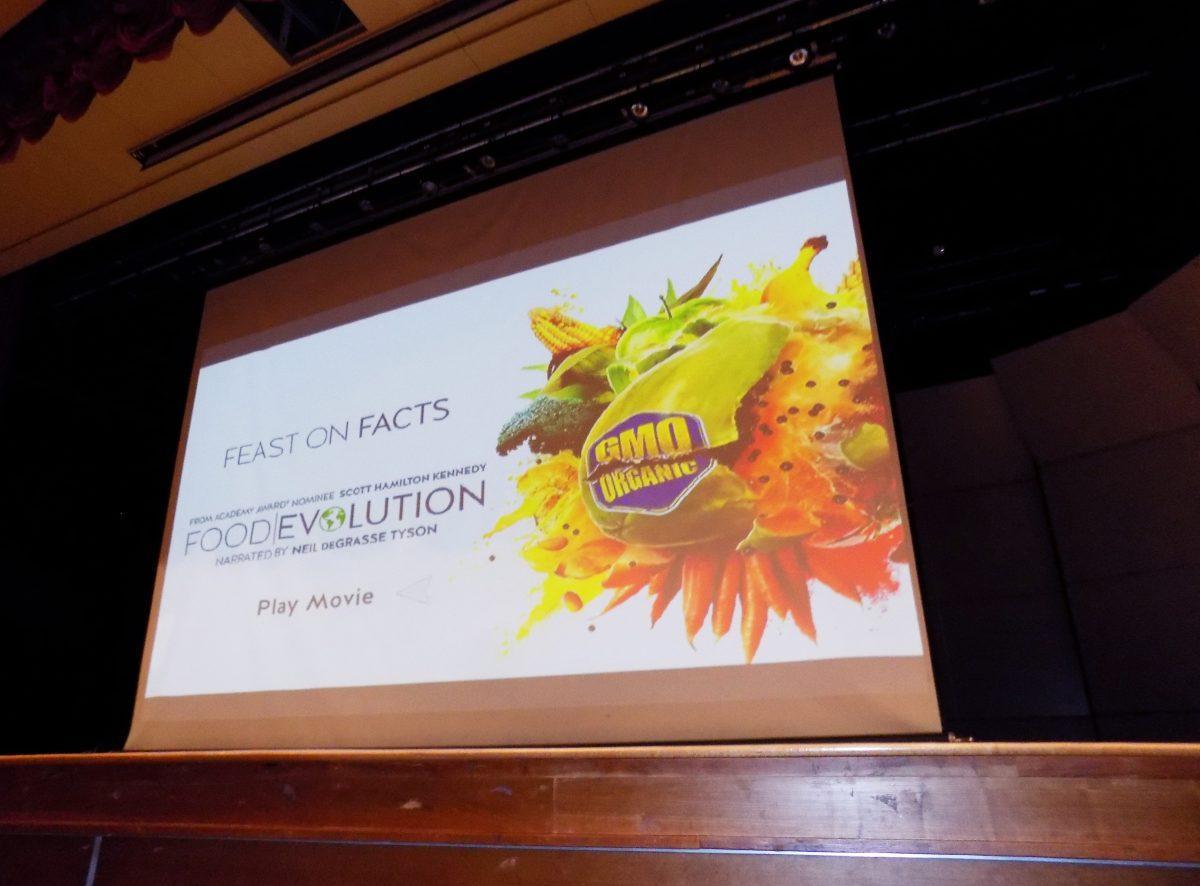
Genetically Modified Organisms (GMOs) starred in a film screening and panel discussion Wednesday evening.
People gathered in Cox Auditorium at 7 p.m. to watch “Food Evolution,” a documentary that addresses the controversy surrounding GMOs. Societal standards tend to warp the reputation of GMOs as harmful to humans when inserted into our crops, and anti-GMO advocates believe GMOs cause negative health effects, according to the film.
“Food Evolution” distorts the societal standards by stating that there is no scientific evidence to prove the negative claims against GMOs and further focuses on how fear has falsely shaped the view of GMOs in society.
The film takes place in Hawaii before moving to Iowa and lastly Uganda to give the audience different examples of how GMOs have significantly benefited farmers in each place.
In Hawaii, papayas faced the brink of extinction before the Rainbow papaya was invented and introduced with the help of GMOs. On the next stop of the documentary, Iowa, the audience watches Monsanto, an agrochemical company, produce a crop-preservation mixture called Roundup. The mixture is sprayed on crops and household plants and gardens to eliminate weeds around the crops without harming the plants and crops themselves.
Bananas face their own extinction in Uganda, according to the last destination in the film. A disease causes the fruit to rot from the inside out. The documentary explains a solution to the crisis, but due to a law prohibiting the use of GMOs, the solution has not come to fruition.
After discussing different examples of GMOs across the world, the film shifted its focus to discuss the public’s distrust of greedy corporations. Examples given in the documentary include oil companies who deny global warming and tobacco companies who deny a link between nicotine and cancer. Money continuously trumps the health of the customer, according to the film.
Monsanto is at the forefront of criticism from the public for its use of GMOs. Anti-GMO advocates began an annual march in 2013 called “March Against Monsanto” to protest the corporation. Roundup and other Monsanto products have ensured the safety of crops and cut costs for farmers, but the film said society is still missing that point.
To conclude, the film gave examples of GMOs currently in production, including a peanut that is allergy-free and mosquitos that stop the spread of diseases such as malaria.
Following the film, UT Institute of Agriculture professor of plant science Neal Stewart and professor of sociology from Occidental College in Los Angeles John Wayne hosted a panel discussion.
Questions ranged from the panelists’ thoughts on the film to the possibility of crops forming a resistance to GMOs. When asked about resistance, Stewart said, “Overusing anything will cause a resistance.”
Freshman in kinesiology Jacob Greer said he enjoyed the film because it provided him with information that he didn’t know before.
“I just assumed GMOs were bad. That’s all I’ve ever heard, so I just thought that they were bad for us,” Greer said. “This movie taught me a lot about them.”