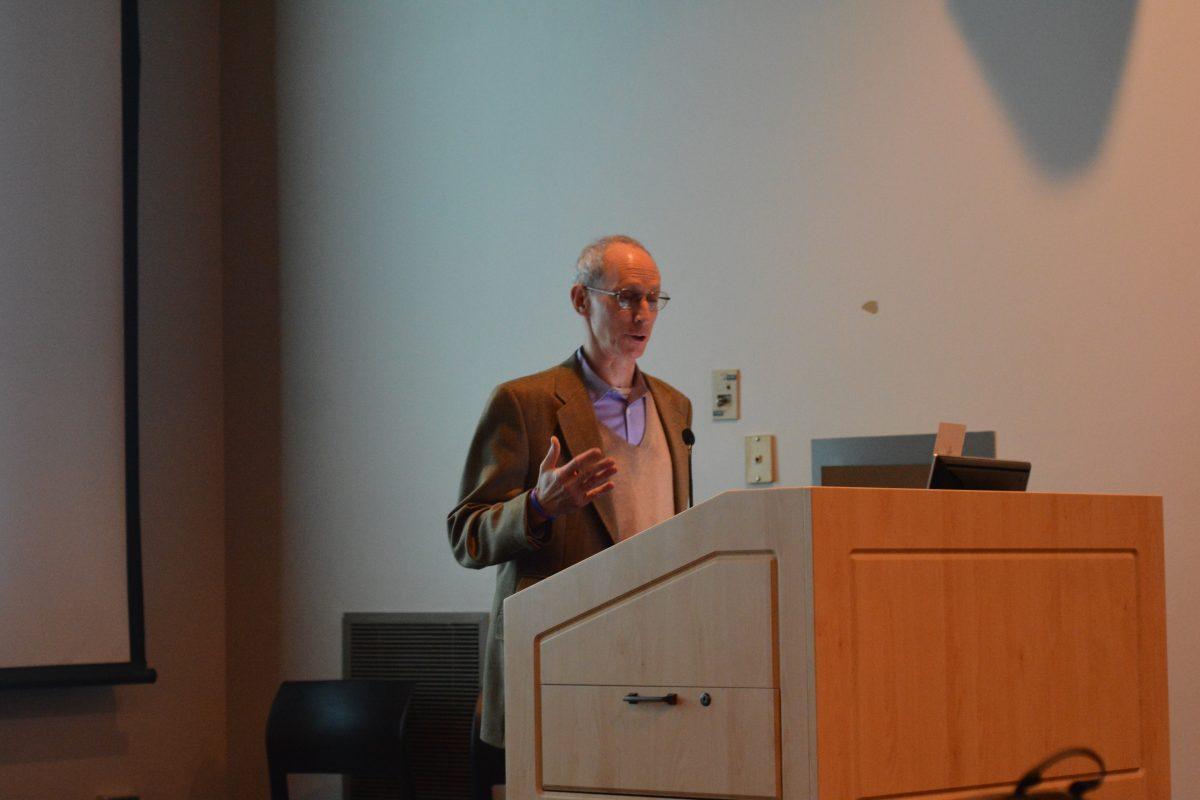
Peter Aronson, former journalist, attorney and writer of children’s books, delivered a presentation on Bronislaw Huberman, the famed Polish violinist who organized the Israel Philharmonic Orchestra in the years leading up to the Holocaust.
Aronson began his presentation with the culmination of research that took him across the world from Toronto to Israel to Germany, in search of letters from Huberman, stories from his living contemporaries and other historical documents.
The lecture, accompanied by a slideshow depicting significant milestones in Huberman’s life and musical career, is the counterpart to “From Child Prodigy to Hero, the Violinist who saved Jewish Musicians from the Holocaust,”a 58-page volume written for middle-grade audiences.
Huberman proved himself to be a musical prodigy from a young age, Aronson explained. At only 13, the young musician played to sold out audiences in Vienna, the center of the classical music world at the time. Huberman proceeded to become a world-class performer throughout the early twentieth century.
The onset of World War I affected Huberman deeply and would compel the musician to adopt a philosophy of pacifism and become a proponent of pan-Europeanism, a cultural and political movement which advocated for the dissolution of national borders within Europe.
Aronson took a brief detour to track the rise of anti-Semitism that accompanied the emergence of the Nazi regime as a power in Germany and central Europe.
The journalist described the incremental stripping away of the Jewish people’s rights in Germany, especially focusing on musicians: many were fired from their positions in esteemed orchestras and universities, while several fled the country. A few remained in Germany and performed in kulturbunds, segregated music institutions.
After performing in Palestine, Huberman noted that there was an unfilled niche for a world-class orchestra in the country.
Refusing an offer to play alongside the Berlin Philharmonic Orchestra, Huberman formulated a plan to form an all Jewish orchestra in Palestine, gathering the best musicians in the world into one ensemble.
In an interview, Aronson reflected on the profound strength of Huberman’s resolve.
“When you talk about someone enough, you understand the themes of someone’s personality. (Huberman) obviously had tremendous confidence in himself,” Aronson said, referencing the musician’s correspondences with figures such as Albert Einstein.
“(I realized) that this guy was an extraordinary individual, not only a great musician, but a man of great confidence and great belief in what he was doing,” Aronson said. “When he decided he was going to do this, nothing was going to stop him.”
Huberman embarked on a breakneck American tour to raise funds for the orchestra, performing 42 concerts in 60 days.
After raising the requisite funds as well as overcoming numerous bureaucratic, political and logistic difficulties, Huberman was able to audition and transport his musicians to Palestine. In October 1936, 53 musicians and their families departed from the coast of Italy for Palestine.
The Palestine Philharmonic Orchestra, as it was then called, performed its first concert on December 26, 1936 in a renovated conference center to a crowd of 3000. The Israel Philharmonic continues to be a major cultural institution in Israel today.
Abigail Green, a freshman majoring in psychology, was impressed by the impact Huberman had on history.
“I enjoy learning about this section of history … I’ve never heard about how musicians in Europe were affected during this time and what was done to combat that,” Green said.
Aronson’s lecture was presented by the School of Art in conjunction with the Violins of Hope exhibit in the UT Downtown Gallery.