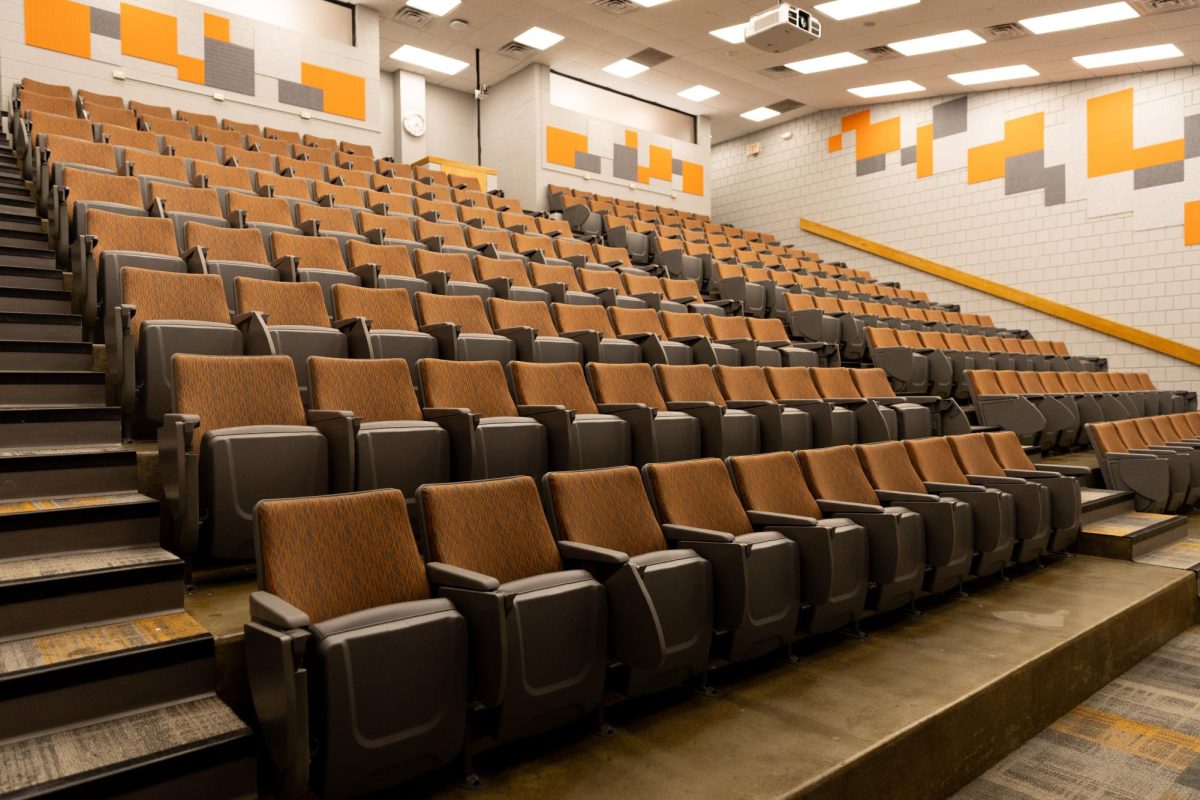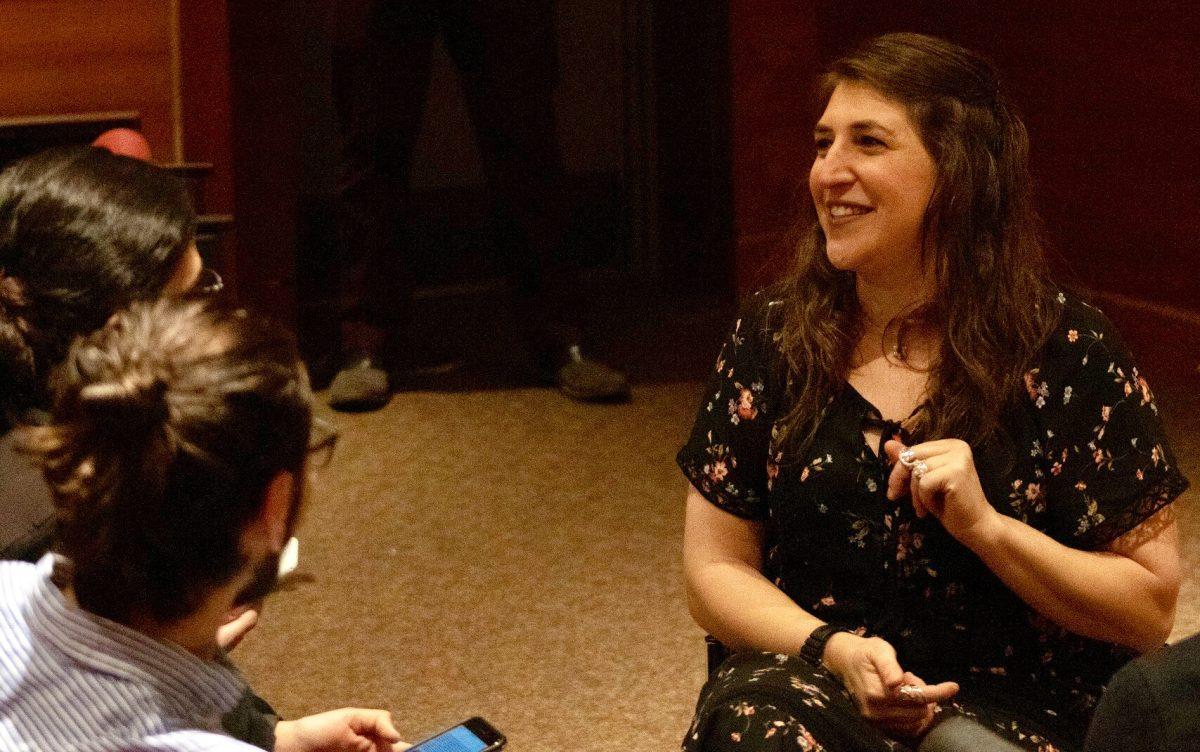
Activist, actress, author and neuroscientist Mayim Bialik took a break from filming “The Big Bang Theory’s” final season to speak at Cox Auditorium this Monday.
The lecture was the fifth in the Mossman Lecture series, which previously featured former “Mythbuster” Adam Savage, scientist/entertainer Bill Nye, inventor and Autism advocate Temple Grandin and former “M*A*S*H” star Alan Alda.
Bialik spoke at 6:30 p.m, but eager attendees lined up long before then in anticipation. In a brief pre-lecture press conference, Bialik discussed her authorship on masculinity and femininity, gave humorous anecdotes about her experience as a parent and commented on her feelings about the ending of “The Big Bang Theory.”
She also reflected on her experience as a public speaker, saying that her involvement in multiple communities and her experiences traveling let her speak on multiple subjects.
“(The speech topic) really depends, you know. That’s the neat thing about going to all these different places; it really depends on the population (and) what they want,” Bialik said. “So in places where there’s a large Jewish student presence, I’ll often do a talk with the Jewish community and also do a talk with the general community so that I can talk about different things.”
After entering to thunderous applause, Bialik gave each side of Cox Auditorium an opportunity for photos before describing her experience as an actress, neuroscientist and activist.
Bialik is the daughter of second-generation Jewish immigrants who moved to San Diego, California from New York City’s Bronx borough. She described starting her Hollywood career as a child actress. After a series of short appearances in various TV shows, Bialik became the star of “Blossom.”
After finishing “Blossom,” Bialik earned her PhD in neuroscience at the University of California in Los Angeles. Bialik then returned to acting and joined the cast of “The Big Bang Theory” in 2007 as the character Amy Farah Fowler. She has played this role for nine years.
With the show airing its last season, Bialik said that she looks forward to the future.
“In terms of what’s next, I have a few things that I’m interested in, and (I’m) working on a few projects (that) I’m in the process of trying to produce,” Bialik said. “I actually wrote a screenplay that I’m hoping to direct later this year. That’s all I can say for now.”
Following the lecture, microphones were opened for a Q&A session. Most questions were about Bialik’s neuroscience experience and included a playful moment where Bialik described earning her PhD as leagues harder than her work on the “Big Bang.”
On a serious note, Bialik addressed the difficulties women face in STEM fields. When attending college, her classes were 70 percent male, her graduate professors underestimated her abilities due to her work as an actress and she felt pressured to live up to the standard of the “ideal American woman.”
Despite the difficulties they could face, Bialik encouraged young women to pursue careers in STEM fields.
“There are some ways that it doesn’t get easier to be different and to feel different, but with age and with experience, it begins to feel less scary to be different,” Bialik said. “When I was (young), even though I was on TV … I was still just a scared child in a growing body. I think that’s what I would have wanted to hear from someone. That wasn’t the message of my culture or my family.”
Bialik’s advice for upcoming college students was the same for both men and women, focus on your studies and don’t spend all your time partying.
Mary Coulter, chemistry teacher at Roan County’s Midway High School, attended the event with the school’s female STEM Club. She said that Bialik’s words could help her students become excited for STEM subjects.
“We just wanted to see someone who has achieved a high degree in science and manages to have a balance between science and life,” Coulter said. “I think that being here tonight, hearing Mayim speak and having my students with, (is) really going to resonate with and have them carry that enthusiasm (for STEM) with them. (STEM) is really hard, but nothing in life that’s easy is worth having.”