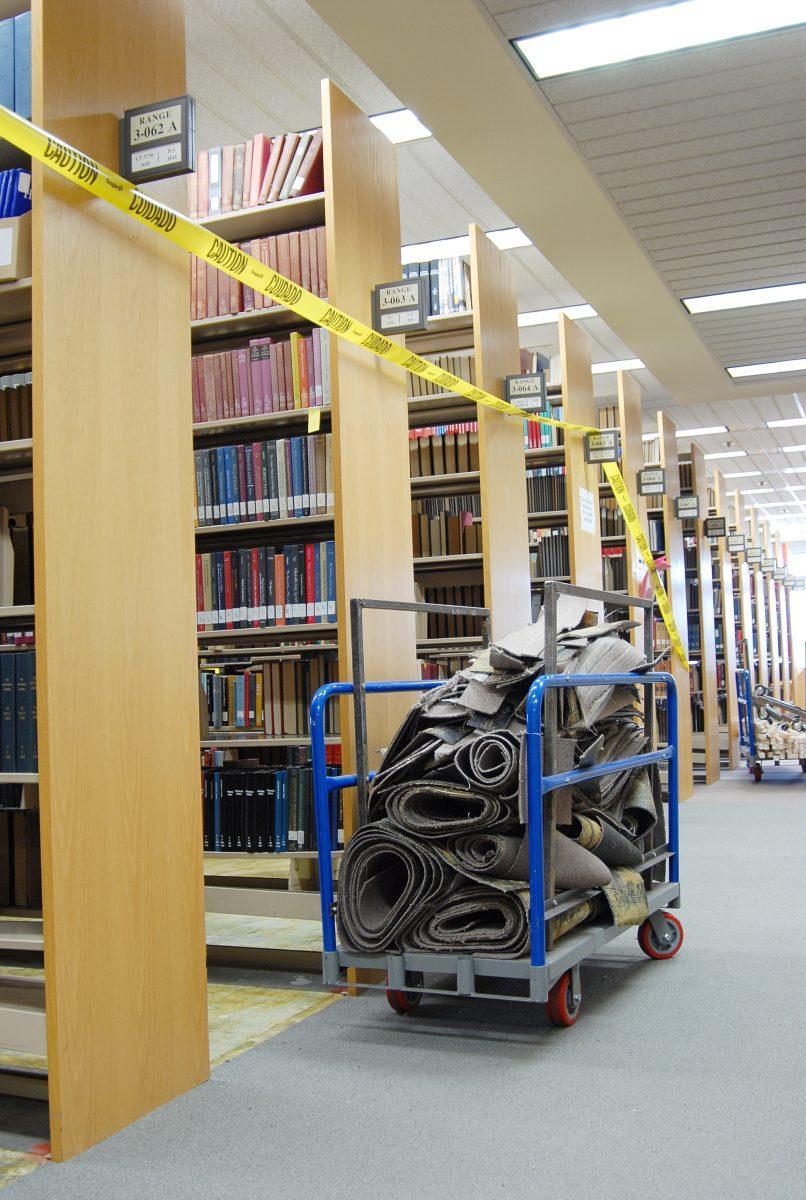
The libraries administration and faculty of the John C. Hodges Library are preparing for renovations on the second floor Commons.
The main goal of the renovations is to maximize the space available at the library. The wall dividing the South Commons and the Studio will be torn down. This will make the area more open and allow for more space to be used by students. The outer wall next to Starbucks will also be torn down to open up more space.
According to Rita Smith, the executive associate dean of the libraries, there will also be an effort to put in more electrical outlets.
“As we are able to do renovations,” Smith said, “we try to look at the electrical power situation and create more places to plug in, as we are able to do that within the budget of the project.”
The renovations will also include additional furniture being purchased and the floor being refurbished. The Research Center will be combined with Circulation. There will also be $20,000-30,000 invested in new cameras and laptops for students to check out.
The current renovations are the third phase of a plan that started in 2005. The most recent updates Hodges has gone through (the second phase) involved the creation of both the North and South Commons in 2007. The long time gap was due to the library administration gradually getting the full amount of funding they needed year after year.
“The third phase was already on paper with the idea of integrating the Studio and Media Services and opening things up,” Smith said. “We didn’t get the funding until (recently). You get a little bit of funding and you’re able to do it.”
Now with all the resources they need, officials plan to begin the renovations in May, once the summer semester begins. The construction should be finished by early August. While there may be some inconvenience with the noise and portions of Hodges closed off, the Commons will remain open during the summer.
Resources from the parts of the library under construction, such as the video cameras in the Studio, will be temporarily relocated so they can still be available for student use.
The library administration is also planning additional renovations for the first floor. While still in the planning phase, potential first floor renovations could include relocating some of the reference material.
Dean of Libraries Steven Smith said there are also plans to create a better environment for displaying some of the library’s special collections.
“We want to create a better exhibit area,” Steven Smith said. “We have spectacular rare books and manuscripts in Special Collections, but no great place to exhibit them.”
In preparation for the renovations, the libraries administration held a free luncheon for selected students and student-employees of Hodges to have an open discussion on what the administration is doing right and what could be improved on. Both Steven Smith and members of the administration were in attendance.
“We at the library are engaged in a strategic planning process,” Steven Smith said. “Part of that process is to get various feedback from your stake holders and constituencies. And the students, of course, are our most important constituencies.”
The forum gathered in the Mary Greer Room in the Commons and discussed the library for an hour while eating pizza and drinking sodas.
Some of the areas where the students felt the library was doing well included the provision of study areas (both group and quiet), the helpful resource services such as the OIT Help Desk and the Resource Center, and having many tutorials on the library’s website that explain how to use everything from the cameras in the Studio to the research databases.
But the students provided a variety of topics where Hodges could be improved.
The biggest concern was the availability of electrical outlets for students’ laptops. Steven Smith agreed and said it was not the first time the concern was brought to his attention. He admitted there is some difficulty in getting more outlets to the upper floors, but he hopes to provide more in the near future.
“One way to get power to those study tables would be to bring in drop poles,” he said. “We’ve never done that because it doesn’t look very pretty. But there’s such a demand I think as a temporary, two- or three-year solution, I’m about ready to see if we can do that in some areas.”
Additional concerns brought up included the availability of parking, the need for more computers for printing only (as well as having a master login on the printer computers so students won’t have to continuously logout and login with each individual use), and the price of using the copy machine.