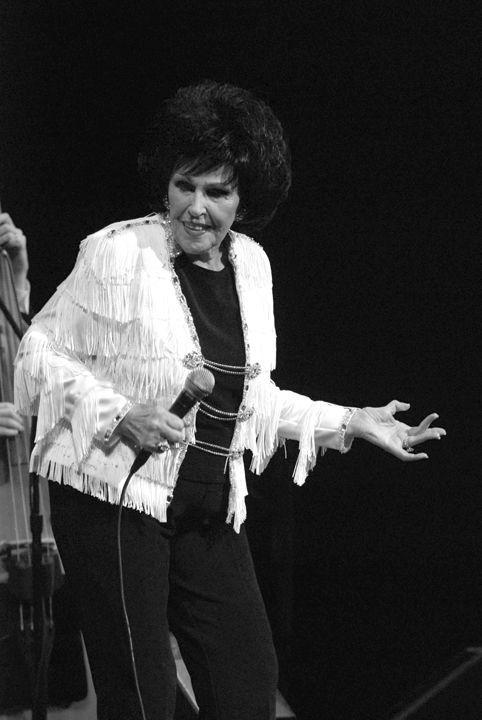
Progenitors of the lynchpin genre “rock ‘n’ roll” are few and far between these days. One would be hard-pressed to name more than a handful of performers and songwriters who can remember first-hand when “Rumble” caused riots with no words and an impaled speaker cone, or when Elvis’ hips were perceived as the potential downfall of Western civilization.
Fortunately, rockabilly queen Wanda Jackson is still blazing a trail from stage to stage with a momentum that shows no signs of flagging anytime soon.
Jackson, whose 1960 recording of “Let’s Have a Party” has been an early rock staple since it debuted, began her career more than half a century ago as a high school student. Since then she has been instrumental in keeping the spirit of rock ‘n’ roll alive, traversing country and gospel before returning to rockabilly on her Jack White-produced LP, “The Party Ain’t Over,” earlier this year. If anyone needed convincing that Jackson still has a few tricks up the sleeve of her white fringe jacket, her May 27 performance at the Bijou erased all doubt.
On being seated at 7 p.m., prospects seemed grim for a full house. A few seats were occupied towards the front, with a median age of 50 or so. Though Jackson’s most recent album has exposed her music to a younger audience via White’s pop appeal, I figured the Detroit Darling’s absence likely severed the attention span of the U25 crowd.
I was proven pleasantly wrong.
As Holly Golightly and Lawyer Dave, billed as the Brokeoffs, strummed through their set of buzzed roots music, the Bijou began to swell with a crowd of generationally transcendent patrons.
Golightly, another one-time collaborator with White, has built a genre-hopping career not dissimilar to Jackson’s. Building on Brill Building girl groups and 60s garage rock, Golightly formed the Thee Headcoatees in 1991 before embarking on a solo career in 1995. Her most recent project, The Brokeoffs, began as a quartet, but has shrunk to a duo with Dave playing a foot-rig drum kit and guitar to compensate. The sound has suffered no shrinkage, however.
Between tales of escalator massacres and trash-burning neighbors, Golightly and Dave projected a warm camaraderie and confidence which could just have easily been observed in a living room or a stadium. Both showed their vocal and guitar chops, with Dave alternating on slide and lead guitar with a husky tenor to compliment Golightly’s girlish falsetto and sultry growl.
Prior to Jackson’s taking the stage, her band of hired guns took on rock ‘n’ roll classics such as “Roadrunner” and “Rumble” before calling out the Rockabilly Queen for an evening of house-shaking rock thunder and reminisces of a half-century on the stage.
One of Jackson’s strongest suits and most distinctive features has been heavy grit Oklahoma croon, undiminished by decades of performing. Hits like “Funnel of Love” and “Fujiyama Mama” sounded as crisp in May 2011 as in 1961.
While a certain portion of the evening’s set was devoted to “Party” selections, Jackson’s repertoire revolved around stories from her career and life, from dating Elvis at 17 to her 1971 Christian rebirth. On the latter matter, Jackson reminded the audience members that they may not share her views, but she felt it important to give a little time each night to praise and thanks.
After much of her story was told, Jackson and crew blazed through a collection of rock classics such as “Riot in Cell Block #9” and the often-covered “Whole Lotta Shakin’ Going On.” Though she excelled at songs made famous by others, Jackson shone with a white lightning rendition of her own “Hard Headed Woman,” which at this point isn’t so much a statement about women as a burden, but rather Jackson’s own refusal to be put to pasture.
At 73, it would be easy to count Wanda Jackson out of the running in the rock ‘n’ roll game. But if experience proves anything, youth fads come and go, but the legends beat on forever.