While war and faith certainly have a sordid history together, no era prior to the modern age has held such great stakes for the outcome of any major conflict. United States foreign policy towards potential “rogue states” often tempers public opinion to be fearful of Communists and theocratic regimes in Asia with nuclear capabilities. One assumption of such a position is that it is formed by white Christians looking to defend their dominance in America.
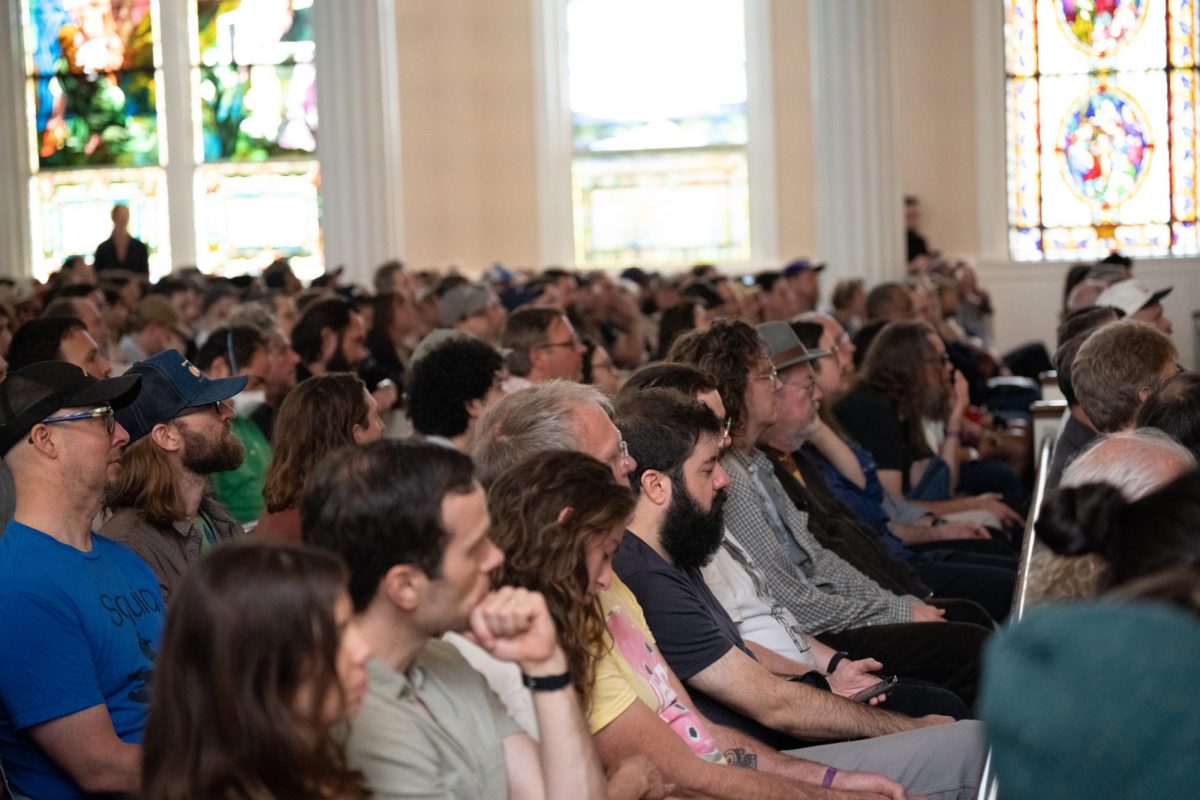
Members of the university faculty, students and informed citizens spoke on a panel Monday evening in the Toyota Auditorium of the Baker Center for Public Policy on the interconnectedness of faith and nuclear energy proliferation, weaponized or otherwise. From their discussion, the previous assumption could be ruled as moot, if not fallacious.
Moderated by Mark Walker, a Haslam scholar and senior in nuclear engineering, and David Burman, a senior in religious studies, the panel included speakers with experience in the nuclear energy industry, expert knowledge of political science and personal beliefs ranging from Unitarianism to evangelical Christianity.
The discussion began with a brief introduction and message from the four primary speakers. Dr. Howard Hull, professor of nuclear engineering, opened his commentary with a joke about the surety of safety in one region of the world.
“We can say with certainty that there are currently no nuclear threats on Antarctica,” Hull said, to applause and laughter from the crowd.
While this icebreaker served to open the proceedings with a jovial mood, the discussion was at times alternately heartfelt and sincere, at others tense and apprehensive.
Hull summarized the major opportunities for nuclear exchange and armament worldwide, describing theocratic Iran as a gateway for Middle Eastern proliferation, with Israel and Saudi Arabia already having avowed to arm themselves should Iran prove their nuclear capabilities. A question regarding Iranian president Mahmoud Ahmadinejad’s statement earlier this month stating Iran’s perceived threat as “politically and mentally retarded” posed during the audience question-and-answer session was neither fielded nor answered, but from Hull’s statement and the air of the room, it seemed that many in attendance agreed with his assessment.
Hull also mentioned the potential for India and Pakistan to go to war. He quoted the figure of one-fifth of the world’s population in that region fighting for resources of one watershed, acknowledging resource control as a motivator for violence being more immediately drastic than cultural differences.
Dr. Brandon Prins, associate professor in political science, introduced the idea of isolated, homogenous cultures, with the examples of Pol Pot in Cambodia and Maoist China, as more intrinsically destructive than ethnically diverse cultures. Prins offered a top-down paradigm for such instances of mass violence, wherein the highest authorities ended up killing mass numbers of the populace versus the common citizens instigating major conflicts.
Dr. Jeffrey Kovac, professor in engineering and recently appointed head of the College Scholars Program, spoke as an affirmed pacifist and a historian of conscientious objection to violence.
Kovac outlined how national citizenship and religious faith can inform a person’s view of the world. He posited that citizenship evokes obligations in people, which will cause them to act in a certain manner for the good of their country which is compounded by the individual’s personal history with their country. Then the person’s personal religious tradition will come into play in their inner life and affect how an individual interacts with the world.
“Religious perspective changes based on world events,” Kovac said, elaborating that this was positively manifested in maintaining core values with an open mind, versus hardening into narrow, sectarian views.
Sherrell Greene, the retired director of Nuclear Technology Programs at Oak Ridge National Laboratory (ORNL), spoke from a position of evangelical faith, which he said leads his motives for nuclear energy proliferation as “all people are created in God’s image and therefore have some intrinsic value.”
“Any religious system which doesn’t inform your views is little more than a hobby,” Greene said.
Greene stated that of the estimated seven billion humans on Earth, four billion were without electricity, and that the availability of electricity and resources would be a major destabilizing factor in world politics for decades to come. With over three decades of experience in the nuclear energy field, Greene said that the only way to increase energy availability on the necessary scale for a worldwide standard of living on par with South Africa, let alone the United States, would be through harnessing nuclear power.
Following this initial exchange, which in reality consumed most of the lecture time, the audience posed some questions to the panel. One question led the remaining discussion time, regarding the idea of a technology or weapon as being intrinsically evil.
Hull again gave a humorous aside.
“I’m all for nuclear abolition,” Hull said. “You go first.”
Greene said that there was no simple answer to the nature of technology, stating that nuclear bombs and power plants are an amalgam of several technologies and knowledge bases, of which there is no way to determine the relative moral intent in discovery and utility. He said the only solid answer is in how these technologies are utilized.
“If a biological weapon is immoral,” Greene asked, “is microbiology immoral?”
Kovac opined that some of the tension people feel toward nuclear energy can be misplaced.
“Nuclear risks make people more fearful than other risks,” Kovac said. “(In reality) you get more radiation from the food you eat than living next to a plant, since the food is filled with radioactive Carbon-14.”
In the end, a clear consensus among panelists was established that religion had a positive role in public policymaking. Prins stated that while there are conflicting ideas on religion’s role, the median of public opinion has drifted further to polar extremes over the last 30 years.
Greene said that faith dictated a certain forced neutrality and dilemma in his case, as Christianity espouses love of one’s neighbor and enemy equally.
“Conflict has its own logic,” Greene said. “What do I do when the neighbor I love and the enemy I’m supposed to love are killing each other?”