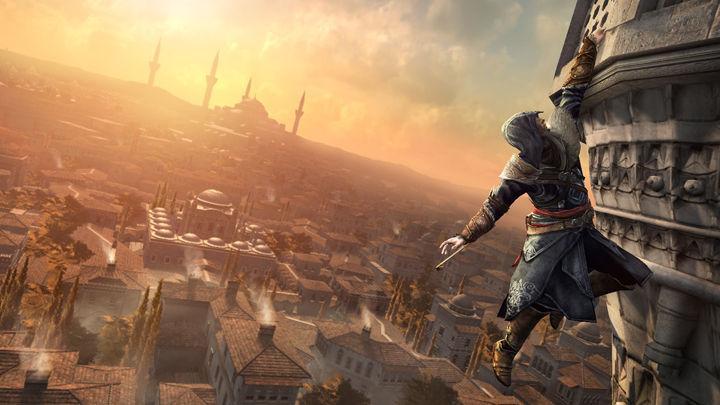
Few game series have taken as unexpected a trajectory as Ubisoft’s Assassin’s Creed line. Introduced as a standalone game with a sequential sequel, it appeared a trilogy was in the works. Instead, the developer released a mid-series trilogy tying together the lives of Altair Ibn La’Had and Ezio Auditore da Firenze, the series’ two tertiary protagonists, with a third numbered title to be released next November to coincide with the game’s 2012 chronology.
Now step back and ask yourself: Was it necessary to make three games as a character when he essentially acts as a puppet for the game’s true protagonist, in this case Altair and Ezio’s descendant Desmond Miles.
Halfway through 2010’s “Brotherhood,” the answer was a resolute “no.” The revenge plot against the Borgia family which Ezio undertakes in “Assassin’s Creed II” could have ended in that game, but Ubisoft instead took an entry with a relatively sparse storyline to introduce new mini-games and a prototype multiplayer unlike any released to date.
While that game redeemed itself in the end, “Assassin’s Creed: Revelations,” which was released on Nov. 15, seemed at first to be like kicking a dead horse up a broken hill. Granted the pendulous cliffhanger at the end of “Brotherhood,” many of the series’ fans rabidly awaited resolution and the “revelations” promised in the title. Of the former, an ostensible answer is given roughly five minutes into the game. The latter comes some 20 hours later, depending on your level of retentive completionism.
The game’s necessity to exist, however, depends on your commitment to the series. Over four core entries, the series has sketched the intersection of three lives in roughly 500-year intervals, with extensively researched and deftly delivered worlds, whose detail offers a level of immersion rare in games set in the confines of actual world history. Over the trilogy capped by “Revelations,” a sandbox experience and style of play unparalleled by similar series such as “Grand Theft Auto” has emerged and given Ubisoft’s chagrin with the stunted development of current consoles, perhaps only offers a taste of coming developments in the series.
“Revelations,” then, is a necessary closer for two chapters of the Assassin’s Creed story and a bridge to the end of the original projected trilogy. As with most of the games, the action ends in medias res, with another year of conspiracy theories and half-baked, foredrawn conclusions to follow.
The game succeeds in all respects, and though it merely continues stories introduced by earlier games with relatively little “playing catch-up” exposition for new players, “Revelations” is probably the best game of the series to date in terms of controls and mechanics, as well as narrative strategy.
For four years, players have trawled memory space in the Animus, a machine developed by Knights Templar shadow group Abstergo Industries to tap into the exploits of ancestors locked in the human genome. While the first game offered a linear, repetitive play-style, it offered the tightest story prior to “Revelations.” “Assassin’s Creed II” and “Brotherhood” turned the player’s proclivities towards stealth and range of kills into nuanced advantages, especially in the latter’s multiplayer.
“Revelations” delivers the most complex weapons system of the series, adding bomb crafting to the mix, as well as a storyline in which for the first time in series history players probe the mind and history of Desmond Miles. The Desmond memories play in first person and bear a resemblance to Valve’s “Portal” games, trading that series’ signature transitory gateways for flat geometrical planes and inclines as a way to traverse wild data streams which form complex death traps.
Moreover, the game offers somewhat conclusive answers to the identity and nature of Desmond’s predecessor at Abstergo, known previously as Subject 16. The intrinsic connection between Altair and Ezio also becomes apparent in an interlaced climax both poignant and appropriately esoteric given the game world’s loose definition of reality apparent in the titular Creed: “Nothing is true, everything is permitted.”
The multiplayer comes as a production model of the “Brotherhood” test model, itself a sleeper hit. Through a new series of game types and some old favorites, players utilized a class and persona system to build classes, not unlike in the Call of Duty line. While “Brotherhood” offered a system of level unlocks like the Modern Warfare series, “Revelations” adds a “Black Ops” twist wherein not only do abilities require a level unlock, but also must be purchased using points acquired through online play.
This is not to say the multiplayer experience is in anyway derivative. Chalk it up to an evolution across the board introduced by Call of Duty, but even the game’s prestige system offers more incentive than Call of Duty. Abstergo dossiers a new feature in “Revelations,” offer incentive for fans skeptical of online play to participate and level through the game to find more secrets from the unfolding story. While it is far from the guns-blazing fare of “Modern Warfare 3” and “Battlefield 3” which dominate the multiplayer field at the moment, “Assassin’s Creed” may have a potential cottage industry in the stealth and strategy hunting games offered in “Revelations.”
Though it exists as a transitional game and bears the stigma of necessity for fans keeping score at home in the ongoing war between the Assassin Brotherhood and Templars, one should not discount the solid gameplay and stellar storytelling offered in this new entry in the Assassin’s Creed canon. Remember these numbers: 43 39 19 N 75 27 42 W. See you there next November.